Thank you for visiting SNEWPapers!
Sign up free
The Virginia Gazette
Richmond, Williamsburg, Richmond County, Virginia
What is this article about?
A continued letter to the public advocating for the public establishment and funding of Christianity through general assessments, arguing it promotes societal good like civil taxes and military duties, without favoring denominations, and refuting objections to compelled support.
Merged-components note: This component is a continuation of the letter to the editor across pages 1 and 2, as indicated by the text flow and sequential reading orders.
Clippings
1 of 2
OCR Quality
Full Text
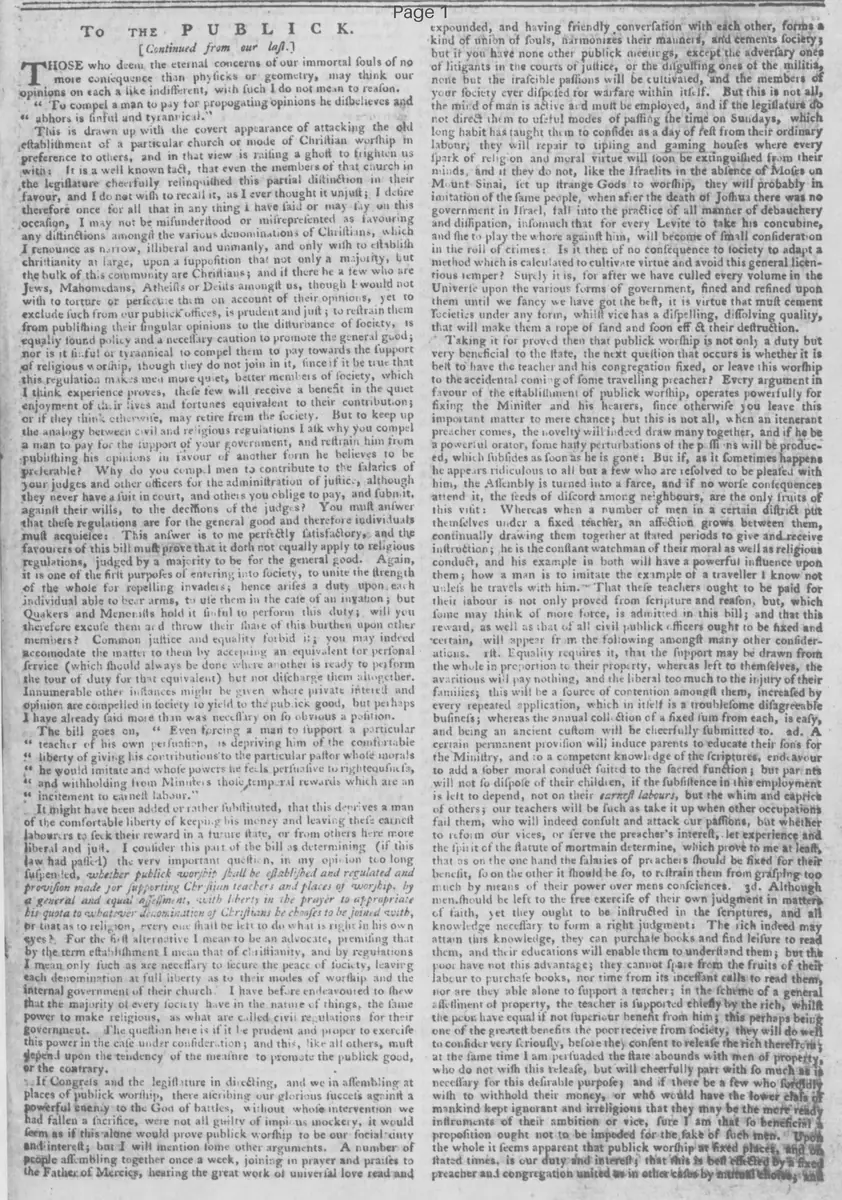
[Continued from our last.]
more consequence than physicks or geometry, may think our
opinions on each a like indifferent, with such I do not mean to reason.
"To compel a man to pay for propogating opinions he disbelieves and
abhors is sinful and tyrannical."
This is drawn up with the covert appearance of attacking the old
establishment of a particular church or mode of Christian worship in
preference to others, and in that view is raising a ghost to frighten us
with: It is a well known fact, that even the members of this church in
the legislature cheerfully relinquished this partial distinction in their
favour, and I do not wish to recall it, as I ever thought it unjust; I desire
therefore once for all that in any thing I have said or may say on this
occasion, I may not be misunderstood or misrepresented as favouring
any distinctions amongst the various denominations of Christians, which
I renounce as narrow, illiberal and unmanly, and only wish to establish
christianity at large, upon a supposition that not only a majority, but
the bulk of this community are Christians; and if there be a few who are
Jews, Mahomedans, Atheists or Deists amongst us, though I would not
wish to torture or persecute them on account of their opinions, yet to
exclude such from our publick offices, is prudent and just; to restrain them
from publishing their singular opinions to the disturbance of society, is
equally sound policy and a necessary caution to promote the general good;
nor is it sinful or tyrannical to compel them to pay towards the support
of religious worship, though they do not join in it, since if it be true that
this regulation makes men more quiet, better members of society, which
I think experience proves, these few will receive a benefit in the quiet
enjoyment of their lives and fortunes equivalent to their contribution;
or if they think otherwise, may retire from the society. But to keep up
the analogy between civil and religious regulations I ask why you compel
a man to pay for the support of your government, and restrain him from
publishing his opinions in favour of another form he believes to be
preferable? Why do you compel men to contribute to the salaries of
your judges and other officers for the administration of justice, although
they never have a suit in court, and others you oblige to pay, and submit,
against their wills, to the decisions of the judges? You must answer
that these regulations are for the general good and therefore individuals
must acquiesce: This answer is to me perfectly satisfactory, and the
favourers of this bill must prove that it doth not equally apply to religious
regulations, judged by a majority to be for the general good. Again,
it is one of the first purposes of entering into society, to unite the strength
of the whole for repelling invaders; hence arises a duty upon each
individual able to bear arms, to use them in the case of an invasion; but
Quakers and Menonists hold it sinful to perform this duty; will you
therefore excuse them and throw their share of this burthen upon other
members? Common justice and equality forbid it; you may indeed
accomodate the matter to them by accepting an equivalent for personal
service (which should always be done where another is ready to perform
the tour of duty for that equivalent) but not discharge them altogether.
Innumerable other instances might be given where private interest and
opinion are compelled in society to yield to the publick good, but perhaps
I have already said more than was necessary on so obvious a position.
The bill goes on, "Even forcing a man to support a particular
"teacher of his own persuation, is depriving him of the comfortable
"liberty of giving his contributions to the particular pastor whose morals
"he would imitate and whose power he feels persualive to righteousness,
"and withholding from Ministers those temporal rewards which are an
"incitement to earnest labour."
It might have been added or rather substituted, that this deprives a man
of the comfortable liberty of keeping his money and leaving these gaincit
labours to seek their reward in a future state, or from others here more
liberal and just. I consider this part of the bill as determining (if this
law had passed) the very important question, in my opinion too long
suspended, whether publick worship shall be established and regulated and
provision made for supporting Christian teachers and places of worship by
a general and equal assessment, with liberty in the payer to appropriate
his quota to whatever denomination of Christians he chooses to be joined with,
or that as to religion, every one shall be left to do what is right in his own
eyes? For the first alternative I mean to be an advocate, premising that
by the term establishment I mean that of christianity, and by regulations
I mean only such as are necessary to secure the peace of society, leaving
each denomination at full liberty as to their modes of worship and the
internal government of their church. I have before endeavoured to shew
that the majority of every society have in the nature of things, the same
power to make religious, as what are called civil regulations for their
government. The question here is if it be prudent and proper to exercise
this power in the case under consideration; and this, like all others, must
depend upon the tendency of the measure to promote the publick good,
or the contrary.
If Congress and the legislature indicting, and we in assembling at
places of publick worship, there ascribing our glorious success against a
powerful enemy to the God of battles, without whose intervention we
had fallen a sacrifice, were not all guilty of impious mockery, it would
seem as if this alone would prove publick worship to be our social duty
and interest; but I will mention some other arguments. A number of
people assembling together once a week, joining in prayer and praises to
the Father of Mercies, hearing the great work of universal love read and
that to have the former supported by fixed and equal contributions from the latter, is not consonant to justice and the peace of society; will then the legislature be withheld from adopting this, for the sake of somebody who wishes to obstruct it for no better reason than that he may retain the comfortable liberty of giving his part to I know not whom.
When I speak of regulations, I mean that they should extend only to two objects, the protecting of all religious assemblies from violence and insult, without which the smaller congregations will be constantly subject to them from the larger; and some cautions to guard the state against conspiracies which might be formed in assemblies under pretence of religious worship: For I cannot accord to the assertion that "it is time enough for the civil government to interpose when principles break out into overt acts against its peace," having been long since taught a prudent maxim in Government. That preventive justice is better than vindicative, even if we could be sure of retaining the power of punishment; which however the conspirators would generally prevent, if they were suffered to go on to overt act before they could be intermeddled with.
I will now take leave of this bill not without sanguine hopes that the Assembly at their next session will consign it to eternal oblivion, and pass a law for the support of religion upon some such plan as is herein explained.
I am the publick's most obedient servant,
A SOCIAL CHRISTIAN.
What sub-type of article is it?
What themes does it cover?
What keywords are associated?
What entities or persons were involved?
Letter to Editor Details
Author
A Social Christian
Recipient
To The Public.
Main Argument
the letter argues for establishing and publicly funding christianity through general and equal assessments, allowing choice of denomination, as it promotes the general good similar to civil regulations like taxes and military service, refuting claims of tyranny in compelling non-believers' contributions.
Notable Details