Thank you for visiting SNEWPapers!
Sign up free
Story
May 29, 1913
Mexico Missouri Message
Mexico, Audrain County, Missouri
What is this article about?
The 50th anniversary reunion of the Battle of Gettysburg in July 1913 will bring 40,000 Civil War veterans from North and South to the Pennsylvania battlefield for a peaceful gathering, hosted by the U.S. government and states with extensive preparations for camping, feeding, and entertainment.
Clipping
OCR Quality
98%
Excellent
Full Text
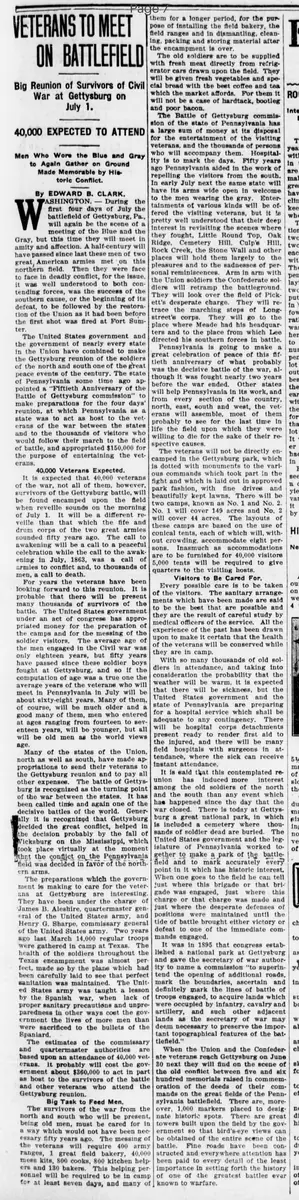
VETERANS TO MEET
ON BATTLEFIELD
Big Reunion of Survivors of Civil War at Gettysburg on July 1.
40,000 EXPECTED TO ATTEND
Men Who Wore the Blue and Gray to Again Gather on Ground Made Memorable by Historic Conflict.
By EDWARD B. CLARK.
WASHINGTON. - During the first four days of July the battlefield of Gettysburg, Pa., will again be the scene of a meeting of the Blue and the Gray, but this time they will meet in amity and affection. A half-century will have passed since last these men of two great American armies met on this northern field. Then they were face to face in deadly conflict, for the issue, it was well understood to both contending forces, was the success of the southern cause or the beginning of its defeat, to be followed by the restoration of the Union as it had been before the first shot was fired at Fort Sumter.
The United States government and the government of nearly every state in the Union have combined to make the Gettysburg reunion of the soldiers of the north and south one of the great peace events of the century. The state of Pennsylvania some time ago appointed a "Fiftieth Anniversary of the Battle of Gettysburg commission" to make preparations for the four days' reunion, at which Pennsylvania as a state was to act as host to the veterans of the war between the states and to the thousands of visitors who would follow their march to the field of battle, and appropriated $150,000 for the purpose of entertaining the veterans.
40,000 Veterans Expected.
It is expected that 40,000 veterans of the war, not all of them, however, survivors of the Gettysburg battle, will be found encamped upon the field when reveille sounds on the morning of July 1. It will be a different reveille than that which the fife and drum corps of the two great armies sounded fifty years ago. The call to awakening will be a call to a peaceful celebration while the call to the awakening in July, 1863, was a call of armies to conflict and, to thousands of men, a call to death.
For years the veterans have been looking forward to this reunion. It is probable that there will be present many thousands of survivors of the battle. The United States government under an act of congress has appropriated money for the preparation of the camps and for the messing of the soldier visitors. The average age of the men engaged in the Civil war was only eighteen years, but fifty years have passed since these soldier boys fought at Gettysburg, and so if the computation of age was a true one the average years of the veterans who will meet in Pennsylvania in July will be about sixty-eight years. Many of them, of course, will be much older and a good many of them, men who entered at ages ranging from fourteen to seventeen years, will be younger, but all will be old men as the world views age.
Many of the states of the Union, north as well as south, have made appropriations to send their veterans to the Gettysburg reunion and to pay all other expenses. The battle of Gettysburg is recognized as the turning point of the war between the states. It has been called time and again one of the decisive battles of the world. Generally it is recognized that Gettysburg decided the great conflict, helped in the decision probably by the fall of Vicksburg on the Mississippi, which took place virtually at the moment that the conflict on the Pennsylvania field was decided in favor of the northern arms.
The preparations which the government is making to care for the veterans at Gettysburg are interesting. They have been under the charge of James B. Aleshire, quartermaster general of the United States army, and Henry G. Sharpe, commissary general of the United States army. Two years ago last March 14,000 regular troops were gathered in camp at Texas. The health of the soldiers throughout the Texas encampment was almost perfect, made so by the plans which had been carefully laid to see that perfect sanitation was maintained. The United States army was taught a lesson by the Spanish war, when lack of proper sanitary precautions and unpreparedness in other ways cost the government the lives of more men than were sacrificed to the bullets of the Spaniard.
The estimates of the commissary and quartermaster authorities are based upon an attendance of 40,000 veterans. It probably will cost the government about $360,000 to act in part as host to the survivors of the battle and other veterans who attend the Gettysburg reunion.
Big Task to Feed Men.
The survivors of the war from the north and south who will be present, being old men, must be cared for in a way which would not have been necessary fifty years ago. The messing of the veterans will require 400 army ranges, 1 great field bakery, 40,000 mess kits, 800 cooks, 800 kitchen helpers and 130 bakers. This helping personnel will be required to be in camp for at least seven days, and many of them for a longer period, for the purpose of installing the field bakery, the field ranges and in dismantling, cleaning, packing and storing material after the encampment is over.
The old soldiers are to be supplied with fresh meat directly from refrigerator cars drawn upon the field. They will be given fresh vegetables and special bread with the best coffee and tea which the market affords. For them it will not be a case of hardtack, bootleg and poor bacon.
The Battle of Gettysburg commission of the state of Pennsylvania has a large sum of money at its disposal for the entertainment of the visiting veterans, and the thousands of persons who will accompany them. Hospitality is to mark the days. Fifty years ago Pennsylvania aided in the work of repelling the visitors from the south. In early July next the same state will have its arms wide open in welcome to the men wearing the gray. Entertainments of various kinds will be offered the visiting veterans, but it is pretty well understood that their deep interest in revisiting the scenes where they fought, Little Round Top, Oak Ridge, Cemetery Hill, Culp's Hill, Rock Creek, the Stone Wall and other places will hold them largely to the pleasures and to the sadnesses of personal reminiscences. Arm in arm with the Union soldiers the Confederate soldiers will retramp the battleground. They will look over the field of Pickett's desperate charge. They will retrace the marching steps of Longstreet's corps. They will go to the place where Meade had his headquarters and to the place from which Lee directed his southern forces in battle.
Pennsylvania is going to make a great celebration of peace of this fiftieth anniversary of what probably was the decisive battle of the war, although it was fought nearly two years before the war ended. Other states will help Pennsylvania in its work, and from every section of the country, north, east, south and west, the veterans will assemble, most of them probably to see for the last time in life the field upon which they were willing to die for the sake of their respective causes.
The veterans will not be directly encamped in the Gettysburg park, which is dotted with monuments to the various commands which took part in the fight and which is laid out in approved park fashion, with fine drives and beautifully kept lawns. There will be two camps, known as No. 1 and No. 2. No. 1 will cover 149 acres and No. 2 will cover 44 acres. The layouts of these camps are based on the use of conical tents, each of which will, without crowding, accommodate eight persons. Inasmuch as accommodations are to be furnished for 40,000 visitors 5,000 tents will be required to give quarters to the visiting hosts.
Visitors to Be Cared For
Every possible care is to be taken of the visitors. The sanitary arrangements which have been made are said to be the best that are possible and they are the result of careful study by medical officers of the service. All the experience of the past has been drawn upon to make it certain that the health of the veterans will be conserved while they are in camp.
With so many thousands of old soldiers in attendance, and taking into consideration the probability that the weather will be warm, it is expected that there will be sickness, but the United States government and the state of Pennsylvania are preparing for a hospital service which shall be adequate to any contingency. There will be hospital corps detachments present ready to render first aid to the injured, and there will be many field hospitals with surgeons in attendance, where the sick can receive instant attendance.
It is said that this contemplated reunion has induced more interest among the old soldiers of the north and the south than any event which has happened since the day that the war closed. There is today at Gettysburg a great national park, in which is included a cemetery where thousands of soldier dead are buried. The United States government and the legislature of Pennsylvania worked together to make a park of the battlefield and to mark accurately every point in it which has historic interest. When one goes to the field he can tell just where this brigade or that brigade was engaged, just where this charge or that charge was made and just where the desperate defenses of positions were maintained until the tide of battle brought either victory or defeat to one of the immediate commands engaged.
It was in 1895 that congress established a national park at Gettysburg and gave the secretary of war authority to name a commission "to superintend the opening of additional roads, mark the boundaries, ascertain and definitely mark the lines of battle of troops engaged, to acquire lands which were occupied by infantry, cavalry and artillery, and such other adjacent lands as the secretary of war may deem necessary to preserve the important topographical features of the battlefield."
When the Union and the Confederate veterans reach Gettysburg on June 30 next they will find on the scene of the old conflict between five and six hundred memorials raised in commemoration of the deeds of their commands on the great fields of the Pennsylvania battlefield. There are, moreover, 1,000 markers placed to designate historic spots. There are great towers built upon the field by the government so that bird's-eye views can be obtained of the entire scene of the battle. Fine roads have been constructed and everywhere attention has been paid to every detail of the least importance in setting forth the history of one of the greatest battles ever known to warfare.
ON BATTLEFIELD
Big Reunion of Survivors of Civil War at Gettysburg on July 1.
40,000 EXPECTED TO ATTEND
Men Who Wore the Blue and Gray to Again Gather on Ground Made Memorable by Historic Conflict.
By EDWARD B. CLARK.
WASHINGTON. - During the first four days of July the battlefield of Gettysburg, Pa., will again be the scene of a meeting of the Blue and the Gray, but this time they will meet in amity and affection. A half-century will have passed since last these men of two great American armies met on this northern field. Then they were face to face in deadly conflict, for the issue, it was well understood to both contending forces, was the success of the southern cause or the beginning of its defeat, to be followed by the restoration of the Union as it had been before the first shot was fired at Fort Sumter.
The United States government and the government of nearly every state in the Union have combined to make the Gettysburg reunion of the soldiers of the north and south one of the great peace events of the century. The state of Pennsylvania some time ago appointed a "Fiftieth Anniversary of the Battle of Gettysburg commission" to make preparations for the four days' reunion, at which Pennsylvania as a state was to act as host to the veterans of the war between the states and to the thousands of visitors who would follow their march to the field of battle, and appropriated $150,000 for the purpose of entertaining the veterans.
40,000 Veterans Expected.
It is expected that 40,000 veterans of the war, not all of them, however, survivors of the Gettysburg battle, will be found encamped upon the field when reveille sounds on the morning of July 1. It will be a different reveille than that which the fife and drum corps of the two great armies sounded fifty years ago. The call to awakening will be a call to a peaceful celebration while the call to the awakening in July, 1863, was a call of armies to conflict and, to thousands of men, a call to death.
For years the veterans have been looking forward to this reunion. It is probable that there will be present many thousands of survivors of the battle. The United States government under an act of congress has appropriated money for the preparation of the camps and for the messing of the soldier visitors. The average age of the men engaged in the Civil war was only eighteen years, but fifty years have passed since these soldier boys fought at Gettysburg, and so if the computation of age was a true one the average years of the veterans who will meet in Pennsylvania in July will be about sixty-eight years. Many of them, of course, will be much older and a good many of them, men who entered at ages ranging from fourteen to seventeen years, will be younger, but all will be old men as the world views age.
Many of the states of the Union, north as well as south, have made appropriations to send their veterans to the Gettysburg reunion and to pay all other expenses. The battle of Gettysburg is recognized as the turning point of the war between the states. It has been called time and again one of the decisive battles of the world. Generally it is recognized that Gettysburg decided the great conflict, helped in the decision probably by the fall of Vicksburg on the Mississippi, which took place virtually at the moment that the conflict on the Pennsylvania field was decided in favor of the northern arms.
The preparations which the government is making to care for the veterans at Gettysburg are interesting. They have been under the charge of James B. Aleshire, quartermaster general of the United States army, and Henry G. Sharpe, commissary general of the United States army. Two years ago last March 14,000 regular troops were gathered in camp at Texas. The health of the soldiers throughout the Texas encampment was almost perfect, made so by the plans which had been carefully laid to see that perfect sanitation was maintained. The United States army was taught a lesson by the Spanish war, when lack of proper sanitary precautions and unpreparedness in other ways cost the government the lives of more men than were sacrificed to the bullets of the Spaniard.
The estimates of the commissary and quartermaster authorities are based upon an attendance of 40,000 veterans. It probably will cost the government about $360,000 to act in part as host to the survivors of the battle and other veterans who attend the Gettysburg reunion.
Big Task to Feed Men.
The survivors of the war from the north and south who will be present, being old men, must be cared for in a way which would not have been necessary fifty years ago. The messing of the veterans will require 400 army ranges, 1 great field bakery, 40,000 mess kits, 800 cooks, 800 kitchen helpers and 130 bakers. This helping personnel will be required to be in camp for at least seven days, and many of them for a longer period, for the purpose of installing the field bakery, the field ranges and in dismantling, cleaning, packing and storing material after the encampment is over.
The old soldiers are to be supplied with fresh meat directly from refrigerator cars drawn upon the field. They will be given fresh vegetables and special bread with the best coffee and tea which the market affords. For them it will not be a case of hardtack, bootleg and poor bacon.
The Battle of Gettysburg commission of the state of Pennsylvania has a large sum of money at its disposal for the entertainment of the visiting veterans, and the thousands of persons who will accompany them. Hospitality is to mark the days. Fifty years ago Pennsylvania aided in the work of repelling the visitors from the south. In early July next the same state will have its arms wide open in welcome to the men wearing the gray. Entertainments of various kinds will be offered the visiting veterans, but it is pretty well understood that their deep interest in revisiting the scenes where they fought, Little Round Top, Oak Ridge, Cemetery Hill, Culp's Hill, Rock Creek, the Stone Wall and other places will hold them largely to the pleasures and to the sadnesses of personal reminiscences. Arm in arm with the Union soldiers the Confederate soldiers will retramp the battleground. They will look over the field of Pickett's desperate charge. They will retrace the marching steps of Longstreet's corps. They will go to the place where Meade had his headquarters and to the place from which Lee directed his southern forces in battle.
Pennsylvania is going to make a great celebration of peace of this fiftieth anniversary of what probably was the decisive battle of the war, although it was fought nearly two years before the war ended. Other states will help Pennsylvania in its work, and from every section of the country, north, east, south and west, the veterans will assemble, most of them probably to see for the last time in life the field upon which they were willing to die for the sake of their respective causes.
The veterans will not be directly encamped in the Gettysburg park, which is dotted with monuments to the various commands which took part in the fight and which is laid out in approved park fashion, with fine drives and beautifully kept lawns. There will be two camps, known as No. 1 and No. 2. No. 1 will cover 149 acres and No. 2 will cover 44 acres. The layouts of these camps are based on the use of conical tents, each of which will, without crowding, accommodate eight persons. Inasmuch as accommodations are to be furnished for 40,000 visitors 5,000 tents will be required to give quarters to the visiting hosts.
Visitors to Be Cared For
Every possible care is to be taken of the visitors. The sanitary arrangements which have been made are said to be the best that are possible and they are the result of careful study by medical officers of the service. All the experience of the past has been drawn upon to make it certain that the health of the veterans will be conserved while they are in camp.
With so many thousands of old soldiers in attendance, and taking into consideration the probability that the weather will be warm, it is expected that there will be sickness, but the United States government and the state of Pennsylvania are preparing for a hospital service which shall be adequate to any contingency. There will be hospital corps detachments present ready to render first aid to the injured, and there will be many field hospitals with surgeons in attendance, where the sick can receive instant attendance.
It is said that this contemplated reunion has induced more interest among the old soldiers of the north and the south than any event which has happened since the day that the war closed. There is today at Gettysburg a great national park, in which is included a cemetery where thousands of soldier dead are buried. The United States government and the legislature of Pennsylvania worked together to make a park of the battlefield and to mark accurately every point in it which has historic interest. When one goes to the field he can tell just where this brigade or that brigade was engaged, just where this charge or that charge was made and just where the desperate defenses of positions were maintained until the tide of battle brought either victory or defeat to one of the immediate commands engaged.
It was in 1895 that congress established a national park at Gettysburg and gave the secretary of war authority to name a commission "to superintend the opening of additional roads, mark the boundaries, ascertain and definitely mark the lines of battle of troops engaged, to acquire lands which were occupied by infantry, cavalry and artillery, and such other adjacent lands as the secretary of war may deem necessary to preserve the important topographical features of the battlefield."
When the Union and the Confederate veterans reach Gettysburg on June 30 next they will find on the scene of the old conflict between five and six hundred memorials raised in commemoration of the deeds of their commands on the great fields of the Pennsylvania battlefield. There are, moreover, 1,000 markers placed to designate historic spots. There are great towers built upon the field by the government so that bird's-eye views can be obtained of the entire scene of the battle. Fine roads have been constructed and everywhere attention has been paid to every detail of the least importance in setting forth the history of one of the greatest battles ever known to warfare.
What sub-type of article is it?
Historical Event
What themes does it cover?
Bravery Heroism
Triumph
Survival
What keywords are associated?
Gettysburg Reunion
Civil War Veterans
50th Anniversary
Blue And Gray
Battlefield Encampment
Peace Celebration
Veterans Gathering
What entities or persons were involved?
Edward B. Clark
James B. Aleshire
Henry G. Sharpe
George G. Meade
Robert E. Lee
George Pickett
James Longstreet
Union Veterans
Confederate Veterans
Where did it happen?
Gettysburg, Pa.
Story Details
Key Persons
Edward B. Clark
James B. Aleshire
Henry G. Sharpe
George G. Meade
Robert E. Lee
George Pickett
James Longstreet
Union Veterans
Confederate Veterans
Location
Gettysburg, Pa.
Event Date
July 1 4, 1913
Story Details
Civil War veterans from North and South reunite peacefully at Gettysburg for the 50th anniversary, with 40,000 expected; governments provide camps, food, and medical care; they revisit battle sites like Little Round Top and Pickett's Charge.