Thank you for visiting SNEWPapers!
Sign up free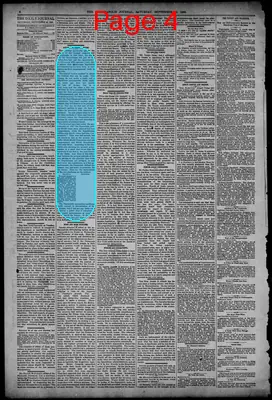
Editorial
September 13, 1890
The Indianapolis Journal
Indianapolis, Marion County, Indiana
What is this article about?
Editorial condemns Democratic gerrymander in the state as worse than 1872 Republican one, rejecting 'you're another' defense. Highlights Republican platform pledge for fair districts versus Democratic silence, urging punishment of current fraud.
Clipping
OCR Quality
98%
Excellent
Full Text
CONCERNING GERRYMANDERS
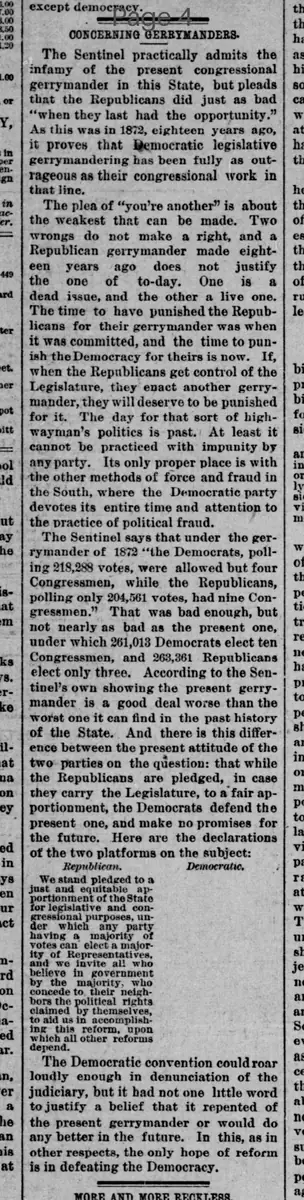
The Sentinel practically admits the infamy of the present congressional gerrymander in this State, but pleads that the Republicans did just as bad "when they last had the opportunity." As this was in 1872, eighteen years ago, it proves that Democratic legislative gerrymandering has been fully as outrageous as their congressional work in that line.
The plea of "you're another" is about the weakest that can be made. Two wrongs do not make a right, and a Republican gerrymander made eighteen years ago does not justify the one of to-day. One is a dead issue, and the other a live one. The time to have punished the Republicans for their gerrymander was when it was committed, and the time to punish the Democracy for theirs is now. If when the Republicans get control of the Legislature, they enact another gerrymander, they will deserve to be punished for it. The day for that sort of highwayman's politics is past. At least it cannot be practiced with impunity by any party. Its only proper place is with the other methods of force and fraud in the South, where the Democratic party devotes its entire time and attention to the practice of political fraud.
The Sentinel says that under the gerrymander of 1872 "the Democrats, polling 218,288 votes, were allowed but four Congressmen, while the Republicans, polling only 204,561 votes, had nine Congressmen." That was bad enough, but not nearly as bad as the present one, under which 261,013 Democrats elect ten Congressmen, and 263,361 Republicans elect only three. According to the Sentinel's own showing the present gerrymander is a good deal worse than the worst one it can find in the past history of the State. And there is this difference between the present attitude of the two parties on the question: that while the Republicans are pledged, in case they carry the Legislature, to a fair apportionment, the Democrats defend the present one, and make no promises for the future. Here are the declarations of the two platforms on the subject:
Republican. Democratic
We stand pledged to a The Democratic convention could roar
just and equitable ap- loudly enough in denunciation of the
portionment of the State judiciary, but it had not one little word
for legislative and con- to justify a belief that it repented of
gressional purposes, un- the present gerrymander or would do
der which any party any better in the future. In this, as in
having a majority of other respects, the only hope of reform
votes can elect a major- is in defeating the Democracy.
ity of Representatives,
and we invite all who
believe in government
by the majority, who
concede to their neigh-
bors the political rights
claimed by themselves,
to aid us in accomplish-
ing this reform, upon
which all other reforms
depend.
The Sentinel practically admits the infamy of the present congressional gerrymander in this State, but pleads that the Republicans did just as bad "when they last had the opportunity." As this was in 1872, eighteen years ago, it proves that Democratic legislative gerrymandering has been fully as outrageous as their congressional work in that line.
The plea of "you're another" is about the weakest that can be made. Two wrongs do not make a right, and a Republican gerrymander made eighteen years ago does not justify the one of to-day. One is a dead issue, and the other a live one. The time to have punished the Republicans for their gerrymander was when it was committed, and the time to punish the Democracy for theirs is now. If when the Republicans get control of the Legislature, they enact another gerrymander, they will deserve to be punished for it. The day for that sort of highwayman's politics is past. At least it cannot be practiced with impunity by any party. Its only proper place is with the other methods of force and fraud in the South, where the Democratic party devotes its entire time and attention to the practice of political fraud.
The Sentinel says that under the gerrymander of 1872 "the Democrats, polling 218,288 votes, were allowed but four Congressmen, while the Republicans, polling only 204,561 votes, had nine Congressmen." That was bad enough, but not nearly as bad as the present one, under which 261,013 Democrats elect ten Congressmen, and 263,361 Republicans elect only three. According to the Sentinel's own showing the present gerrymander is a good deal worse than the worst one it can find in the past history of the State. And there is this difference between the present attitude of the two parties on the question: that while the Republicans are pledged, in case they carry the Legislature, to a fair apportionment, the Democrats defend the present one, and make no promises for the future. Here are the declarations of the two platforms on the subject:
Republican. Democratic
We stand pledged to a The Democratic convention could roar
just and equitable ap- loudly enough in denunciation of the
portionment of the State judiciary, but it had not one little word
for legislative and con- to justify a belief that it repented of
gressional purposes, un- the present gerrymander or would do
der which any party any better in the future. In this, as in
having a majority of other respects, the only hope of reform
votes can elect a major- is in defeating the Democracy.
ity of Representatives,
and we invite all who
believe in government
by the majority, who
concede to their neigh-
bors the political rights
claimed by themselves,
to aid us in accomplish-
ing this reform, upon
which all other reforms
depend.
What sub-type of article is it?
Partisan Politics
What keywords are associated?
Gerrymander
Congressional Districts
Party Fraud
Electoral Reform
Apportionment
What entities or persons were involved?
Sentinel
Republicans
Democrats
Democratic Party
Editorial Details
Primary Topic
Criticism Of Democratic Gerrymander
Stance / Tone
Strongly Anti Democratic, Supportive Of Republican Reform
Key Figures
Sentinel
Republicans
Democrats
Democratic Party
Key Arguments
The Sentinel Admits The Infamy Of The Current Congressional Gerrymander But Excuses It By Citing Republican Gerrymander In 1872
Two Wrongs Do Not Make A Right; Past Republican Gerrymander Does Not Justify Current One
Current Gerrymander Is Worse: 261,013 Democrats Elect 10 Congressmen, 263,361 Republicans Elect 3
Republicans Pledged To Fair Apportionment If They Gain Control
Democrats Defend The Present Gerrymander And Make No Promises For Reform