Thank you for visiting SNEWPapers!
Sign up free
The Recorder, Or, Lady's And Gentleman's Miscellany
Richmond, Virginia
What is this article about?
Report from London Oracle on Britain's national debt from 1793-1800, increasing from £238M to £403M, estimated total around £560M due to war, with commentary criticizing the economic impact and doubting trade gains offset costs.
Clipping
OCR Quality
Full Text
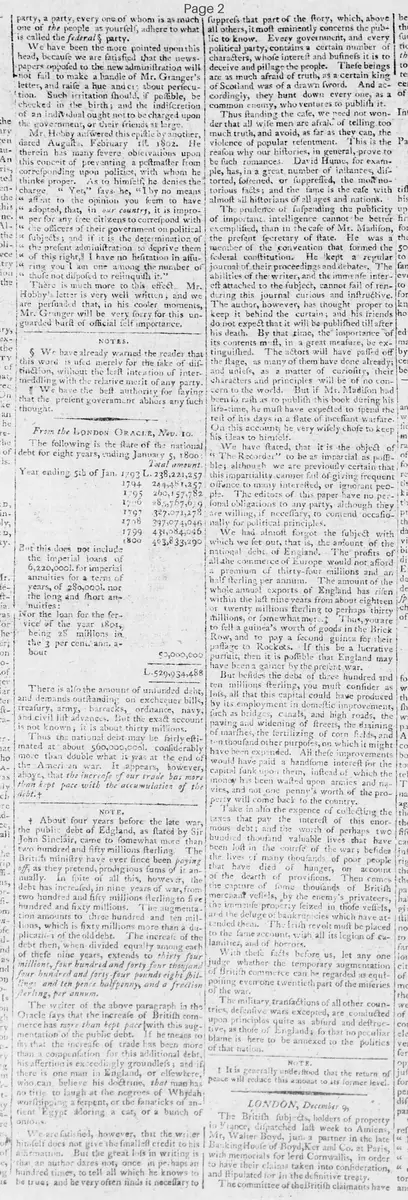
We have already warned the reader that this word is used merely for the sake of distinction, without the least intention of intermeddling with the relative merit of any party.
We have the best authority for saying that the present government abhors any such thought.
From the London Oracle, Nov. 10.
The following is the state of the national debt for eight years, ending January 5, 1800:
Total amount.
Year ending 5th of Jan. 1793 £238,221,257
1794 249,481,257
1795 260,157,782
1796 285,767,619
1797 327,071,278
1798 397,074,046
1799 431,084,046
1800 403,833,290
But this does not include the imperial loans of 6,220,000l. for imperial annuities for a term of years, of 250,000l. nor the long and short annuities: Nor the loan for the service of the year 1801, being 28 millions in the 3 per cent. ann. about 53,000,000 L.529,934,488
There is also the amount of unfunded debt, and demands outstanding on exchequer bills, treasury, army, barracks, ordnance, navy, and civil list advances. But the exact account is not known: it is about thirty millions.
Thus the national debt may be fairly estimated at about 560,000,000l. considerably more than double what it was at the end of the American war. It appears, however, above, that the increase of our trade has more than kept pace with the accumulation of the debt.
NOTE,
About four years before the late war, the public debt of England, as stated by Sir John Sinclair, came to somewhat more than two hundred and fifty millions sterling. The British ministry have ever since been paying off, as they pretend, prodigious sums of it annually. In spite of all this, however, the debt has increased, in nine years of war, from two hundred and fifty millions sterling to five hundred and sixty millions. The augmentation amounts to three hundred and ten millions, which is sixty millions more than a duplicate of the old debt. The increase of the debt then, when divided equally among each of these nine years, extends to thirty four millions, four hundred and forty four thousand four hundred and forty-four pounds eight shillings and ten pence halfpenny, and a fraction sterling, per annum.
The writer of the above paragraph in the Oracle says that the increase of British commerce has more than kept pace with this augmentation of the public debt. If he means to say that the increase of trade has been more than a compensation for this additional debt, his assertion is exceedingly groundless; and if there is one man in England, or elsewhere, who can believe his doctrine, that man has no title to laugh at the negroes of Whydah worshipping a serpent, or the fanatics of ancient Egypt adoring a cat, or a bunch of onions.
We are satisfied, however, that the writer himself does not give the smallest credit to his assertion. But the great loss in writing is that an author dares not, once in perhaps a hundred times, to tell all which he knows to be true; and he very often finds it necessary to suppress-that part of the story, which, above all others, it most eminently concerns the public to know. Every government, and every political party, contains a certain number of characters, whose interest and business it is to deceive and pillage the people. These beings are as much afraid of truth, as a certain king of Scotland was of a drawn sword. And accordingly, they hunt down every one, as a common enemy, who ventures to publish it.
Thus standing the case, we need not wonder that all wise men are afraid of telling too much truth, and avoid, as far as they can, the violence of popular resentment. This is the reason why our histories, in general, prove to be such romances. David Hume, for example, has, in a great number of instances, distorted, softened, or suppressed, the most notorious facts: and the same is the case with almost all historians of all ages and nations.
The absurdity of suspending the publicity of important intelligence cannot be better exemplified, than in the case of Mr. Madison, the present secretary of state. He was a member of the convention that formed the federal constitution. He kept a regular journal of their proceedings and debates. The abilities of the writer, and the immense interest attached to the subject, cannot fail of rendering this journal curious and instructive. The author, however, has thought proper to keep it behind the curtain; and his friends do not expect that it will be published till after his death. By that time, the importance of its contents must, in a great measure, be extinguished. The actors will have passed off the stage, as many of them have done already; and unless, as a matter of curiosity, their characters and principles will be of no concern to the world. But if Mr. Madison had been so rash as to publish this book during his life-time, he must have expected to spend the rest of his days in a state of incessant warfare. On this account, he very wisely chose to keep his ideas to himself.
We have stated, that it is the object of "The Recorder" to be as impartial as possible; although we are previously certain that this impartiality cannot fail of giving frequent offence to many interested, or ignorant people. The editors of this paper have no personal obligations to any party, although they are willing, if necessary, to contend occasionally for political principles.
We had almost forgot the subject with which we set out, that is, the amount of the national debt of England. The profits of all the commerce of Europe would not afford a premium of thirty-four millions and a half sterling per annum. The amount of the whole annual exports of England has risen within the last nine years from about eighteen or twenty millions sterling to perhaps thirty millions, or somewhat more. Thus, you are to sell a guinea's worth of goods in the Brick Row, and to pay a second guinea for their passage to Rockets. If this be a lucrative pursuit, then it is possible that England may have been a gainer by the present war.
But besides the debt of three hundred and ten millions sterling, you must consider as loss, all that this capital could have produced by its employment in domestic improvement, such as bridges, canals, and high roads, the paving and widening of streets, the draining of marshes, the fertilizing of corn fields, and ten thousand other purposes, on which it might have been expended. All these improvements would have paid a handsome interest for the capital sunk upon them, instead of which the money has been wasted upon armies and navies, and not one penny's worth of the property will come back to the country.
Take in also the expense of collecting the taxes that pay the interest of this enormous debt; and the worth of perhaps two hundred thousand valuable lives that have been lost in the course of the war; besides the lives of many thousands of poor people that have died of hunger, on account of the dearth of provisions. Then comes the capture of some thousands of British merchant vessels, by the enemy's privateers, the immense property seized in those vessels, and the deluge of bankruptcies which have attended them. The Irish revolt must be placed to the same account, with all its legion of calamities, and of horrors.
With these facts before us, let any one judge whether the temporary augmentation of British commerce can be regarded as equalling even one twentieth part of the miseries of the war.
The military transactions of all other countries, defensive wars excepted, are conducted upon principles quite as absurd and destructive, as those of England; so that no peculiar blame is here to be annexed to the politics of that nation.
NOTE.
It is generally understood that the return of peace will reduce this amount to its former level.
What sub-type of article is it?
What keywords are associated?
What entities or persons were involved?
Where did it happen?
Foreign News Details
Primary Location
England
Event Date
Nov. 10 (London Oracle); Years Ending Jan. 5, 1793 1800
Key Persons
Outcome
national debt increased from £238,221,257 (1793) to £403,833,290 (1800), estimated total £560,000,000; war-related losses including 200,000 lives, merchant vessel captures, bankruptcies, irish revolt calamities; trade increase from 18-20m to 30m exports annually.
Event Details
Report details the growth of Britain's national debt over eight years ending 1800, excluding additional loans and unfunded debt, totaling around £560M, more than double post-American War level. Commentary criticizes war's economic burden, doubts trade gains compensate, highlights suppressed truths in history and politics, references Mr. Madison's unpublished journal.