Thank you for visiting SNEWPapers!
Sign up free
The Nome Nugget
Nome, Nome County, Alaska
What is this article about?
The U.S. Navy unveils a discus-shaped radar device called a "flying saucer" in South Weymouth, Mass., mounted on a WV-2E aircraft to enhance air defense by detecting threats from sea level to 100,000 feet.
Clipping
OCR Quality
Full Text
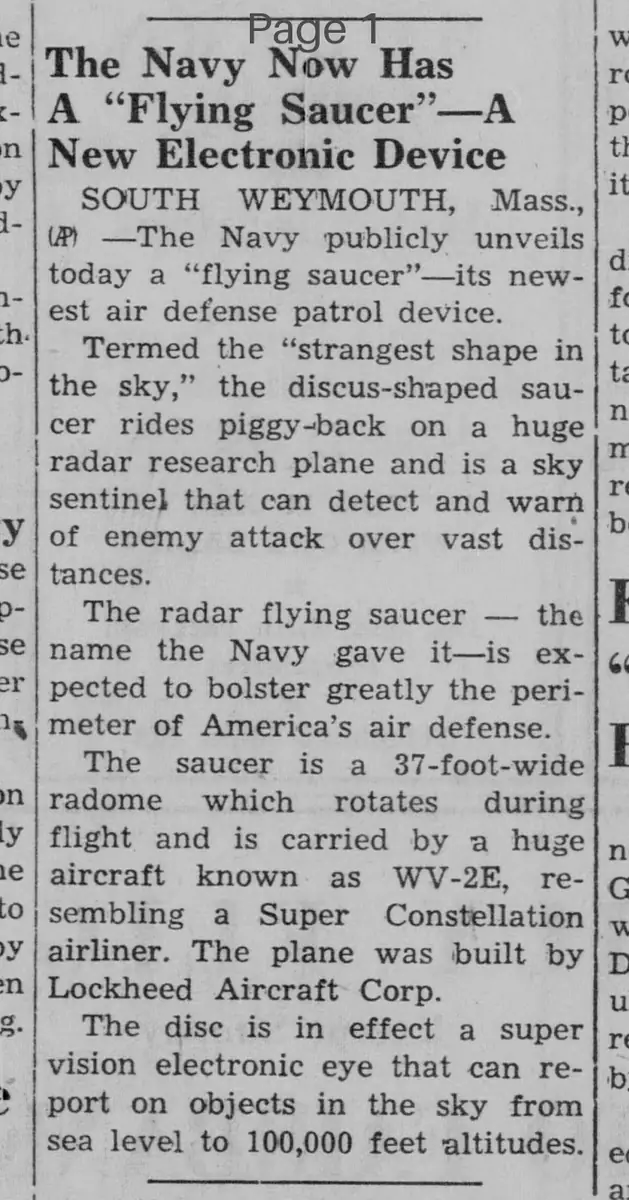
SOUTH WEYMOUTH, Mass., (AP) —The Navy publicly unveils today a "flying saucer" its newest air defense patrol device.
Termed the "strangest shape in the sky," the discus-shaped saucer rides piggy-back on a huge radar research plane and is a sky sentinel that can detect and warn of enemy attack over vast distances.
The radar flying saucer - the name the Navy gave it-is expected to bolster greatly the perimeter of America's air defense.
The saucer is a 37-foot-wide radome which rotates during flight and is carried by a huge aircraft known as WV-2E, resembling a Super Constellation airliner. The plane was built by Lockheed Aircraft Corp.
The disc is in effect a super vision electronic eye that can report on objects in the sky from sea level to 100,000 feet altitudes.
What sub-type of article is it?
What keywords are associated?
Where did it happen?
Domestic News Details
Primary Location
South Weymouth, Mass.
Event Date
Today
Outcome
expected to bolster greatly the perimeter of america's air defense
Event Details
The Navy publicly unveils a discus-shaped saucer, termed the "strangest shape in the sky," that rides piggy-back on a huge radar research plane known as WV-2E, resembling a Super Constellation airliner built by Lockheed Aircraft Corp. The 37-foot-wide radome rotates during flight and can detect and warn of enemy attack over vast distances, reporting on objects in the sky from sea level to 100,000 feet altitudes.