Thank you for visiting SNEWPapers!
Sign up free
Editorial
February 10, 1849
New England Religious Herald
Hartford, Hartford County, Connecticut
What is this article about?
An editorial critiques the pervasive 'spirit of trade' in 19th-century Britain, arguing it undermines true religion by fostering materialism, ethical compromises, and neglect of spiritual duties among professing Christians, urging them to resist this dominance.
Clipping
OCR Quality
98%
Excellent
Full Text
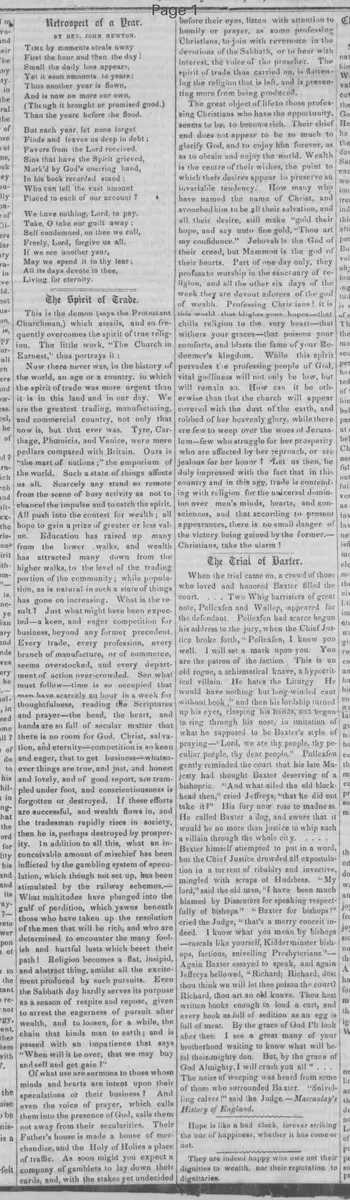
The Spirit of Trade.
This is the demon (says the Protestant Churchman,) which assails, and so frequently overcomes the spirit of true religion. The little work, "The Church in Earnest," thus portrays it:
Now there never was, in the history of the world, an age or a country, in which the spirit of trade was more urgent than it is in this land and in our day. We are the greatest trading, manufacturing, and commercial country, not only that now is, but that ever was. Tyre, Carthage, Phænicia, and Venice, were mere pedlars compared with Britain. Ours is "the mart of nations;" the emporium of the world. Such a state of things affects us all. Scarcely any stand so remote from the scene of busy activity as not to feel the impulse and to catch the spirit. All push into the contest for wealth; all hope to gain a prize of greater or less value. Education has raised up many from the lower walks, and wealth has attracted many down from the higher walks, to the level of the trading portion of the community; while population, as is natural in such a state of things has gone on increasing. What is the result? Just what might have been expected—a keen, and eager competition for business, beyond any former precedent. Every trade, every profession, every branch of manufacture, or of commerce, seems overstocked, and every department of action over-crowded. See what must follow—time is so occupied that men have scarcely an hour in a week for thoughtfulness, reading the Scriptures and prayer—the head, the heart, and hands are so full of secular matter that there is no room for God, Christ, salvation, and eternity—competition is so keen and eager, that to get business whatsoever things are true, and just, and honest and lovely, and of good report, are trampled under foot, and conscientiousness is forgotten or destroyed. If these efforts are successful, and wealth flows in, and the tradesman rapidly rises in society, then he is, perhaps destroyed by prosperity. In addition to all this, what an inconceivable amount of mischief has been inflicted by the gambling system of speculation, which though not set up, has been stimulated by the railway schemes.—What multitudes have plunged into the gulf of perdition, which yawns beneath those who have taken up the resolution of the men that will be rich, and who are determined to encounter the many foolish and hurtful lusts which beset their path! Religion becomes a flat, insipid, and abstract thing, amidst all the excitement produced by such pursuits. Even the Sabbath day hardly serves its purpose as a season of respite and repose, given to arrest the eagerness of pursuit after wealth, and to loosen, for a while, the chain that binds man to earth; and is passed with an impatience that says "When will it be over, that we may buy and sell and get gain?" Of what use are sermons to those whose minds and hearts are intent upon their speculations or their business? And even the voice of prayer, which calls them into the presence of God, calls them not away from their secularities. Their Father's house is made a house of merchandise, and the Holy of Holies a place of traffic. And soon might you expect a company of gamblers to lay down their cards, and, with the stakes yet undecided before their eyes, listen with attention to homily or prayer, as some professing Christians, to join with reverence in the devotions of the Sabbath, or to hear with interest, the voice of the preacher. The spirit of trade thus carried on, is flattening the religion that is left, and is preventing more from being produced.
The great object of life to those professing Christians who have the opportunity, seems to be, to become rich. Their chief end does not appear to be so much to glorify God, and to enjoy him forever, as to obtain and enjoy the world. Wealth is the centre of their wishes, the point to which their desires appear to preserve an invariable tendency. How many who have named the name of Christ, and avouched him to be all their salvation, and all their desire, still make "gold their hope, and say unto fine gold, "Thou art my confidence." Jehovah is the God of their creed, but Mammon is the god of their hearts. Part of one day only, they profess to worship in the sanctuary of religion, and all the other six days of the week they are devout adorers of the god of wealth. Professing Christians! it is this world that blights your hopes—that chills religion to the very heart—that withers your graces—that poisons your comforts, and blasts the fame of your Redeemer's kingdom. While this spirit pervades the professing people of God, vital godliness will not only be low, but will remain so. How can it be otherwise than that the church will appear covered with the dust of the earth, and robbed of her heavenly glory, while there are few to weep over the woes of Jerusalem—few who struggle for her prosperity who are affected by her reproach, or are jealous of her honor? Let us then, be duly impressed with the fact that in this country and in this age, trade is contending with religion for the universal dominion over men's minds, hearts, and consciences, and that according to present appearances, there is no small danger of the victory being gained by the former.
Christians, take the alarm!
This is the demon (says the Protestant Churchman,) which assails, and so frequently overcomes the spirit of true religion. The little work, "The Church in Earnest," thus portrays it:
Now there never was, in the history of the world, an age or a country, in which the spirit of trade was more urgent than it is in this land and in our day. We are the greatest trading, manufacturing, and commercial country, not only that now is, but that ever was. Tyre, Carthage, Phænicia, and Venice, were mere pedlars compared with Britain. Ours is "the mart of nations;" the emporium of the world. Such a state of things affects us all. Scarcely any stand so remote from the scene of busy activity as not to feel the impulse and to catch the spirit. All push into the contest for wealth; all hope to gain a prize of greater or less value. Education has raised up many from the lower walks, and wealth has attracted many down from the higher walks, to the level of the trading portion of the community; while population, as is natural in such a state of things has gone on increasing. What is the result? Just what might have been expected—a keen, and eager competition for business, beyond any former precedent. Every trade, every profession, every branch of manufacture, or of commerce, seems overstocked, and every department of action over-crowded. See what must follow—time is so occupied that men have scarcely an hour in a week for thoughtfulness, reading the Scriptures and prayer—the head, the heart, and hands are so full of secular matter that there is no room for God, Christ, salvation, and eternity—competition is so keen and eager, that to get business whatsoever things are true, and just, and honest and lovely, and of good report, are trampled under foot, and conscientiousness is forgotten or destroyed. If these efforts are successful, and wealth flows in, and the tradesman rapidly rises in society, then he is, perhaps destroyed by prosperity. In addition to all this, what an inconceivable amount of mischief has been inflicted by the gambling system of speculation, which though not set up, has been stimulated by the railway schemes.—What multitudes have plunged into the gulf of perdition, which yawns beneath those who have taken up the resolution of the men that will be rich, and who are determined to encounter the many foolish and hurtful lusts which beset their path! Religion becomes a flat, insipid, and abstract thing, amidst all the excitement produced by such pursuits. Even the Sabbath day hardly serves its purpose as a season of respite and repose, given to arrest the eagerness of pursuit after wealth, and to loosen, for a while, the chain that binds man to earth; and is passed with an impatience that says "When will it be over, that we may buy and sell and get gain?" Of what use are sermons to those whose minds and hearts are intent upon their speculations or their business? And even the voice of prayer, which calls them into the presence of God, calls them not away from their secularities. Their Father's house is made a house of merchandise, and the Holy of Holies a place of traffic. And soon might you expect a company of gamblers to lay down their cards, and, with the stakes yet undecided before their eyes, listen with attention to homily or prayer, as some professing Christians, to join with reverence in the devotions of the Sabbath, or to hear with interest, the voice of the preacher. The spirit of trade thus carried on, is flattening the religion that is left, and is preventing more from being produced.
The great object of life to those professing Christians who have the opportunity, seems to be, to become rich. Their chief end does not appear to be so much to glorify God, and to enjoy him forever, as to obtain and enjoy the world. Wealth is the centre of their wishes, the point to which their desires appear to preserve an invariable tendency. How many who have named the name of Christ, and avouched him to be all their salvation, and all their desire, still make "gold their hope, and say unto fine gold, "Thou art my confidence." Jehovah is the God of their creed, but Mammon is the god of their hearts. Part of one day only, they profess to worship in the sanctuary of religion, and all the other six days of the week they are devout adorers of the god of wealth. Professing Christians! it is this world that blights your hopes—that chills religion to the very heart—that withers your graces—that poisons your comforts, and blasts the fame of your Redeemer's kingdom. While this spirit pervades the professing people of God, vital godliness will not only be low, but will remain so. How can it be otherwise than that the church will appear covered with the dust of the earth, and robbed of her heavenly glory, while there are few to weep over the woes of Jerusalem—few who struggle for her prosperity who are affected by her reproach, or are jealous of her honor? Let us then, be duly impressed with the fact that in this country and in this age, trade is contending with religion for the universal dominion over men's minds, hearts, and consciences, and that according to present appearances, there is no small danger of the victory being gained by the former.
Christians, take the alarm!
What sub-type of article is it?
Moral Or Religious
Trade Or Commerce
Social Reform
What keywords are associated?
Spirit Of Trade
True Religion
British Commerce
Moral Decline
Sabbath Observance
Professing Christians
Mammon Worship
Railway Speculation
What entities or persons were involved?
Protestant Churchman
The Church In Earnest
Britain
Professing Christians
Mammon
Editorial Details
Primary Topic
Conflict Between Spirit Of Trade And True Religion In Britain
Stance / Tone
Moral Exhortation Warning Against Commercialism's Dominance Over Faith
Key Figures
Protestant Churchman
The Church In Earnest
Britain
Professing Christians
Mammon
Key Arguments
Spirit Of Trade Occupies Time, Preventing Religious Practices Like Scripture Reading And Prayer
Keen Competition Leads To Trampling Of Truth, Justice, And Conscientiousness
Prosperity From Trade Destroys Individuals Morally
Railway Speculation Stimulates Gambling And Perdition
Religion Becomes Insipid Amid Commercial Excitement, Even Sabbath Is Impatiently Endured
Church Services Are Undermined By Worldly Distractions
Professing Christians Prioritize Wealth Over Glorifying God, Worshiping Mammon In Practice
This Spirit Blights Hopes, Chills Religion, And Keeps Vital Godliness Low
Trade Contends With Religion For Dominion Over Minds, Hearts, And Consciences