Thank you for visiting SNEWPapers!
Sign up free
Story
June 15, 1907
The Southern Farm Gazette
Starkville, Oktibbeha County, Mississippi
What is this article about?
Entomologist Glenn W. Herrick describes slugs, not insects, damaging cotton crops in Attala County, Mississippi. He explains their habits, silk trails, vulnerabilities, and suggests remedies like scattering dry ashes or lime to protect plants.
Clipping
OCR Quality
98%
Excellent
Full Text
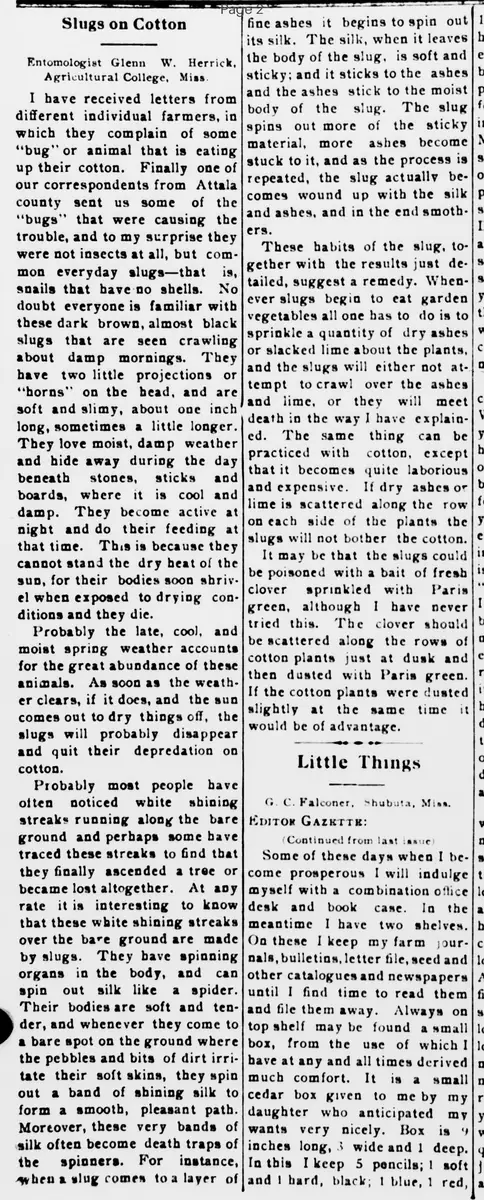
Slugs on Cotton
Entomologist Glenn W. Herrick, Agricultural College, Miss.
I have received letters from different individual farmers, in which they complain of some "bug" or animal that is eating up their cotton. Finally one of our correspondents from Attala county sent us some of the "bugs" that were causing the trouble, and to my surprise they were not insects at all, but common everyday slugs—that is, snails that have no shells. No doubt everyone is familiar with these dark brown, almost black slugs that are seen crawling about damp mornings. They have two little projections or "horns" on the head, and are soft and slimy, about one inch long, sometimes a little longer. They love moist, damp weather and hide away during the day beneath stones, sticks and boards, where it is cool and damp. They become active at night and do their feeding at that time. This is because they cannot stand the dry heat of the sun, for their bodies soon shrivel up when exposed to drying conditions and they die. Probably the late, cool, and moist spring weather accounts for the great abundance of these animals. As soon as the weather clears, if it does, and the sun comes out to dry things off, the slugs will probably disappear and quit their depredation on cotton.
Probably most people have often noticed white shining streaks running along the bare ground and perhaps some have traced these streaks to find that they finally ascended a tree or became lost altogether. At any rate it is interesting to know that these white shining streaks over the bare ground are made by slugs. They have spinning organs in the body, and can spin out silk like a spider. Their bodies are soft and tender, and whenever they come to a bare spot on the ground where the pebbles and bits of dirt irritate their soft skins, they spin out a band of shining silk to form a smooth, pleasant path. Moreover, these very bands of silk often become death traps of the spinners. For instance, when a slug comes to a layer of fine ashes it begins to spin out its silk. The silk, when it leaves the body of the slug, is soft and sticky; and it sticks to the ashes and the ashes stick to the moist body of the slug. The slug spins out more of the sticky material, more ashes become stuck to it, and as the process is repeated, the slug actually becomes wound up with the silk and ashes, and in the end smothers.
These habits of the slug, together with the results just detailed, suggest a remedy. Whenever slugs begin to eat garden vegetables all one has to do is to sprinkle a quantity of dry ashes or slacked lime about the plants, and the slugs will either not attempt to crawl over the ashes and lime, or they will meet death in the way I have explained. The same thing can be practiced with cotton, except that it becomes quite laborious and expensive. If dry ashes or lime is scattered along the row on each side of the plants the slugs will not bother the cotton. It may be that the slugs could be poisoned with a bait of fresh clover sprinkled with Paris green, although I have never tried this. The clover should be scattered along the rows of cotton plants just at dusk and then dusted with Paris green. If the cotton plants were dusted slightly at the same time it would be of advantage.
Entomologist Glenn W. Herrick, Agricultural College, Miss.
I have received letters from different individual farmers, in which they complain of some "bug" or animal that is eating up their cotton. Finally one of our correspondents from Attala county sent us some of the "bugs" that were causing the trouble, and to my surprise they were not insects at all, but common everyday slugs—that is, snails that have no shells. No doubt everyone is familiar with these dark brown, almost black slugs that are seen crawling about damp mornings. They have two little projections or "horns" on the head, and are soft and slimy, about one inch long, sometimes a little longer. They love moist, damp weather and hide away during the day beneath stones, sticks and boards, where it is cool and damp. They become active at night and do their feeding at that time. This is because they cannot stand the dry heat of the sun, for their bodies soon shrivel up when exposed to drying conditions and they die. Probably the late, cool, and moist spring weather accounts for the great abundance of these animals. As soon as the weather clears, if it does, and the sun comes out to dry things off, the slugs will probably disappear and quit their depredation on cotton.
Probably most people have often noticed white shining streaks running along the bare ground and perhaps some have traced these streaks to find that they finally ascended a tree or became lost altogether. At any rate it is interesting to know that these white shining streaks over the bare ground are made by slugs. They have spinning organs in the body, and can spin out silk like a spider. Their bodies are soft and tender, and whenever they come to a bare spot on the ground where the pebbles and bits of dirt irritate their soft skins, they spin out a band of shining silk to form a smooth, pleasant path. Moreover, these very bands of silk often become death traps of the spinners. For instance, when a slug comes to a layer of fine ashes it begins to spin out its silk. The silk, when it leaves the body of the slug, is soft and sticky; and it sticks to the ashes and the ashes stick to the moist body of the slug. The slug spins out more of the sticky material, more ashes become stuck to it, and as the process is repeated, the slug actually becomes wound up with the silk and ashes, and in the end smothers.
These habits of the slug, together with the results just detailed, suggest a remedy. Whenever slugs begin to eat garden vegetables all one has to do is to sprinkle a quantity of dry ashes or slacked lime about the plants, and the slugs will either not attempt to crawl over the ashes and lime, or they will meet death in the way I have explained. The same thing can be practiced with cotton, except that it becomes quite laborious and expensive. If dry ashes or lime is scattered along the row on each side of the plants the slugs will not bother the cotton. It may be that the slugs could be poisoned with a bait of fresh clover sprinkled with Paris green, although I have never tried this. The clover should be scattered along the rows of cotton plants just at dusk and then dusted with Paris green. If the cotton plants were dusted slightly at the same time it would be of advantage.
What sub-type of article is it?
Curiosity
Animal Story
What themes does it cover?
Nature
Misfortune
What keywords are associated?
Slugs On Cotton
Agricultural Pests
Slug Habits
Cotton Damage
Remedies Ashes Lime
What entities or persons were involved?
Glenn W. Herrick
Where did it happen?
Attala County, Mississippi
Story Details
Key Persons
Glenn W. Herrick
Location
Attala County, Mississippi
Story Details
Farmers mistake slugs for bugs eating cotton; Herrick identifies them, describes habits including nocturnal feeding and silk trails, explains abundance due to moist weather, and suggests remedies like ashes, lime, or poisoned bait.