Thank you for visiting SNEWPapers!
Sign up free
The Virginia Gazette
Williamsburg, Virginia
What is this article about?
In a London court case on December 16, plaintiffs Hope and Co. of Amsterdam and Hoare and Co. of London sued assignees of bankrupt Fordyce and Co. over a disputed guarantee for a separate financial transaction by Alexander Fordyce. Lord Mansfield ruled gross negligence invalidated the guarantee, and the jury found for the defendants.
Clipping
OCR Quality
Full Text
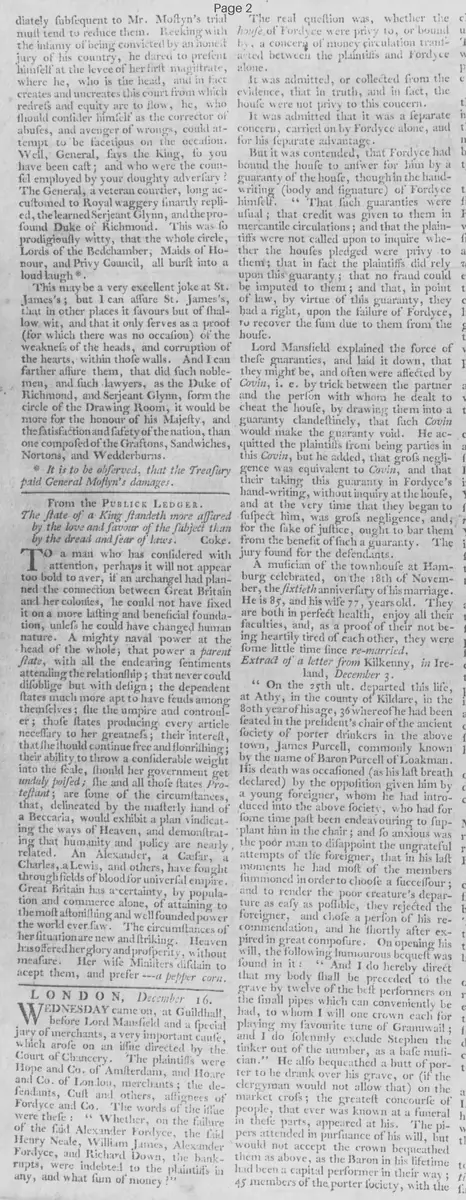
WEDNESDAY came on, at Guildhall, before Lord Mansfield and a special jury of merchants, a very important cause, which arose on an issue directed by the Court of Chancery. The plaintiffs were Hope and Co. of Amsterdam, and Hoare and Co. of London, merchants; the defendants, Cust and others, assignees of Fordyce and Co. The words of the issue were these: "Whether, on the failure of the said Alexander Fordyce, the said Henry Neale, William Jones, Alexander Fordyce, and Richard Down, the bankrupts, were indebted to the plaintiffs in any, and what sum of money?"
The real question was, whether the house of Fordyce were privy to, or bound by, a concern of money circulation transacted between the plaintiffs and Fordyce alone.
It was admitted, or collected from the evidence, that in truth, and in fact, the house were not privy to this concern. It was admitted that it was a separate concern, carried on by Fordyce alone, and for his separate advantage.
But it was contended, that Fordyce had bound the house to answer for him by a guaranty of the house, though in the hand-writing (body and signature) of Fordyce himself. That such guaranties were usual; that credit was given to them in mercantile circulations; and that the plaintiffs were not called upon to inquire whether the houses pledged were privy to them; that in fact the plaintiffs did rely upon this guaranty; that no fraud could be imputed to them; and that, in point of law, by virtue of this guaranty, they had a right, upon the failure of Fordyce, to recover the sum due to them from the house.
Lord Mansfield explained the force of these guaranties, and laid it down, that they might be, and often were affected by Covin, i.e. by trick between the partner and the person with whom he dealt to cheat the house, by drawing them into a guaranty clandestinely, that such Covin would make the guaranty void. He acquitted the plaintiffs from being parties in this Covin, but he added, that gross negligence was equivalent to Covin, and that their taking this guaranty in Fordyce's hand-writing, without inquiry at the house, and at the very time that they began to suspect him, was gross negligence, and, for the sake of justice, ought to bar them from the benefit of such a guaranty. The jury found for the defendants.
What sub-type of article is it?
What keywords are associated?
What entities or persons were involved?
Where did it happen?
Foreign News Details
Primary Location
London
Event Date
December 16
Key Persons
Outcome
jury found for the defendants
Event Details
Trial at Guildhall before Lord Mansfield and a special jury of merchants on whether bankrupts Fordyce and partners owed plaintiffs for a separate money circulation concern by Fordyce alone. Plaintiffs relied on a guarantee in Fordyce's handwriting, but Lord Mansfield held it void due to gross negligence in accepting it without inquiry, especially amid suspicions.