Thank you for visiting SNEWPapers!
Sign up free
Story
November 6, 1926
The Watchman And Southron
Sumter, Sumter County, South Carolina
What is this article about?
The U.S. Supreme Court in Washington on Nov. 1 ruled that federal and state courts can both convict violators of Prohibition laws for the same act, as in the Louisiana case of Doras Hebert et al., upholding independent enforcement without double jeopardy.
Clipping
OCR Quality
98%
Excellent
Full Text
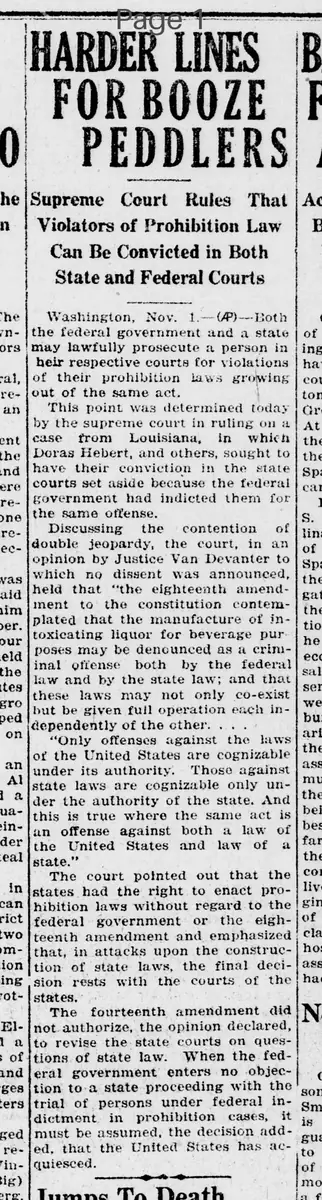
HARDER LINES
FOR BOOZE
PEDDLERS
Supreme Court Rules That Violators of Prohibition Law Can Be Convicted in Both State and Federal Courts
Washington, Nov. 1.--Both the federal government and a state may lawfully prosecute a person in their respective courts for violations of their prohibition laws growing out of the same act.
This point was determined today by the supreme court in ruling on a case from Louisiana, in which Doras Hebert, and others, sought to have their conviction in the state courts set aside because the federal government had indicted them for the same offense.
Discussing the contention of double jeopardy, the court, in an opinion by Justice Van Devanter to which no dissent was announced, held that "the eighteenth amendment to the constitution contemplated that the manufacture of intoxicating liquor for beverage purposes may be denounced as a criminal offense both by the federal law and by the state law; and that these laws may not only co-exist but be given full operation each independently of the other. . . .
"Only offenses against the laws of the United States are cognizable under its authority. Those against state laws are cognizable only under the authority of the state. And this is true where the same act is an offense against both a law of the United States and law of a state."
The court pointed out that the states had the right to enact prohibition laws without regard to the federal government or the eighteenth amendment and emphasized that, in attacks upon the construction of state laws, the final decision rests with the courts of the states.
The fourteenth amendment did not authorize, the opinion declared, to revise the state courts on questions of state law. When the federal government enters no objection to a state proceeding with the trial of persons under federal indictment in prohibition cases, it must be assumed, the decision added, that the United States has acquiesced.
FOR BOOZE
PEDDLERS
Supreme Court Rules That Violators of Prohibition Law Can Be Convicted in Both State and Federal Courts
Washington, Nov. 1.--Both the federal government and a state may lawfully prosecute a person in their respective courts for violations of their prohibition laws growing out of the same act.
This point was determined today by the supreme court in ruling on a case from Louisiana, in which Doras Hebert, and others, sought to have their conviction in the state courts set aside because the federal government had indicted them for the same offense.
Discussing the contention of double jeopardy, the court, in an opinion by Justice Van Devanter to which no dissent was announced, held that "the eighteenth amendment to the constitution contemplated that the manufacture of intoxicating liquor for beverage purposes may be denounced as a criminal offense both by the federal law and by the state law; and that these laws may not only co-exist but be given full operation each independently of the other. . . .
"Only offenses against the laws of the United States are cognizable under its authority. Those against state laws are cognizable only under the authority of the state. And this is true where the same act is an offense against both a law of the United States and law of a state."
The court pointed out that the states had the right to enact prohibition laws without regard to the federal government or the eighteenth amendment and emphasized that, in attacks upon the construction of state laws, the final decision rests with the courts of the states.
The fourteenth amendment did not authorize, the opinion declared, to revise the state courts on questions of state law. When the federal government enters no objection to a state proceeding with the trial of persons under federal indictment in prohibition cases, it must be assumed, the decision added, that the United States has acquiesced.
What sub-type of article is it?
Historical Event
Crime Story
What themes does it cover?
Justice
Crime Punishment
What keywords are associated?
Supreme Court Ruling
Prohibition Law
Double Jeopardy
Eighteenth Amendment
Federal State Prosecution
What entities or persons were involved?
Doras Hebert
Justice Van Devanter
Where did it happen?
Washington, Louisiana
Story Details
Key Persons
Doras Hebert
Justice Van Devanter
Location
Washington, Louisiana
Event Date
Nov. 1
Story Details
The Supreme Court ruled that both federal and state governments can prosecute individuals for the same Prohibition violation, rejecting double jeopardy claims in a case involving Doras Hebert and others from Louisiana.