Thank you for visiting SNEWPapers!
Sign up free
Trainman News
Indianapolis, Marion County, Indiana
What is this article about?
Informational article on Canada's Government Annuities Act, administered by Minister of Labour Humphrey Mitchell, providing fixed income for old age. Features case of a Western Ontario woman who invested $5,312 at age 75 and collected $20,000 by 100. Covers deferred/immediate annuities, group plans, and taxation changes up to 1948.
Clipping
OCR Quality
Full Text
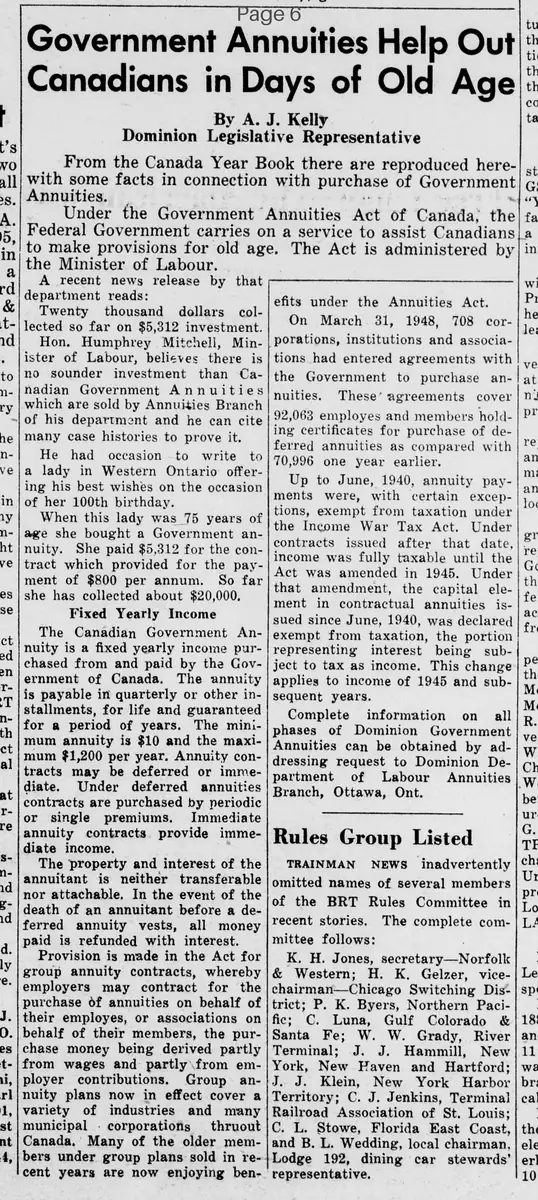
By A. J. Kelly Dominion Legislative Representative
From the Canada Year Book there are reproduced herewith some facts in connection with purchase of Government Annuities.
Under the Government Annuities Act of Canada, the Federal Government carries on a service to assist Canadians to make provisions for old age. The Act is administered by the Minister of Labour.
A recent news release by that department reads:
Twenty thousand dollars collected so far on $5,312 investment.
Hon. Humphrey Mitchell, Minister of Labour, believes there is no sounder investment than Canadian Government Annuities which are sold by Annuities Branch of his department and he can cite many case histories to prove it.
He had occasion to write to a lady in Western Ontario offering his best wishes on the occasion of her 100th birthday.
When this lady was 75 years of age she bought a Government annuity. She paid $5,312 for the contract which provided for the payment of $800 per annum. So far she has collected about $20,000.
Fixed Yearly Income
The Canadian Government Annuity is a fixed yearly income purchased from and paid by the Government of Canada. The annuity is payable in quarterly or other installments, for life and guaranteed for a period of years. The minimum annuity is $10 and the maximum $1,200 per year. Annuity contracts may be deferred or immediate. Under deferred annuities contracts are purchased by periodic or single premiums.
Immediate annuity contracts provide immediate income.
The property and interest of the annuitant is neither transferable nor attachable. In the event of the death of an annuitant before a deferred annuity vests, all money paid is refunded with interest.
Provision is made in the Act for group annuity contracts, whereby employers may contract for the purchase of annuities on behalf of their employes, or associations on behalf of their members, the purchase money being derived partly from wages and partly from employer contributions. Group annuity plans now in effect cover a variety of industries and many municipal corporations thruout Canada. Many of the older members under group plans sold in recent years are now enjoying benefits under the Annuities Act.
On March 31, 1948, 708 corporations, institutions and associations had entered agreements with the Government to purchase annuities. These agreements cover 92,063 employes and members holding certificates for purchase of deferred annuities as compared with 70,996 one year earlier.
Up to June, 1940, annuity payments were, with certain exceptions, exempt from taxation under the Income War Tax Act. Under contracts issued after that date, income was fully taxable until the Act was amended in 1945. Under that amendment, the capital element in contractual annuities issued since June, 1940, was declared exempt from taxation, the portion representing interest being subject to tax as income. This change applies to income of 1945 and subsequent years.
Complete information on all phases of Dominion Government Annuities can be obtained by addressing request to Dominion Department of Labour Annuities Branch, Ottawa, Ont.
What sub-type of article is it?
What themes does it cover?
What keywords are associated?
What entities or persons were involved?
Where did it happen?
Story Details
Key Persons
Location
Canada, Western Ontario, Ottawa, Ont.
Event Date
March 31, 1948
Story Details
The Government Annuities Act assists Canadians with old age provisions through fixed yearly incomes. Example: A lady bought an annuity at 75 for $5,312, receiving $800 annually, collecting $20,000 by age 100. Details include deferred/immediate contracts, group plans covering 92,063 employees in 1948, and taxation changes from 1940-1945.