Thank you for visiting SNEWPapers!
Sign up free
Editorial
June 26, 1830
Daily Richmond Whig
Richmond, Virginia
What is this article about?
The New York Commercial Advertiser reprints and mockingly sympathizes with a Long Island Star editorial decrying the Jackson party's decline due to policy inconsistencies, corruption, Indian removal, and loss of support, predicting victory for Henry Clay in 1832.
Clipping
OCR Quality
95%
Excellent
Full Text
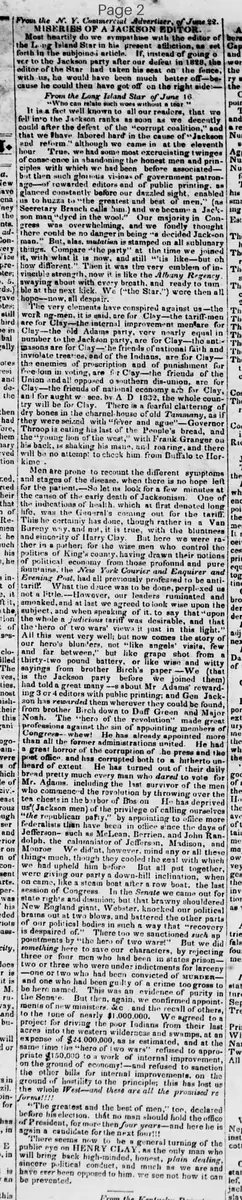
From the N. Y. Commercial Advertiser, of June 22.
MISERIES OF A JACKSON EDITOR.
Most heartily do we sympathise with the editor of the Long Island Star in his present affliction, as set forth in the subjoined article. If, instead of going over to the Jackson party after our defeat in 1828, the editor of the Star had taken his seat on the fence, with us, he would have been much better off—because he could then have got off on the right side:—
From the Long Island Star of June 16
"Who can relate such woes without a tear"
It is a fact well known to all our readers, that we fell into the Jackson ranks as soon as we decently could after the defeat of the "corrupt coalition," and that we have labored hard in the cause of "Jackson and reform," although we came in at the eleventh hour.
True, we had some most excruciating twinges of conscience in abandoning the honest men and principles with which we had been before associated—but then such glorious visions of government patronage—of rewarded editors and of public printing, as glanced constantly before our dazzled sight, enabled us to huzza to "the greatest and best of men," (as Secretary Branch calls him) and we became a Jackson man "dyed in the wool." Our majority in Congress was overwhelming, and we fondly thought there could be no danger in being "a decided Jackson man." But, alas! mutation is stamped on all sublunary things. Compare "the party" at the time we joined it, with what it is now, and still "'tis like—but oh how different." Then it was the very emblem of invincible strength, now it is like the Albany Regency, swaying about with every breath, and ready to tumble at the next kick. We ("the Star") were then all hope—now, all despair.
The very elements have conspired against us—the working-men, it is said, are for Clay—the tariff-men are for Clay—the internal improvement men are for Clay—the old Adams party, very nearly equal in number to the Jackson party, are for Clay—the anti-masons are for Clay—the friends of national faith and inviolate treaties, and of the Indians, are for Clay—the enemies of proscription and of punishment for opinion in voting, are for Clay—the friends of the Union and all opposed to southern dis-union, are for Clay—the friends of national economy are for Clay, and for aught we see, by A. D. 1832, the whole country will be for Clay. There is a fearful clattering of dry bones in the charnel-house of old Tammany, as if they were seized with "fever and ague"—Governor Throop is eating his last of the People's bread, and the "young lion of the west," with Frank Granger on his back, is shaking his mane, and roaring, and there will be no attempt to check him from Buffalo to Hornellsville.
Men are prone to recount the different symptoms and stages of the disease, when there is no hope left for the patient.—So let us look for a few minutes at the cause of the early death of Jacksonism. One of the indications of health, which at first denoted long life, was the General's coming out for the tariff. This he certainly has done, though rather in a Van Buren way, and not, it is true, with the bluntness and sincerity of Harry Clay. But here we were rather in a pother; for the wise men who control the politics of King's county, having drawn their notions of political economy from those profound and pure fountains, the New York Courier and Enquirer and Evening Post, had all previously professed to be anti-tariff. "What the deuce was to be done," perplexed us not a little.—However, our leaders ruminated and smoaked, and at last we agreed to look wise upon the subject, and when speaking of it, to say that "upon the whole a judicious tariff was desirable, and that the 'hero of two wars' views it just in this light."
All this went very well; but now comes the story of our hero's blunders, not "like angels' visits, few and far between," but like grape shot from a thirty-two pound battery, or like wise and witty sayings from brother Birch's paper—We (that is the Jackson party before we joined them) had told a great many lies about Mr. Adams' rewarding 3 or 4 editors with public printing; and Gen. Jackson has rewarded them wherever they could be found, from brother Birch down to Duff Green and Major Noah. The "hero of the revolution" made great professions against the sin of appointing members of Congress—whew! He has already appointed more than all the former administrations united. He had a great horror of the corruption of the press and the post office, and has corrupted both to a hitherto unheard of extent. He has turned out of their daily bread pretty much every man who dared to vote for Mr. Adams, including the last survivor of the men who commenced the revolution by throwing over the tea chests in the harbor of Boston. He has deprived us (Jackson men) of the privilege of calling ourselves "the republican party," by appointing to office more federalists than have been in office since the days of Jefferson—such as McLean, Berrien, and John Randolph, the calumniator of Jefferson, Madison, and Monroe.
We didn't, however, mind any or all these things much, though they cooled the zeal with which we had upheld him before. But all put together, were giving our party a down-hill inclination, when on came, like a steam boat after a row boat, the last session of Congress. In the Senate we came out for state rights and disunion; but that brawny shouldered New England giant, Webster, knocked our political brains out at two blows, and battered the other parts of our political bodies in such a way that "recovery is despaired of." There too we sanctioned such appointments by "the hero of two wars!" But we did something here to save our characters, by rejecting three or four men who had been in state's prison—two or three who were under indictments for larceny—one or two who had been convicted of MURDER—and one who had been guilty of a crime too gross to be here named. This was an evidence of purity in the Senate. But then, again, we confirmed appointments of new ministers, &c. and the recall of others, to the tune of nearly 1,000,000. We agreed to a project for driving the poor Indians from their last acres into the western wilderness and swamps, at an expense of $24,000,000, as is estimated, and at the same time the "hero of two wars" refused to appropriate $150,000 to a work of internal improvement, on the ground of economy!—and refused to sanction the other bills for internal improvements, on the ground of hostility to the principle; this has lost us the whole West—and these are all the promised reforms!!!!
"The greatest and the best of men," too, declared before his election, that no man should hold the office of President, for more than four years—and here he is again a candidate for the next four!!!
There seems now to be a general turning of the public eye on HENRY CLAY, as the only man who will bring back high-minded, honest, plain dealing sincere political conduct, and much as we are and have ever been opposed to him, we see not how it can be prevented.
MISERIES OF A JACKSON EDITOR.
Most heartily do we sympathise with the editor of the Long Island Star in his present affliction, as set forth in the subjoined article. If, instead of going over to the Jackson party after our defeat in 1828, the editor of the Star had taken his seat on the fence, with us, he would have been much better off—because he could then have got off on the right side:—
From the Long Island Star of June 16
"Who can relate such woes without a tear"
It is a fact well known to all our readers, that we fell into the Jackson ranks as soon as we decently could after the defeat of the "corrupt coalition," and that we have labored hard in the cause of "Jackson and reform," although we came in at the eleventh hour.
True, we had some most excruciating twinges of conscience in abandoning the honest men and principles with which we had been before associated—but then such glorious visions of government patronage—of rewarded editors and of public printing, as glanced constantly before our dazzled sight, enabled us to huzza to "the greatest and best of men," (as Secretary Branch calls him) and we became a Jackson man "dyed in the wool." Our majority in Congress was overwhelming, and we fondly thought there could be no danger in being "a decided Jackson man." But, alas! mutation is stamped on all sublunary things. Compare "the party" at the time we joined it, with what it is now, and still "'tis like—but oh how different." Then it was the very emblem of invincible strength, now it is like the Albany Regency, swaying about with every breath, and ready to tumble at the next kick. We ("the Star") were then all hope—now, all despair.
The very elements have conspired against us—the working-men, it is said, are for Clay—the tariff-men are for Clay—the internal improvement men are for Clay—the old Adams party, very nearly equal in number to the Jackson party, are for Clay—the anti-masons are for Clay—the friends of national faith and inviolate treaties, and of the Indians, are for Clay—the enemies of proscription and of punishment for opinion in voting, are for Clay—the friends of the Union and all opposed to southern dis-union, are for Clay—the friends of national economy are for Clay, and for aught we see, by A. D. 1832, the whole country will be for Clay. There is a fearful clattering of dry bones in the charnel-house of old Tammany, as if they were seized with "fever and ague"—Governor Throop is eating his last of the People's bread, and the "young lion of the west," with Frank Granger on his back, is shaking his mane, and roaring, and there will be no attempt to check him from Buffalo to Hornellsville.
Men are prone to recount the different symptoms and stages of the disease, when there is no hope left for the patient.—So let us look for a few minutes at the cause of the early death of Jacksonism. One of the indications of health, which at first denoted long life, was the General's coming out for the tariff. This he certainly has done, though rather in a Van Buren way, and not, it is true, with the bluntness and sincerity of Harry Clay. But here we were rather in a pother; for the wise men who control the politics of King's county, having drawn their notions of political economy from those profound and pure fountains, the New York Courier and Enquirer and Evening Post, had all previously professed to be anti-tariff. "What the deuce was to be done," perplexed us not a little.—However, our leaders ruminated and smoaked, and at last we agreed to look wise upon the subject, and when speaking of it, to say that "upon the whole a judicious tariff was desirable, and that the 'hero of two wars' views it just in this light."
All this went very well; but now comes the story of our hero's blunders, not "like angels' visits, few and far between," but like grape shot from a thirty-two pound battery, or like wise and witty sayings from brother Birch's paper—We (that is the Jackson party before we joined them) had told a great many lies about Mr. Adams' rewarding 3 or 4 editors with public printing; and Gen. Jackson has rewarded them wherever they could be found, from brother Birch down to Duff Green and Major Noah. The "hero of the revolution" made great professions against the sin of appointing members of Congress—whew! He has already appointed more than all the former administrations united. He had a great horror of the corruption of the press and the post office, and has corrupted both to a hitherto unheard of extent. He has turned out of their daily bread pretty much every man who dared to vote for Mr. Adams, including the last survivor of the men who commenced the revolution by throwing over the tea chests in the harbor of Boston. He has deprived us (Jackson men) of the privilege of calling ourselves "the republican party," by appointing to office more federalists than have been in office since the days of Jefferson—such as McLean, Berrien, and John Randolph, the calumniator of Jefferson, Madison, and Monroe.
We didn't, however, mind any or all these things much, though they cooled the zeal with which we had upheld him before. But all put together, were giving our party a down-hill inclination, when on came, like a steam boat after a row boat, the last session of Congress. In the Senate we came out for state rights and disunion; but that brawny shouldered New England giant, Webster, knocked our political brains out at two blows, and battered the other parts of our political bodies in such a way that "recovery is despaired of." There too we sanctioned such appointments by "the hero of two wars!" But we did something here to save our characters, by rejecting three or four men who had been in state's prison—two or three who were under indictments for larceny—one or two who had been convicted of MURDER—and one who had been guilty of a crime too gross to be here named. This was an evidence of purity in the Senate. But then, again, we confirmed appointments of new ministers, &c. and the recall of others, to the tune of nearly 1,000,000. We agreed to a project for driving the poor Indians from their last acres into the western wilderness and swamps, at an expense of $24,000,000, as is estimated, and at the same time the "hero of two wars" refused to appropriate $150,000 to a work of internal improvement, on the ground of economy!—and refused to sanction the other bills for internal improvements, on the ground of hostility to the principle; this has lost us the whole West—and these are all the promised reforms!!!!
"The greatest and the best of men," too, declared before his election, that no man should hold the office of President, for more than four years—and here he is again a candidate for the next four!!!
There seems now to be a general turning of the public eye on HENRY CLAY, as the only man who will bring back high-minded, honest, plain dealing sincere political conduct, and much as we are and have ever been opposed to him, we see not how it can be prevented.
What sub-type of article is it?
Partisan Politics
Indian Affairs
Economic Policy
What keywords are associated?
Jackson Party Decline
Henry Clay Support
Political Corruption
Indian Removal
Tariff Policy
Internal Improvements
1832 Election
Party Appointments
What entities or persons were involved?
Andrew Jackson
Henry Clay
Martin Van Buren
Daniel Webster
John Quincy Adams
Enos T. Throop
Francis Granger
Editorial Details
Primary Topic
Decline Of Jacksonism And Rise Of Clay Support
Stance / Tone
Critical Of Jackson Administration, Pro Clay, Satirical Mockery Of Party Convert
Key Figures
Andrew Jackson
Henry Clay
Martin Van Buren
Daniel Webster
John Quincy Adams
Enos T. Throop
Francis Granger
Key Arguments
Jackson Party Losing Support From Working Men, Tariff Men, Internal Improvement Advocates, Adams Party, Anti Masons, Union Friends, And Others
Jackson's Inconsistent Tariff Support And Failure To Match Clay's Sincerity
Jackson's Appointments Reward Opponents And Corrupt Press And Post Office
Proscription Of Adams Supporters, Including Revolutionary Veterans
Senate Support For Disunion And Indian Removal At Great Expense
Refusal Of Internal Improvements Despite Economy Claims
Jackson Seeking Re Election Contrary To Prior Declarations
Clay Seen As Restorer Of Honest Politics