Thank you for visiting SNEWPapers!
Sign up free
Domestic News
October 10, 1860
Semi Weekly Standard
Raleigh, Wake County, North Carolina
What is this article about?
Editorial in Goldsboro' Tribune debates if Lincoln's potential election justifies Union dissolution, viewing it as an incident amid existing constitutional violations by free states, but urges adherence to the electoral process under the Constitution.
Clipping
OCR Quality
95%
Excellent
Full Text
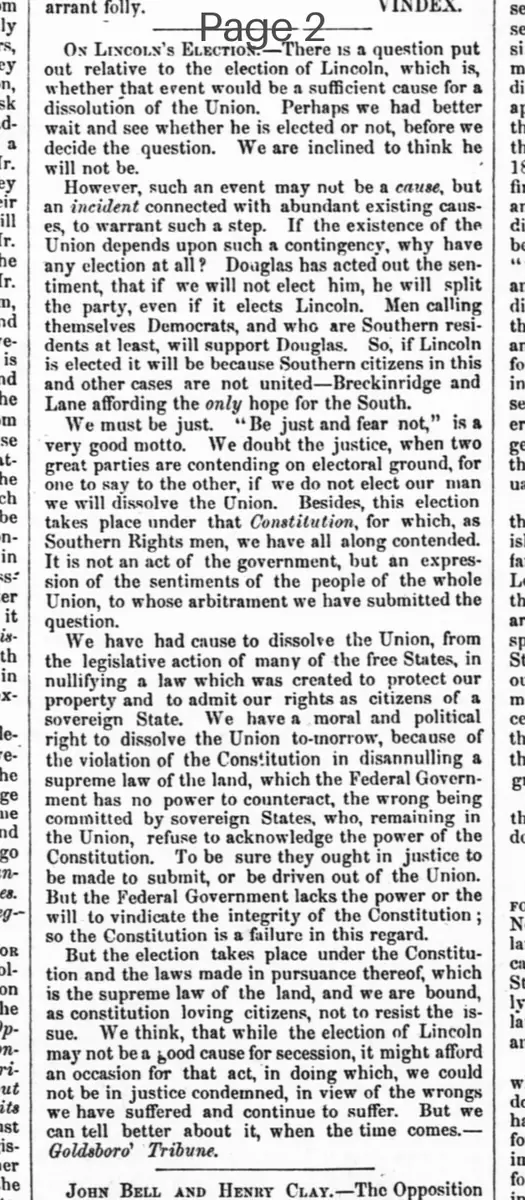
On Lincoln's Election.—There is a question put out relative to the election of Lincoln, which is, whether that event would be a sufficient cause for a dissolution of the Union. Perhaps we had better wait and see whether he is elected or not, before we decide the question. We are inclined to think he will not be. However, such an event may not be a cause, but an incident connected with abundant existing causes, to warrant such a step. If the existence of the Union depends upon such a contingency, why have any election at all? Douglas has acted out the sentiment, that if we will not elect him, he will split the party, even if it elects Lincoln. Men calling themselves Democrats, and who are Southern residents at least, will support Douglas. So, if Lincoln is elected it will be because Southern citizens in this and other cases are not united—Breckinridge and Lane affording the only hope for the South. We must be just. "Be just and fear not," is a very good motto. We doubt the justice, when two great parties are contending on electoral ground, for one to say to the other, if we do not elect our man we will dissolve the Union. Besides, this election takes place under that Constitution, for which, as Southern Rights men, we have all along contended. It is not an act of the government, but an expression of the sentiments of the people of the whole Union, to whose arbitrament we have submitted the question. We have had cause to dissolve the Union, from the legislative action of many of the free States, in nullifying a law which was created to protect our property and to admit our rights as citizens of a Sovereign State. We have a moral and political right to dissolve the Union to-morrow, because of the violation of the Constitution in disannulling a supreme law of the land, which the Federal Government has no power to counteract, the wrong being committed by sovereign States, who, remaining in the Union, refuse to acknowledge the power of the Constitution. To be sure they ought in justice to be made to submit, or be driven out of the Union. But the Federal Government lacks the power or the will to vindicate the integrity of the Constitution; so the Constitution is a failure in this regard. But the election takes place under the Constitution and the laws made in pursuance thereof, which is the supreme law of the land, and we are bound, as constitution loving citizens, not to resist the issue. We think, that while the election of Lincoln may not be a good cause for secession, it might afford an occasion for that act, in doing which, we could not be in justice condemned, in view of the wrongs we have suffered and continue to suffer. But we can tell better about it, when the time comes.—Goldsboro' Tribune.
What sub-type of article is it?
Politics
Rebellion Or Revolt
What keywords are associated?
Lincoln Election
Union Dissolution
Secession
Southern Rights
Constitution Violation
Democrats
Free States
What entities or persons were involved?
Lincoln
Douglas
Breckinridge
Lane
Where did it happen?
Goldsboro
Domestic News Details
Primary Location
Goldsboro
Key Persons
Lincoln
Douglas
Breckinridge
Lane
Event Details
Editorial questions if Lincoln's election would cause Union dissolution, sees it as incident amid existing causes like free states nullifying laws protecting Southern property rights, argues moral right to secede exists but election under Constitution must be respected, may provide occasion for secession without condemnation.