Thank you for visiting SNEWPapers!
Sign up free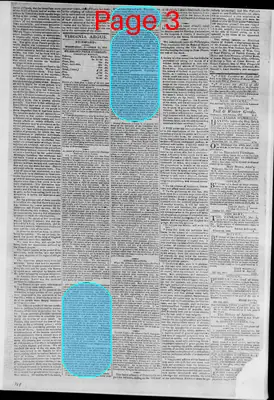
Editorial
October 23, 1805
Virginia Argus
Richmond, Virginia
What is this article about?
Editorial praises American republican government for low taxes and prosperity, contrasting it with burdensome British monarchy imposing new taxes on letters, salt, horses, and legacies; quotes Jefferson's inaugural on ending internal taxes.
Merged-components note: Continuation of 'The Contrast' editorial across components on page 3, sequential reading order.
Clipping
OCR Quality
98%
Excellent
Full Text
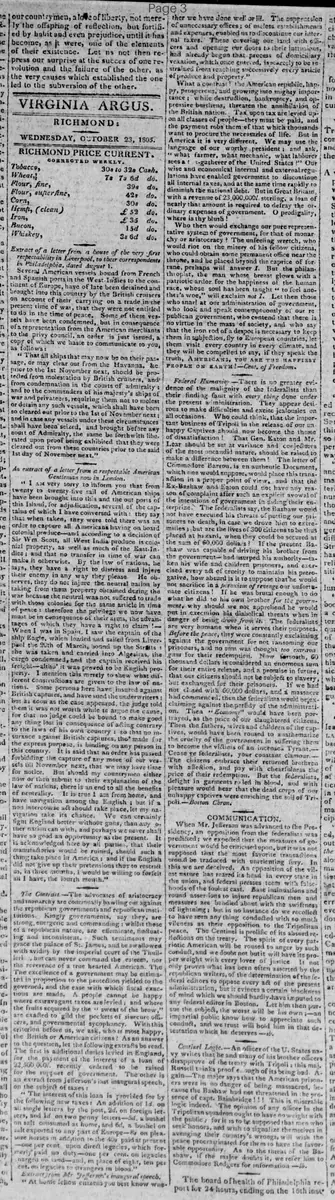
The Contrast.--The advocates of aristocracy and monarchy are continually bawling out against the republican governments and republican institutions. Kingly governments, say they, are strong, energetic and commanding: whilst those of a republican nature, are effeminate, fluctuating and inconsistent. Such sentiments may grace the palace of St. James, and be swallowed with avidity by the imperial court of the Tuilleries, but can never command the esteem, nor the reverence of a truehearted American. The excellence of a government may be estimated in proportion to the protection yielded to the governed, and the ease with which fiscal exactions are made. A people cannot be happy where extravagant taxes are levied; and where the fruits acquired by the "sweat of the brow," are exacted to gild the pockets of sinecure officers, and governmental sycophancy. With this criterion before us, we ask, who is most happy, the British or American citizens? As an answer to the question, let the following extracts be read. The first is additional duties levied in England, for the payment of the interest of a loan of 22,500,000l. recently ordered to be raised for the support of government. The other is an extract from Jefferson's last inaugural speech, on the subject of taxes:
The interest of this loan is provided for by the following new taxes: An addition of 1d. on all single letters by the post, 2d. on foreign letters, and 1d on two penny letters--5d. a bushel on salt consumed at home, and 6d. a bushel on salt exported to any part of Europe--6s on pleasure horses in addition to the 40s paid at present--one per cent upon direct legacies, which formerly paid no duty--one per cent. on legacies charged on land--and, in place of eight, ten per cent. on legacies to strangers in blood.
Extract from Mr. Jefferson's inaugural speech.
At home, fellow citizens you best know whether we have done well or ill. The suppression of unnecessary offices; of useless establishments and expenses, enabled us to discontinue our internal taxes. These covering our land with officers and opening our doors to their intrusions, had already begun that process of domiciliary vexation, which once entered, is scarcely to be restrained from reaching successively every article of produce and property.
What a contrast! the American republic, happy, prosperous, and growing into mighty importance; while destruction, bankruptcy, and oppressive burthens, threaten the annihilation of the British nation. Tax upon tax are levied upon all classes of people--they must be paid, and the payment robs them of that which thousands want to procure the necessaries of life. But in America it is very different. We may use the language of our worthy president; and ask, "what farmer, what mechanic, what labourer sees a tax-gatherer of the United States?" Our wise and economical internal and external regulations have enabled government to discontinue all internal taxes, and at the same time rapidly to diminish the national debt. But in Great Britain, with a revenue of 23,000,000l. sterling. a loan of nearly that amount is required to defray the ordinary expenses of government. O prodigality, where is thy blush! Who then would exchange our pure representative system of government, for that of monarchy or aristocracy? The unfeeling wretch, who would riot on the misery of his fellow citizens, who could obtain some permanent office near the throne, and be placed beyond the caprice of fortune, perhaps will answer I. But the philanthropist, the man whose breast glows with a patriotic ardor for the happiness of the human race, whose soul has been taught "to feel another's woe," will exclaim not I. Let then those who snarl at our administration of government, who look and speak contemptuously of our republican government, who contend that there is no virtue in the mass of society, and who say that the iron rod of a despot is necessary to keep them in subjection, fly to European countries, let them visit every country in every climate, and they will be compelled to say, if they speak the truth, AMERICANS, YOU ARE THE HAPPIEST PEOPLE ON EARTH!--Cent. Of Freedom.
The interest of this loan is provided for by the following new taxes: An addition of 1d. on all single letters by the post, 2d. on foreign letters, and 1d on two penny letters--5d. a bushel on salt consumed at home, and 6d. a bushel on salt exported to any part of Europe--6s on pleasure horses in addition to the 40s paid at present--one per cent upon direct legacies, which formerly paid no duty--one per cent. on legacies charged on land--and, in place of eight, ten per cent. on legacies to strangers in blood.
Extract from Mr. Jefferson's inaugural speech.
At home, fellow citizens you best know whether we have done well or ill. The suppression of unnecessary offices; of useless establishments and expenses, enabled us to discontinue our internal taxes. These covering our land with officers and opening our doors to their intrusions, had already begun that process of domiciliary vexation, which once entered, is scarcely to be restrained from reaching successively every article of produce and property.
What a contrast! the American republic, happy, prosperous, and growing into mighty importance; while destruction, bankruptcy, and oppressive burthens, threaten the annihilation of the British nation. Tax upon tax are levied upon all classes of people--they must be paid, and the payment robs them of that which thousands want to procure the necessaries of life. But in America it is very different. We may use the language of our worthy president; and ask, "what farmer, what mechanic, what labourer sees a tax-gatherer of the United States?" Our wise and economical internal and external regulations have enabled government to discontinue all internal taxes, and at the same time rapidly to diminish the national debt. But in Great Britain, with a revenue of 23,000,000l. sterling. a loan of nearly that amount is required to defray the ordinary expenses of government. O prodigality, where is thy blush! Who then would exchange our pure representative system of government, for that of monarchy or aristocracy? The unfeeling wretch, who would riot on the misery of his fellow citizens, who could obtain some permanent office near the throne, and be placed beyond the caprice of fortune, perhaps will answer I. But the philanthropist, the man whose breast glows with a patriotic ardor for the happiness of the human race, whose soul has been taught "to feel another's woe," will exclaim not I. Let then those who snarl at our administration of government, who look and speak contemptuously of our republican government, who contend that there is no virtue in the mass of society, and who say that the iron rod of a despot is necessary to keep them in subjection, fly to European countries, let them visit every country in every climate, and they will be compelled to say, if they speak the truth, AMERICANS, YOU ARE THE HAPPIEST PEOPLE ON EARTH!--Cent. Of Freedom.
What sub-type of article is it?
Constitutional
Taxation
What keywords are associated?
Republican Government
Monarchy Criticism
Taxation Contrast
Jefferson Inaugural
American Happiness
British Taxes
What entities or persons were involved?
Thomas Jefferson
British Government
American Republic
Editorial Details
Primary Topic
Contrast Between Republican And Monarchical Governments
Stance / Tone
Strongly Pro Republican And Anti Monarchical
Key Figures
Thomas Jefferson
British Government
American Republic
Key Arguments
Republican Governments Provide Better Protection And Easier Fiscal Exactions Than Monarchical Ones
American Citizens Are Happier Due To Discontinued Internal Taxes
British Citizens Face New Heavy Taxes Including On Letters, Salt, Horses, And Legacies
Jefferson's Administration Suppressed Unnecessary Offices And Expenses To End Internal Taxes
America Is Prosperous Without Tax Gatherers, While Britain Requires Massive Loans Despite High Revenue
Pure Representative System Is Superior To Monarchy Or Aristocracy