Thank you for visiting SNEWPapers!
Sign up free
The National Intelligencer And Washington Advertiser
Washington, District Of Columbia
What is this article about?
Proceedings of a military court of enquiry at General Wilkinson's request to perpetuate testimony against accusations tied to Aaron Burr's conspiracy. Wilkinson addresses the court, calls witnesses including Lt. Spence, Lt. Murray, and Thomas H. Williams, whose testimonies discredit Daniel Clark and relate to events in 1805.
Clipping
OCR Quality
Full Text
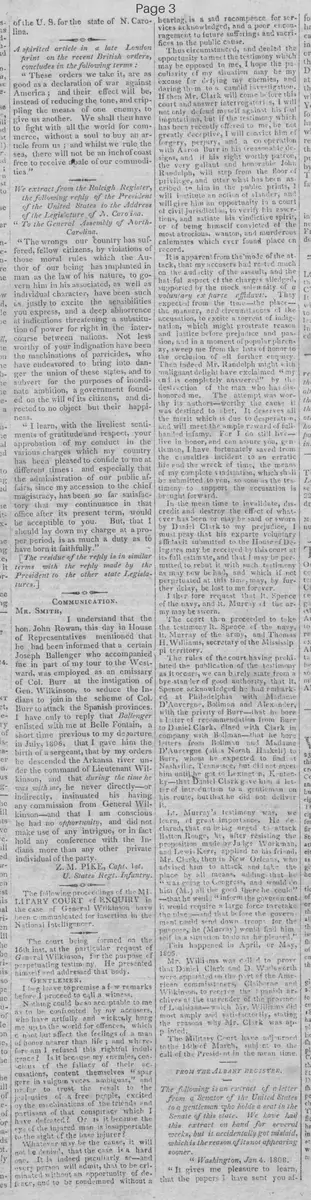
The court being formed on the 16th inst. at the particular request of General Wilkinson, for the purpose of perpetuating testimony. He presented himself and addressed that body.
GENTLEMEN,
I beg leave to premise a few remarks before I proceed to call a witness. Nothing could be so acceptable to me as to be confronted by my accusers, who have artfully and wickedly hung me up to the world for offences, which cannot but affect the feelings of a man of honor nearer than life; and wherefore am I refused this rightful indulgence? Is it because my enemies, conscious of the fallacy of their accusations, content themselves "spargere in vulgum voces ambiguas," and prefer to trust the result to the jealousies of a free people, excited by the machinations of the friends and partisans of that conspiracy which I have defeated? Or is it because the eye of the injured man is insupportable to the sight of the base injurer?
Whatever may be the cause, it will not be denied, that the case is a hard one. It is indeed peculiarly so—and every person will admit, that to be criminated without an opportunity of defence, and to be condemned without a hearing, is a sad recompence for services acknowledged, and a poor encouragement to future sufferings and sacrifices in the public cause.
Thus circumstanced, and denied the opportunity to meet the testimony which may be opposed to me, I hope the peculiarity of my situation may be my excuse for defying my enemies, and daring them to a candid investigation. If then Mr. Clark will come before this court and answer interrogatories, I will not only defend myself against his foul imputations, but if the testimony which has been recently offered to me, be not greatly deceptive, I will convict him of forgery, perjury, and a co-operation with Aaron Burr in his treasonable designs, and if his right worthy patron, the very gallant and honorable John Randolph, will step from the floor of privilege, and utter what has been ascribed to him in the public prints, I will institute an action of slander, and will give him an opportunity in a court of civil jurisdiction, to verify his assertions, and satiate his vindictive spirit, or of being himself convicted of the most atrocious, wanton, and murderous calumnies which ever found place on record.
It is apparent from the mode of the attack, that my accusers had rested much on the audacity of the assault. and the hateful aspect of the charges alledged, supported by the mock solemnity of a voluntary ex parte affidavit. They expected from the time—the place—the manner, and circumstances of the accusation, to excite a torrent of indignation, which might prostrate reason and justice before prejudice and passion, and in a moment of popular phrenzy, sweep me from the lists of honor to the occlusion of all further enquiry. Then indeed Mr. Randolph might with malignant delight have exclaimed "my end is completely answered" by the destruction of the man who has dishonored me. The attempt was worthy its authors—worthy the cause it was destined to abet. It deserves all the merit which is due to desperation, and will meet the ample reward of full-handed infamy. For I do still live—live in honor, and can assure you, gentlemen, I have fortunately saved from the casualties incident to an erratic life and the wreck of time. the means of my complete vindication, which shall be submitted to you, so soon as the testimony to support the accusation is brought forward.
In the mean time to invalidate, discredit and destroy the effect of whatever has been or may be said or sworn by Daniel Clark to my prejudice. I must pray that his ex parte voluntary affidavit submitted to the House of Delegates may be received by this court at its full estimate, and that I may be permitted to rebut it with such testimony as may now be had, and which if not perpetuated at this time, may, by further delay, be lost to me forever.
I therefore request that Lt. Spence of the navy, and Lt. Murray of the army may be sworn.
The court then proceeded to take the testimony Lt. Spence of the navy, Lt. Murray of the army, and Thomas H. Williams, secretary of the Mississippi territory.
The rules of the court having prohibited the publication of the testimony as it occurs, we can only state from a bye-stander of good authority, that Lt. Spence acknowledged he had embarked at Philadelphia with Madame D'Auvergne, Bollman and Alexander, with the privity of Burr—that he bore a letter of recommendation from Burr to Daniel Clark, dined with Clark in company with Bollman—that he bore letters from Bollman and Madame D'Auvergne (alias Norah Haskeli) to Burr, whom he expected to find at Nashville, Tennessee, but did not meet him until he got to Lexington, Kentucky—that Daniel Clark gave him a letter of introduction to a gentleman on his route. but that he did not deliver it.
Lt. Murray's testimony was, we learn, of great importance. He declared, that on being urged to attack Baton Rouge, he, after resisting the proposition made by Judge Workman, and Lewis Kerr, applied to his friend, Mr. Clark, then in New Orleans, who advised him to attack and take the place by all means, adding that he "was going to Congress, and would do him (M.) all the good there he could"—that he would "inform the government it would require a large force to retake the place—and that before the government could send down troops for the purpose, he (Murray) would find himself in a situation to do as he pleased."
This happened in April, or May, 1805.
Mr. Williams was called to prove that Daniel Clark and D. Walshworth were appointed on the part of the American commissioners, Claiborne and Wilkinson, to receive the Spanish archives at the surrender of the province of Louisiana—which Mr. Williams did most amply and satisfactorily. stating the reasons why Mr. Clark was appointed.
The Military Court have adjourned to the 14th of March, subject to the call of the President in the mean time.
What sub-type of article is it?
What themes does it cover?
What keywords are associated?
What entities or persons were involved?
Where did it happen?
Story Details
Key Persons
Location
Philadelphia; New Orleans; Nashville, Tennessee; Lexington, Kentucky; Mississippi Territory
Event Date
16th Inst.; April Or May, 1805; 14th Of March
Story Details
General Wilkinson addresses a military court of enquiry to defend against accusations of involvement in Aaron Burr's conspiracy, calling witnesses whose testimonies implicate Daniel Clark in forgery, perjury, and treasonous cooperation; testimonies cover travels, advice to attack Baton Rouge, and appointments related to Louisiana surrender.