Thank you for visiting SNEWPapers!
Sign up free
Story
September 2, 1820
Daily National Intelligencer
Washington, District Of Columbia
What is this article about?
Detailed 1820 letter excerpt on the Harmony Society, German immigrants led by Mr. Rapp, who built a thriving communal town in Indiana through collective labor, clearing land, erecting mills and vineyards, emphasizing industry and frugality for prosperity.
Clipping
OCR Quality
98%
Excellent
Full Text
COMMUNICATIONS.
THE HARMONY SOCIETY.
The following, extracted from a letter from a gentleman travelling in the Western country, is the best account we have seen of one of the most extraordinary associations of which we have any knowledge. It is not the less interesting, but perhaps the more so, because it is an unstudied composition, describing, as they arose in his mind, the first impressions from what the writer saw and heard.
The moral of this narrative is very impressive. Industry and perseverance, and concerted action, will accomplish almost any thing:
Harmony, Indiana, July 28, 1820.
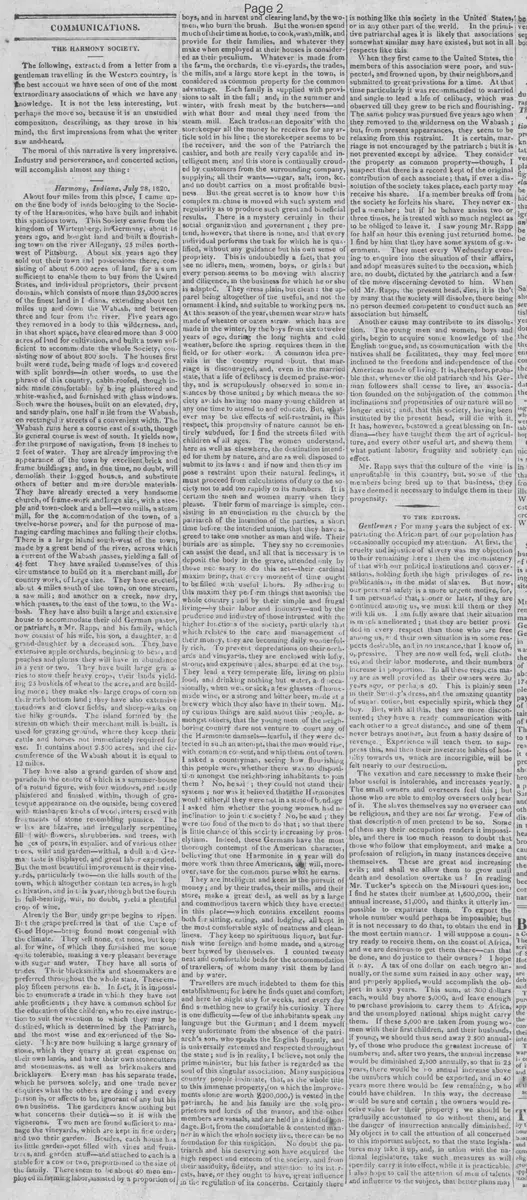
About four miles from this place, I came upon the fine body of lands belonging to the Society of the Harmonites, who have built and inhabit this spacious town. This Society came from the kingdom of Wirtemberg, in Germany, about 16 years ago, and bought land and built a flourishing town on the river Allegany, 25 miles northwest of Pittsburg. About six years ago they sold out their town and possessions there, consisting of about 6000 acres of land, for a sum sufficient to enable them to buy from the United States, and individual proprietors, their present domain, which consists of more than 25,000 acres of the finest land in Indiana, extending about ten miles up and down the Wabash, and between three and four from the river. Five years ago they removed in a body to this wilderness, and, in that short space, have cleared more than 3000 acres of land for cultivation, and built a town sufficient to accommodate the whole Society, consisting now of about 800 souls. The houses first built were rude, being made of logs and covered with split boards—in other words, to use the phrase of this country, cabin-roofed, though inside made comfortable by being plastered and white-washed, and furnished with glass windows. Such were the houses, built on an elevated, dry, and sandy plain, one half mile from the Wabash, on rectangular streets of a convenient width. The Wabash runs here a course east of south, though its general course is west of south. It yields now, for the purpose of navigation, from 18 inches to 2 feet of water. They are already improving the appearance of the town by excellent brick and frame buildings; and, in due time, no doubt, will demolish their logged houses, and substitute others of better and more durable materials. They have already erected a very handsome church, of frame-work and large size, with a steeple and town-clock and a bell—two mills, a steam mill, for the accommodation of the town, of a twelve-horse power, and for the purpose of managing carding machines and fulling their cloths. There is a large island south-west of the town, made by a great bend of the river, across which a current of the Wabash passes, yielding a fall of 4 feet They have availed themselves of this circumstance to build on it a merchant mill, for country work, of large size. They have erected, about 4 miles south of the town, on one stream, a saw mill; and another on a creek, now dry, which passes, to the east of the town, to the Wabash. They have also built a large and extensive house to accommodate their old German pastor, or patriarch, a Mr. Rapp, and his family, which now consist of his wife, his son, a daughter, and grand-daughter by a deceased son. They have extensive apple orchards, beginning to bear, and peaches and plums they will have in abundance in a year or two. They have built large granaries to stow their heavy crops, their lands yielding 25 bushels of wheat to the acre, and are building more; they make also large crops of corn on their rich bottom land; they have also extensive meadows and clover fields, and sheep-walks on the hilly grounds. The island formed by the stream on which their merchant mill is built, is used for grazing ground, where they keep their cattle and horses not immediately required for use. It contains about 2500 acres, and the circumference of the Wabash about it is equal to 12 miles. They have also a grand garden of show and parade, in the centre of which is a summer-house of a rotund figure, with four windows, and neatly plastered and finished within, though of grotesque appearance on the outside, being covered with misshapen knobs of wood, interspersed with fragments of stone resembling pumice. The walks are bizarre, and irregularly serpentine, filled with flowers, shrubberies, and trees, with hedges of pears, in espalier, and of various other trees, wild and garden—withal, a dull and German taste is displayed, and great labor expended. But the most beautiful improvement is their vineyards, particularly two—on the hills south of the town, which altogether contain ten acres, in high cultivation, and this year, though but the fourth in full-bearing, will, no doubt, yield a plentiful crop of wine. Already the Burgundy grape begins to ripen. But the grape preferred is that of the Cape of Good Hope—being found most congenial with the climate. They sell none, eat none, but keep all for wine, of which they furnished me some quite tolerable, making a very pleasant beverage with sugar and water. They have all sorts of trades. Their blacksmiths and shoemakers are preferred throughout the whole state. They employ fifteen persons each. In fact, it is impossible to enumerate a trade in which they have not able proficients; they have a common school for the education of the children, who receive instruction to suit the vocation to which they may be destined, which is determined by the Patriarch, and the most wise and experienced of the Society. They are now building a large granary of stone, which they quarry at great expense on their own lands, and have their own stonecutters and stonemasons, as well as brickmakers and bricklayers. Every man has his separate trade, which he pursues solely, and one trade never enquires what the others are doing; and every person is, or affects to be, ignorant of any but his own business. The gardeners know nothing but what concerns their duties—so it is with the vignerons. Two men are found sufficient to manage the vineyards, which are kept in fine order; and two their garden. Besides, each house has its little garden-spot filled with vines and fruit-trees, and garden stuff—and attached to each is a stable for a cow or two, proportioned to the size of the family. There seem to be about 40 men employed in farming labor, assisted by a proportion of boys, and in harvest and clearing land, by the women, who burn the brush. But the women spend much of their time at home, to cook, wash, milk, and provide for their families, and whatever they make when employed at their houses is considered as their peculium. Whatever is made from the farm, the orchards, the vineyards, the trades, the mills, and a large store kept in the town, is considered as common property for the common advantage. Each family is supplied with provisions to salt in the fall; and, in the summer and winter, with fresh meat by the butchers—and with what flour and meal they need from the steam mill. Each tradesman deposits with the storekeeper all the money he receives for any article sold in his line; the storekeeper seems to be the receiver, and the son of the Patriarch the cashier, and both are really very capable and intelligent men; and this store is continually crowded by customers from the surrounding country, supplying all their wants—sugar, salt, iron, &c. and no doubt carries on a most profitable business. But the great secret is to know how this complex machine is moved with such system and regularity as to produce such great and beneficial results. There is a mystery certainly in their social organization and government; they pretend, however, that there is none, and that every individual performs the task for which he is qualified, without any guidance but his own sense of propriety. This is undoubtedly a fact, that you see no idlers, men, women, boys, or girls: but every person seems to be moving with alacrity and diligence, in the business for which he or she is adapted. They dress plain, but clean: the apparel being altogether of the useful, and not the ornamental kind, and suitable to working persons. At this season of the year, the men wear straw hats made of wheaten or oaten straw, which hats are made in the winter, by the boys from six to twelve years of age, during the long nights and cold weather, before the spring requires them in the field, or for other work. A common idea prevails in the country round about, that marriage is discouraged, and, even in the married state, that a life of celibacy is deemed praiseworthy, and is scrupulously observed in some instances by those united; by which means the society avoids having too many young children at any one time to attend to and educate. But, whatever may be the effects of self-restraint, in this respect, this propensity of nature cannot be entirely subdued, for I find the streets filled with children of all ages. The women understand, here as well as elsewhere, the destination intended for them by nature, and are as well disposed to submit to its laws: and if now and then they impose a restraint upon their natural feelings, it must proceed from calculations of duty to the society not to add too rapidly to its numbers. It is certain the men and women marry when they please. Their form of marriage is simple, consisting in an enunciation in the church by the patriarch of the intention of the parties, a short time before the intended union, that they have agreed to take one another as man and wife. Their burials are as simple. They say no ceremonies can assist the dead, and all that is necessary is to deposit the body in the grave, attended only by those necessary to do this act—their cardinal maxim being, that every moment of time ought to be filled with useful labors. By adhering to this maxim they perform things that astonish the whole country; and by their simple and frugal living—by their labor and industry—and by the prudence and industry of those intrusted with the higher functions of the society, particularly that which relates to the care and management of their money, they are becoming daily wonderfully rich. To prevent depredations on their orchards and vineyards, they are enclosed with lofty, strong, and expensive pales, sharpened at the top. They lead a very temperate life, living on plain food, and drinking nothing but water, and occasionally, when wet, or sick, a few glasses of home-made wine, or a strong and bitter beer, made at a brewery which they also have in their town. Many curious things are said about this people, amongst others, that the young men of the neighboring country dare not venture to court any of the Harmonite damsels——fearful, if they were detected in such an attempt, that the men would rise, with common consent, and whip them out of town. I asked a countryman, seeing how flourishing this people were, whether there was no disposition amongst the neighboring inhabitants to join them? No, he said; they could not stand their system; nor was it believed that the Harmonites would either, if they were not in a state of bondage I asked him whether the young women had no inclination to join the society? No, he said; they were too fond of the men to do that; so that there is little chance of this society increasing by proselytism. Indeed, these Germans have the most thorough contempt of the American character, believing that one Harmonite in a year will do more work than three Americans, and will, moreover, save for the common purse what he earns. They are intelligent and keen in the pursuit of money; and by their trades, their mills, and their store, make a great deal, as well as by a large and commodious tavern which they have erected in this place—which contains excellent rooms both for sitting, eating, and lodging, all kept in the most comfortable style of neatness and cleanliness. They keep no spirituous liquor, but furnish wine foreign and home made, and a strong beer brewed by themselves. I counted twenty neat and comfortable beds for the accommodation of travellers, of whom many visit them by land and by water. Travellers are much indebted to them for this establishment; for here he finds quiet and comfort; and here he might stay for weeks, and every day find something new to gratify his curiosity There is one difficulty—few of the inhabitants speak any language but the German; and I deem myself very unfortunate from the absence of the patriarch's son, who speaks the English fluently, and is universally esteemed and respected throughout the state: and is in reality, I believe, not only the prime minister, but his father is regarded as the soul of this singular association. Many suspicious country people insinuate, that, as the whole title to this immense property, (on which the improvements alone are worth 200,000,) is vested in the patriarch, he and his family are the sole proprietors and lords of the manor, and the other members are vassals, and are held in a kind of bondage. But, from the comfortable & contented manner in which the whole society live, there can be no foundation for this suspicion. No doubt the patriarch and his deserving son have acquired the high respect and esteem of the society, and from their assiduity, fidelity, and attention to its interests, have, or they ought to have, great influence in the regulation of its concerns. Certainly there is nothing like this society in the United States, or in any other part of the world. In the primitive patriarchal ages it is likely that associations somewhat similar may have existed, but not in all respects like this. When they first came to the United States, the members of this association were poor, and suspected, and frowned upon, by their neighbors, and submitted to great privations for a time. At that time particularly it was recommended to married and single to lead a life of celibacy, which was observed till they grew to be rich and flourishing. The same policy was pursued five years ago when they removed to the wilderness on the Wabash; but, from present appearances, they seem to be relaxing from this restraint. It is certain, marriage is not encouraged by the patriarch; but it is not prevented except by advice. They consider the property as common property—though, I suspect that there is a record kept of the original contribution of each associate: that, if ever a dissolution of the society takes place, each party may receive his share. If a member breaks off from the society he forfeits his share. They never expel a member; but if he behave amiss two or three times, he is treated with so much neglect as to be obliged to leave it. I saw young Mr. Rapp for half an hour this evening just returned home. I find by him that they have some system of government. They meet every Wednesday evening to enquire into the situation of their affairs, and adopt measures suited to the occasion, which are, no doubt, dictated by the patriarch and a few of the more discerning devoted to him. When old Mr. Rapp, the present head, dies, it is tho't by many that the society will dissolve, there being no person deemed competent to conduct such an association but himself. Another cause may contribute to its dissolution. The young men and women, boys and girls, begin to acquire some knowledge of the English tongue, and, as communication with the natives shall be facilitated, they may feel more inclined to the freedom and independence of the American mode of living. It is, therefore, probable that, whenever the old patriarch and his German followers shall cease to live, an association founded on the subjugation of the common inclinations and propensities of our nature will no longer exist; and, that this society, having been instituted by the present head, will die with it. It has, however, bestowed a great blessing on Indiana—they have taught them the art of agriculture, and every other useful art, and shewn them what patient labour, frugality and sobriety can effect. Mr. Rapp says that the culture of the vine is unprofitable in this country, but, some of the members being bred up to that business, they have deemed it necessary to indulge them in their propensity.
THE HARMONY SOCIETY.
The following, extracted from a letter from a gentleman travelling in the Western country, is the best account we have seen of one of the most extraordinary associations of which we have any knowledge. It is not the less interesting, but perhaps the more so, because it is an unstudied composition, describing, as they arose in his mind, the first impressions from what the writer saw and heard.
The moral of this narrative is very impressive. Industry and perseverance, and concerted action, will accomplish almost any thing:
Harmony, Indiana, July 28, 1820.
About four miles from this place, I came upon the fine body of lands belonging to the Society of the Harmonites, who have built and inhabit this spacious town. This Society came from the kingdom of Wirtemberg, in Germany, about 16 years ago, and bought land and built a flourishing town on the river Allegany, 25 miles northwest of Pittsburg. About six years ago they sold out their town and possessions there, consisting of about 6000 acres of land, for a sum sufficient to enable them to buy from the United States, and individual proprietors, their present domain, which consists of more than 25,000 acres of the finest land in Indiana, extending about ten miles up and down the Wabash, and between three and four from the river. Five years ago they removed in a body to this wilderness, and, in that short space, have cleared more than 3000 acres of land for cultivation, and built a town sufficient to accommodate the whole Society, consisting now of about 800 souls. The houses first built were rude, being made of logs and covered with split boards—in other words, to use the phrase of this country, cabin-roofed, though inside made comfortable by being plastered and white-washed, and furnished with glass windows. Such were the houses, built on an elevated, dry, and sandy plain, one half mile from the Wabash, on rectangular streets of a convenient width. The Wabash runs here a course east of south, though its general course is west of south. It yields now, for the purpose of navigation, from 18 inches to 2 feet of water. They are already improving the appearance of the town by excellent brick and frame buildings; and, in due time, no doubt, will demolish their logged houses, and substitute others of better and more durable materials. They have already erected a very handsome church, of frame-work and large size, with a steeple and town-clock and a bell—two mills, a steam mill, for the accommodation of the town, of a twelve-horse power, and for the purpose of managing carding machines and fulling their cloths. There is a large island south-west of the town, made by a great bend of the river, across which a current of the Wabash passes, yielding a fall of 4 feet They have availed themselves of this circumstance to build on it a merchant mill, for country work, of large size. They have erected, about 4 miles south of the town, on one stream, a saw mill; and another on a creek, now dry, which passes, to the east of the town, to the Wabash. They have also built a large and extensive house to accommodate their old German pastor, or patriarch, a Mr. Rapp, and his family, which now consist of his wife, his son, a daughter, and grand-daughter by a deceased son. They have extensive apple orchards, beginning to bear, and peaches and plums they will have in abundance in a year or two. They have built large granaries to stow their heavy crops, their lands yielding 25 bushels of wheat to the acre, and are building more; they make also large crops of corn on their rich bottom land; they have also extensive meadows and clover fields, and sheep-walks on the hilly grounds. The island formed by the stream on which their merchant mill is built, is used for grazing ground, where they keep their cattle and horses not immediately required for use. It contains about 2500 acres, and the circumference of the Wabash about it is equal to 12 miles. They have also a grand garden of show and parade, in the centre of which is a summer-house of a rotund figure, with four windows, and neatly plastered and finished within, though of grotesque appearance on the outside, being covered with misshapen knobs of wood, interspersed with fragments of stone resembling pumice. The walks are bizarre, and irregularly serpentine, filled with flowers, shrubberies, and trees, with hedges of pears, in espalier, and of various other trees, wild and garden—withal, a dull and German taste is displayed, and great labor expended. But the most beautiful improvement is their vineyards, particularly two—on the hills south of the town, which altogether contain ten acres, in high cultivation, and this year, though but the fourth in full-bearing, will, no doubt, yield a plentiful crop of wine. Already the Burgundy grape begins to ripen. But the grape preferred is that of the Cape of Good Hope—being found most congenial with the climate. They sell none, eat none, but keep all for wine, of which they furnished me some quite tolerable, making a very pleasant beverage with sugar and water. They have all sorts of trades. Their blacksmiths and shoemakers are preferred throughout the whole state. They employ fifteen persons each. In fact, it is impossible to enumerate a trade in which they have not able proficients; they have a common school for the education of the children, who receive instruction to suit the vocation to which they may be destined, which is determined by the Patriarch, and the most wise and experienced of the Society. They are now building a large granary of stone, which they quarry at great expense on their own lands, and have their own stonecutters and stonemasons, as well as brickmakers and bricklayers. Every man has his separate trade, which he pursues solely, and one trade never enquires what the others are doing; and every person is, or affects to be, ignorant of any but his own business. The gardeners know nothing but what concerns their duties—so it is with the vignerons. Two men are found sufficient to manage the vineyards, which are kept in fine order; and two their garden. Besides, each house has its little garden-spot filled with vines and fruit-trees, and garden stuff—and attached to each is a stable for a cow or two, proportioned to the size of the family. There seem to be about 40 men employed in farming labor, assisted by a proportion of boys, and in harvest and clearing land, by the women, who burn the brush. But the women spend much of their time at home, to cook, wash, milk, and provide for their families, and whatever they make when employed at their houses is considered as their peculium. Whatever is made from the farm, the orchards, the vineyards, the trades, the mills, and a large store kept in the town, is considered as common property for the common advantage. Each family is supplied with provisions to salt in the fall; and, in the summer and winter, with fresh meat by the butchers—and with what flour and meal they need from the steam mill. Each tradesman deposits with the storekeeper all the money he receives for any article sold in his line; the storekeeper seems to be the receiver, and the son of the Patriarch the cashier, and both are really very capable and intelligent men; and this store is continually crowded by customers from the surrounding country, supplying all their wants—sugar, salt, iron, &c. and no doubt carries on a most profitable business. But the great secret is to know how this complex machine is moved with such system and regularity as to produce such great and beneficial results. There is a mystery certainly in their social organization and government; they pretend, however, that there is none, and that every individual performs the task for which he is qualified, without any guidance but his own sense of propriety. This is undoubtedly a fact, that you see no idlers, men, women, boys, or girls: but every person seems to be moving with alacrity and diligence, in the business for which he or she is adapted. They dress plain, but clean: the apparel being altogether of the useful, and not the ornamental kind, and suitable to working persons. At this season of the year, the men wear straw hats made of wheaten or oaten straw, which hats are made in the winter, by the boys from six to twelve years of age, during the long nights and cold weather, before the spring requires them in the field, or for other work. A common idea prevails in the country round about, that marriage is discouraged, and, even in the married state, that a life of celibacy is deemed praiseworthy, and is scrupulously observed in some instances by those united; by which means the society avoids having too many young children at any one time to attend to and educate. But, whatever may be the effects of self-restraint, in this respect, this propensity of nature cannot be entirely subdued, for I find the streets filled with children of all ages. The women understand, here as well as elsewhere, the destination intended for them by nature, and are as well disposed to submit to its laws: and if now and then they impose a restraint upon their natural feelings, it must proceed from calculations of duty to the society not to add too rapidly to its numbers. It is certain the men and women marry when they please. Their form of marriage is simple, consisting in an enunciation in the church by the patriarch of the intention of the parties, a short time before the intended union, that they have agreed to take one another as man and wife. Their burials are as simple. They say no ceremonies can assist the dead, and all that is necessary is to deposit the body in the grave, attended only by those necessary to do this act—their cardinal maxim being, that every moment of time ought to be filled with useful labors. By adhering to this maxim they perform things that astonish the whole country; and by their simple and frugal living—by their labor and industry—and by the prudence and industry of those intrusted with the higher functions of the society, particularly that which relates to the care and management of their money, they are becoming daily wonderfully rich. To prevent depredations on their orchards and vineyards, they are enclosed with lofty, strong, and expensive pales, sharpened at the top. They lead a very temperate life, living on plain food, and drinking nothing but water, and occasionally, when wet, or sick, a few glasses of home-made wine, or a strong and bitter beer, made at a brewery which they also have in their town. Many curious things are said about this people, amongst others, that the young men of the neighboring country dare not venture to court any of the Harmonite damsels——fearful, if they were detected in such an attempt, that the men would rise, with common consent, and whip them out of town. I asked a countryman, seeing how flourishing this people were, whether there was no disposition amongst the neighboring inhabitants to join them? No, he said; they could not stand their system; nor was it believed that the Harmonites would either, if they were not in a state of bondage I asked him whether the young women had no inclination to join the society? No, he said; they were too fond of the men to do that; so that there is little chance of this society increasing by proselytism. Indeed, these Germans have the most thorough contempt of the American character, believing that one Harmonite in a year will do more work than three Americans, and will, moreover, save for the common purse what he earns. They are intelligent and keen in the pursuit of money; and by their trades, their mills, and their store, make a great deal, as well as by a large and commodious tavern which they have erected in this place—which contains excellent rooms both for sitting, eating, and lodging, all kept in the most comfortable style of neatness and cleanliness. They keep no spirituous liquor, but furnish wine foreign and home made, and a strong beer brewed by themselves. I counted twenty neat and comfortable beds for the accommodation of travellers, of whom many visit them by land and by water. Travellers are much indebted to them for this establishment; for here he finds quiet and comfort; and here he might stay for weeks, and every day find something new to gratify his curiosity There is one difficulty—few of the inhabitants speak any language but the German; and I deem myself very unfortunate from the absence of the patriarch's son, who speaks the English fluently, and is universally esteemed and respected throughout the state: and is in reality, I believe, not only the prime minister, but his father is regarded as the soul of this singular association. Many suspicious country people insinuate, that, as the whole title to this immense property, (on which the improvements alone are worth 200,000,) is vested in the patriarch, he and his family are the sole proprietors and lords of the manor, and the other members are vassals, and are held in a kind of bondage. But, from the comfortable & contented manner in which the whole society live, there can be no foundation for this suspicion. No doubt the patriarch and his deserving son have acquired the high respect and esteem of the society, and from their assiduity, fidelity, and attention to its interests, have, or they ought to have, great influence in the regulation of its concerns. Certainly there is nothing like this society in the United States, or in any other part of the world. In the primitive patriarchal ages it is likely that associations somewhat similar may have existed, but not in all respects like this. When they first came to the United States, the members of this association were poor, and suspected, and frowned upon, by their neighbors, and submitted to great privations for a time. At that time particularly it was recommended to married and single to lead a life of celibacy, which was observed till they grew to be rich and flourishing. The same policy was pursued five years ago when they removed to the wilderness on the Wabash; but, from present appearances, they seem to be relaxing from this restraint. It is certain, marriage is not encouraged by the patriarch; but it is not prevented except by advice. They consider the property as common property—though, I suspect that there is a record kept of the original contribution of each associate: that, if ever a dissolution of the society takes place, each party may receive his share. If a member breaks off from the society he forfeits his share. They never expel a member; but if he behave amiss two or three times, he is treated with so much neglect as to be obliged to leave it. I saw young Mr. Rapp for half an hour this evening just returned home. I find by him that they have some system of government. They meet every Wednesday evening to enquire into the situation of their affairs, and adopt measures suited to the occasion, which are, no doubt, dictated by the patriarch and a few of the more discerning devoted to him. When old Mr. Rapp, the present head, dies, it is tho't by many that the society will dissolve, there being no person deemed competent to conduct such an association but himself. Another cause may contribute to its dissolution. The young men and women, boys and girls, begin to acquire some knowledge of the English tongue, and, as communication with the natives shall be facilitated, they may feel more inclined to the freedom and independence of the American mode of living. It is, therefore, probable that, whenever the old patriarch and his German followers shall cease to live, an association founded on the subjugation of the common inclinations and propensities of our nature will no longer exist; and, that this society, having been instituted by the present head, will die with it. It has, however, bestowed a great blessing on Indiana—they have taught them the art of agriculture, and every other useful art, and shewn them what patient labour, frugality and sobriety can effect. Mr. Rapp says that the culture of the vine is unprofitable in this country, but, some of the members being bred up to that business, they have deemed it necessary to indulge them in their propensity.
What sub-type of article is it?
Historical Event
Curiosity
Extraordinary Event
What themes does it cover?
Triumph
Moral Virtue
Fortune Reversal
What keywords are associated?
Harmony Society
George Rapp
Communal Living
Wabash River
Indiana Settlement
German Immigrants
Industry
Perseverance
What entities or persons were involved?
Mr. Rapp
Young Mr. Rapp
Where did it happen?
Harmony, Indiana, On The Wabash River
Story Details
Key Persons
Mr. Rapp
Young Mr. Rapp
Location
Harmony, Indiana, On The Wabash River
Event Date
July 28, 1820
Story Details
A traveler describes the Harmony Society's migration from Germany to Pennsylvania in 1804, then to Indiana in 1815, where under patriarch Mr. Rapp they cleared over 3000 acres, built a town for 800 members, mills, vineyards, and achieved prosperity through communal industry, frugality, and simple living.