Thank you for visiting SNEWPapers!
Sign up free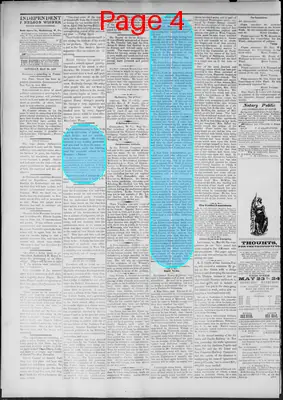
Story
May 21, 1887
Martinsburg Independent
Martinsburg, Berkeley County, West Virginia
What is this article about?
Andrew Carnegie refuses to support a New York celebration of Queen Victoria's Jubilee, emphasizing his American citizenship and republican values in a letter dated May 5, 1887, criticizing monarchy and urging loyalty to the U.S.
Clipping
OCR Quality
95%
Excellent
Full Text
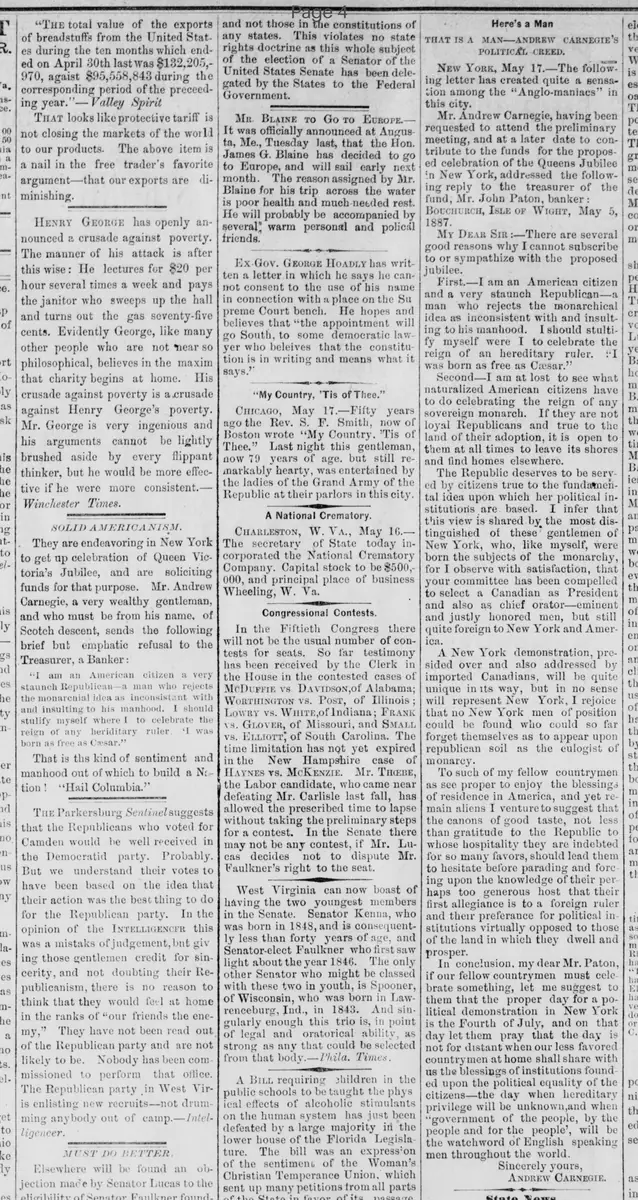
SOLID AMERICANISM.
They are endeavoring in New York to get up celebration of Queen Victoria's Jubilee, and are soliciting funds for that purpose. Mr. Andrew Carnegie, a very wealthy gentleman, and who must be from his name, of Scotch descent, sends the following brief but emphatic refusal to the Treasurer, a Banker:
“I am an American citizen a very staunch Republican-a man who rejects the monarchical idea as inconsistent with and insulting to his manhood. I should stultify myself were I to celebrate the reign of any hereditary ruler. 'I was born as free as Caesar.'"
That is the kind of sentiment and manhood out of which to build a Nation!
“Hail Columbia.”
Here's a Man THAT IS A MAN-ANDREW CARNEGIE'S POLITICAL CREED.
New York, May 17. The following letter has created quite a sensation among the "Anglo-maniacs" in this city.
Mr. Andrew Carnegie, having been requested to attend the preliminary meeting, and at a later date to contribute to the funds for the proposed celebration of the Queens Jubilee in New York, addressed the following reply to the treasurer of the fund, Mr. John Paton, banker :
Bourne Church, Isle of Wight, May 5, 1887.
My DEAR SIR: There are several good reasons why I cannot subscribe to or sympathize with the proposed jubilee.
First. I am an American citizen and a very staunch Republican-a man who rejects the monarchical idea as inconsistent with and insulting to his manhood. I should stultify myself were I to celebrate the reign of an hereditary ruler. :"I was born as free as Caesar."
Second—I am at a loss to see what naturalized American citizens have to do celebrating the reign of any sovereign monarch. If they are not loyal Republicans and true to the land of their adoption, it is open to them at all times to leave its shores and find homes elsewhere.
The Republic deserves to be served by citizens true to the fundamental idea upon which her political institutions are based. I infer that this view is shared by the most distinguished of these gentlemen of New York, who, like myself, were born the subjects of the monarchy, for I observe with satisfaction, that your committee has been compelled to select a Canadian as President and also as chief orator-eminent and justly honored men, but still quite foreign to New York and America.
A New York demonstration, presided over and also addressed by imported Canadians, will be quite unique in its way, but in no sense will represent New York, I rejoice that no New York men of position could be found who could so far forget themselves as to appear upon republican soil as the eulogist of monarchy.
To such of my fellow countrymen as see proper to enjoy the blessings of residence in America, and yet remain aliens I venture to suggest that the canons of good taste, not less than gratitude to the Republic to whose hospitality they are indebted for so many favors, should lead them to hesitate before parading and forcing upon the knowledge of their perhaps too generous host that their first allegiance is to a foreign ruler and their preference for political institutions virtually opposed to those of the land in which they dwell and prosper.
In conclusion, my dear Mr. Paton, if our fellow countrymen must celebrate something, let me suggest to them that the proper day for a political demonstration in New York is the Fourth of July, and on that day let them pray that the day is not far distant when our less favored countrymen at home shall share with us the blessings of institutions founded upon the political equality of the citizens— the day when hereditary privilege will be unknown, and when "government of the people, by the people and for the people", will be the watchword of English speaking men throughout the world.
Sincerely yours,
ANDREW CARNEGIE.
They are endeavoring in New York to get up celebration of Queen Victoria's Jubilee, and are soliciting funds for that purpose. Mr. Andrew Carnegie, a very wealthy gentleman, and who must be from his name, of Scotch descent, sends the following brief but emphatic refusal to the Treasurer, a Banker:
“I am an American citizen a very staunch Republican-a man who rejects the monarchical idea as inconsistent with and insulting to his manhood. I should stultify myself were I to celebrate the reign of any hereditary ruler. 'I was born as free as Caesar.'"
That is the kind of sentiment and manhood out of which to build a Nation!
“Hail Columbia.”
Here's a Man THAT IS A MAN-ANDREW CARNEGIE'S POLITICAL CREED.
New York, May 17. The following letter has created quite a sensation among the "Anglo-maniacs" in this city.
Mr. Andrew Carnegie, having been requested to attend the preliminary meeting, and at a later date to contribute to the funds for the proposed celebration of the Queens Jubilee in New York, addressed the following reply to the treasurer of the fund, Mr. John Paton, banker :
Bourne Church, Isle of Wight, May 5, 1887.
My DEAR SIR: There are several good reasons why I cannot subscribe to or sympathize with the proposed jubilee.
First. I am an American citizen and a very staunch Republican-a man who rejects the monarchical idea as inconsistent with and insulting to his manhood. I should stultify myself were I to celebrate the reign of an hereditary ruler. :"I was born as free as Caesar."
Second—I am at a loss to see what naturalized American citizens have to do celebrating the reign of any sovereign monarch. If they are not loyal Republicans and true to the land of their adoption, it is open to them at all times to leave its shores and find homes elsewhere.
The Republic deserves to be served by citizens true to the fundamental idea upon which her political institutions are based. I infer that this view is shared by the most distinguished of these gentlemen of New York, who, like myself, were born the subjects of the monarchy, for I observe with satisfaction, that your committee has been compelled to select a Canadian as President and also as chief orator-eminent and justly honored men, but still quite foreign to New York and America.
A New York demonstration, presided over and also addressed by imported Canadians, will be quite unique in its way, but in no sense will represent New York, I rejoice that no New York men of position could be found who could so far forget themselves as to appear upon republican soil as the eulogist of monarchy.
To such of my fellow countrymen as see proper to enjoy the blessings of residence in America, and yet remain aliens I venture to suggest that the canons of good taste, not less than gratitude to the Republic to whose hospitality they are indebted for so many favors, should lead them to hesitate before parading and forcing upon the knowledge of their perhaps too generous host that their first allegiance is to a foreign ruler and their preference for political institutions virtually opposed to those of the land in which they dwell and prosper.
In conclusion, my dear Mr. Paton, if our fellow countrymen must celebrate something, let me suggest to them that the proper day for a political demonstration in New York is the Fourth of July, and on that day let them pray that the day is not far distant when our less favored countrymen at home shall share with us the blessings of institutions founded upon the political equality of the citizens— the day when hereditary privilege will be unknown, and when "government of the people, by the people and for the people", will be the watchword of English speaking men throughout the world.
Sincerely yours,
ANDREW CARNEGIE.
What sub-type of article is it?
Biography
Historical Event
What themes does it cover?
Moral Virtue
Bravery Heroism
What keywords are associated?
Andrew Carnegie
Queen Victoria Jubilee
American Republicanism
Monarchy Criticism
Political Loyalty
What entities or persons were involved?
Andrew Carnegie
Queen Victoria
John Paton
Where did it happen?
New York
Story Details
Key Persons
Andrew Carnegie
Queen Victoria
John Paton
Location
New York
Event Date
May 5, 1887
Story Details
Andrew Carnegie writes a letter refusing to contribute to or attend a New York celebration of Queen Victoria's Jubilee, asserting his republican principles, criticizing monarchy, and advocating loyalty to American institutions over foreign allegiance.