Thank you for visiting SNEWPapers!
Sign up free
Story
February 20, 1903
The Delta Independent
Delta, Delta County, Colorado
What is this article about?
In Denver on Feb. 17, John C. Osgood of the Colorado Fuel and Iron Company argues before a House committee against an eight-hour workday law for miners, asserting it undermines workers' interests, liberty, and economic viability without health justification.
Clipping
OCR Quality
98%
Excellent
Full Text
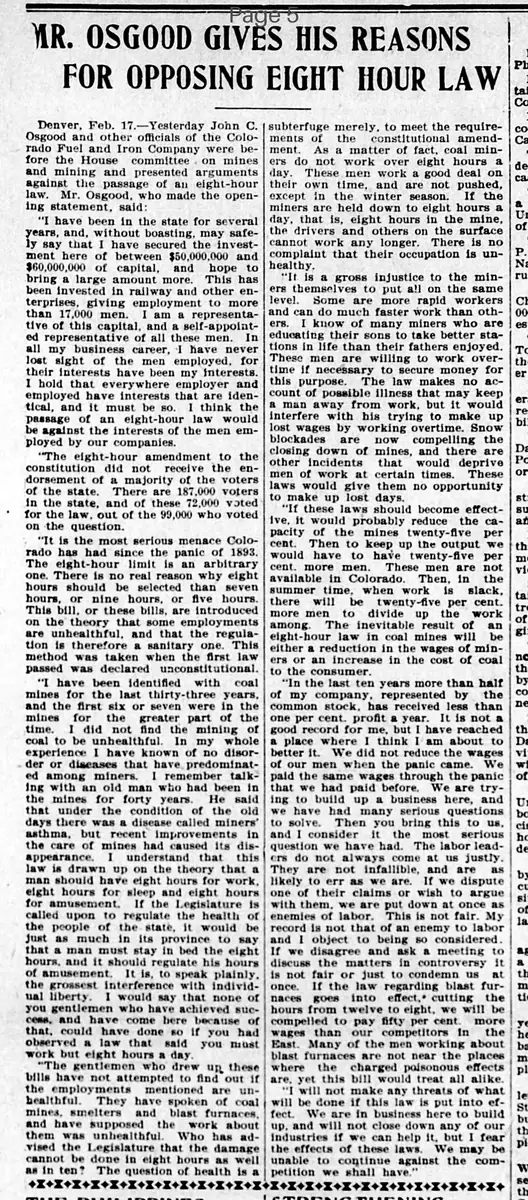
MR. OSGOOD GIVES HIS REASONS FOR OPPOSING EIGHT HOUR LAW
Denver, Feb. 17.—Yesterday John C. Osgood and other officials of the Colorado Fuel and Iron Company were before the House committee on mines and mining and presented arguments against the passage of an eight-hour law. Mr. Osgood, who made the opening statement, said:
"I have been in the state for several years, and, without boasting, may safely say that I have secured the investment here of between $50,000,000 and $60,000,000 of capital, and hope to bring a large amount more. This has been invested in railway and other enterprises, giving employment to more than 17,000 men. I am a representative of this capital, and a self-appointed representative of all these men. In all my business career, I have never lost sight of the men employed, for their interests have been my interests. I hold that everywhere employer and employed have interests that are identical, and it must be so. I think the passage of an eight-hour law would be against the interests of the men employed by our companies.
"The eight-hour amendment to the constitution did not receive the endorsement of a majority of the voters of the state. There are 187,000 voters in the state, and of these 72,000 voted for the law, out of the 99,000 who voted on the question.
"It is the most serious menace Colorado has had since the panic of 1893. The eight-hour limit is an arbitrary one. There is no real reason why eight hours should be selected than seven hours, or nine hours, or five hours. This bill, or these bills, are introduced on the theory that some employments are unhealthful, and that the regulation is therefore a sanitary one. This method was taken when the first law passed was declared unconstitutional.
"I have been identified with coal mines for the last thirty-three years, and the first six or seven were in the mines for the greater part of the time. I did not find the mining of coal to be unhealthful. In my whole experience I have known of no disorder or diseases that have predominated among miners. I remember talking with an old man who had been in the mines for forty years. He said that under the condition of the old days there was a disease called miners' asthma, but recent improvements in the care of mines had caused its disappearance. I understand that this law is drawn up on the theory that a man should have eight hours for work, eight hours for sleep and eight hours for amusement. If the Legislature is called upon to regulate the health of the people of the state, it would be just as much in its province to say that a man must stay in bed the eight hours, and it should regulate his hours of amusement. It is, to speak plainly, the grossest interference with individual liberty. I would say that none of you gentlemen who have achieved success, and have come here because of that, could have done so if you had observed a law that said you must work but eight hours a day.
The gentlemen who drew up these bills have not attempted to find out if the employments mentioned are unhealthful. They have spoken of coal mines, smelters and blast furnaces, and have supposed the work about them was unhealthful. Who has advised the Legislature that the damage cannot be done in eight hours as well as in ten? The question of health is a subterfuge merely, to meet the requirements of the constitutional amendment. As a matter of fact, coal miners do not work over eight hours a day. These men work a good deal on their own time, and are not pushed, except in the winter season. If the miners are held down to eight hours a day, that is, eight hours in the mine, the drivers and others on the surface cannot work any longer. There is no complaint that their occupation is unhealthy.
"It is a gross injustice to the miners themselves to put all on the same level. Some are more rapid workers and can do much faster work than others. I know of many miners who are educating their sons to take better stations in life than their fathers enjoyed. These men are willing to work overtime if necessary to secure money for this purpose. The law makes no account of possible illness that may keep a man away from work, but it would interfere with his trying to make up lost wages by working overtime. Snow blockades are now compelling the closing down of mines, and there are other incidents that would deprive men of work at certain times. These laws would give them no opportunity to make up lost days.
"If these laws should become effective, it would probably reduce the capacity of the mines twenty-five per cent. Then to keep up the output we would have to have twenty-five per cent. more men. These men are not available in Colorado. Then, in the summer time, when work is slack, there will be twenty-five per cent. more men to divide up the work among. The inevitable result of an eight-hour law in coal mines will be either a reduction in the wages of miners or an increase in the cost of coal to the consumer.
"In the last ten years more than half of my company, represented by the common stock, has received less than one per cent. profit a year. It is not a good record for me, but I have reached a place where I think I am about to better it. We did not reduce the wages of our men when the panic came. We paid the same wages through the panic that we had paid before. We are trying to build up a business here, and we have had many serious questions to solve. Then you bring this to us, and I consider it the most serious question we have had. The labor leaders do not always come at us justly. They are not infallible, and are as likely to err as we are. If we dispute one of their claims or wish to argue with them, we are put down at once as enemies of labor. This is not fair. My record is not that of an enemy to labor and I object to being so considered. If we disagree and ask a meeting to discuss the matters in controversy it is not fair or just to condemn us at once. If the law regarding blast furnaces goes into effect, cutting the hours from twelve to eight, we will be compelled to pay fifty per cent. more wages than our competitors in the East. Many of the men working about blast furnaces are not near the places where the charged poisonous effects are, yet this bill would treat all alike.
"I will not make any threats of what will be done if this law is put into effect. We are in business here to build up, and will not close down any of our industries if we can help it, but I fear the effects of these laws. We may be unable to continue against the competition we shall have."
Denver, Feb. 17.—Yesterday John C. Osgood and other officials of the Colorado Fuel and Iron Company were before the House committee on mines and mining and presented arguments against the passage of an eight-hour law. Mr. Osgood, who made the opening statement, said:
"I have been in the state for several years, and, without boasting, may safely say that I have secured the investment here of between $50,000,000 and $60,000,000 of capital, and hope to bring a large amount more. This has been invested in railway and other enterprises, giving employment to more than 17,000 men. I am a representative of this capital, and a self-appointed representative of all these men. In all my business career, I have never lost sight of the men employed, for their interests have been my interests. I hold that everywhere employer and employed have interests that are identical, and it must be so. I think the passage of an eight-hour law would be against the interests of the men employed by our companies.
"The eight-hour amendment to the constitution did not receive the endorsement of a majority of the voters of the state. There are 187,000 voters in the state, and of these 72,000 voted for the law, out of the 99,000 who voted on the question.
"It is the most serious menace Colorado has had since the panic of 1893. The eight-hour limit is an arbitrary one. There is no real reason why eight hours should be selected than seven hours, or nine hours, or five hours. This bill, or these bills, are introduced on the theory that some employments are unhealthful, and that the regulation is therefore a sanitary one. This method was taken when the first law passed was declared unconstitutional.
"I have been identified with coal mines for the last thirty-three years, and the first six or seven were in the mines for the greater part of the time. I did not find the mining of coal to be unhealthful. In my whole experience I have known of no disorder or diseases that have predominated among miners. I remember talking with an old man who had been in the mines for forty years. He said that under the condition of the old days there was a disease called miners' asthma, but recent improvements in the care of mines had caused its disappearance. I understand that this law is drawn up on the theory that a man should have eight hours for work, eight hours for sleep and eight hours for amusement. If the Legislature is called upon to regulate the health of the people of the state, it would be just as much in its province to say that a man must stay in bed the eight hours, and it should regulate his hours of amusement. It is, to speak plainly, the grossest interference with individual liberty. I would say that none of you gentlemen who have achieved success, and have come here because of that, could have done so if you had observed a law that said you must work but eight hours a day.
The gentlemen who drew up these bills have not attempted to find out if the employments mentioned are unhealthful. They have spoken of coal mines, smelters and blast furnaces, and have supposed the work about them was unhealthful. Who has advised the Legislature that the damage cannot be done in eight hours as well as in ten? The question of health is a subterfuge merely, to meet the requirements of the constitutional amendment. As a matter of fact, coal miners do not work over eight hours a day. These men work a good deal on their own time, and are not pushed, except in the winter season. If the miners are held down to eight hours a day, that is, eight hours in the mine, the drivers and others on the surface cannot work any longer. There is no complaint that their occupation is unhealthy.
"It is a gross injustice to the miners themselves to put all on the same level. Some are more rapid workers and can do much faster work than others. I know of many miners who are educating their sons to take better stations in life than their fathers enjoyed. These men are willing to work overtime if necessary to secure money for this purpose. The law makes no account of possible illness that may keep a man away from work, but it would interfere with his trying to make up lost wages by working overtime. Snow blockades are now compelling the closing down of mines, and there are other incidents that would deprive men of work at certain times. These laws would give them no opportunity to make up lost days.
"If these laws should become effective, it would probably reduce the capacity of the mines twenty-five per cent. Then to keep up the output we would have to have twenty-five per cent. more men. These men are not available in Colorado. Then, in the summer time, when work is slack, there will be twenty-five per cent. more men to divide up the work among. The inevitable result of an eight-hour law in coal mines will be either a reduction in the wages of miners or an increase in the cost of coal to the consumer.
"In the last ten years more than half of my company, represented by the common stock, has received less than one per cent. profit a year. It is not a good record for me, but I have reached a place where I think I am about to better it. We did not reduce the wages of our men when the panic came. We paid the same wages through the panic that we had paid before. We are trying to build up a business here, and we have had many serious questions to solve. Then you bring this to us, and I consider it the most serious question we have had. The labor leaders do not always come at us justly. They are not infallible, and are as likely to err as we are. If we dispute one of their claims or wish to argue with them, we are put down at once as enemies of labor. This is not fair. My record is not that of an enemy to labor and I object to being so considered. If we disagree and ask a meeting to discuss the matters in controversy it is not fair or just to condemn us at once. If the law regarding blast furnaces goes into effect, cutting the hours from twelve to eight, we will be compelled to pay fifty per cent. more wages than our competitors in the East. Many of the men working about blast furnaces are not near the places where the charged poisonous effects are, yet this bill would treat all alike.
"I will not make any threats of what will be done if this law is put into effect. We are in business here to build up, and will not close down any of our industries if we can help it, but I fear the effects of these laws. We may be unable to continue against the competition we shall have."
What sub-type of article is it?
Historical Event
What themes does it cover?
Justice
Moral Virtue
What keywords are associated?
Eight Hour Law
Coal Mining
Labor Opposition
John Osgood
Colorado Fuel And Iron Company
What entities or persons were involved?
John C. Osgood
Where did it happen?
Denver, Colorado
Story Details
Key Persons
John C. Osgood
Location
Denver, Colorado
Event Date
Feb. 17
Story Details
John C. Osgood presents arguments against the eight-hour law before the House committee on mines and mining, claiming it interferes with individual liberty, is not based on health concerns, would reduce mine capacity and wages, and harm business competitiveness.