Thank you for visiting SNEWPapers!
Sign up free
Gazette Of The United States And Daily Evening Advertiser
Philadelphia, Philadelphia County, Pennsylvania
What is this article about?
On November 27, 1794, the U.S. House of Representatives debated Mr. Dayton's motion to restore criticism of 'self-created societies' in their response to the President's speech. Speakers including Rutherford, Baldwin, and Madison opposed it, arguing against undue importance to the societies, procedural innovations, and potential overreach beyond legal bounds.
Clipping
OCR Quality
Full Text
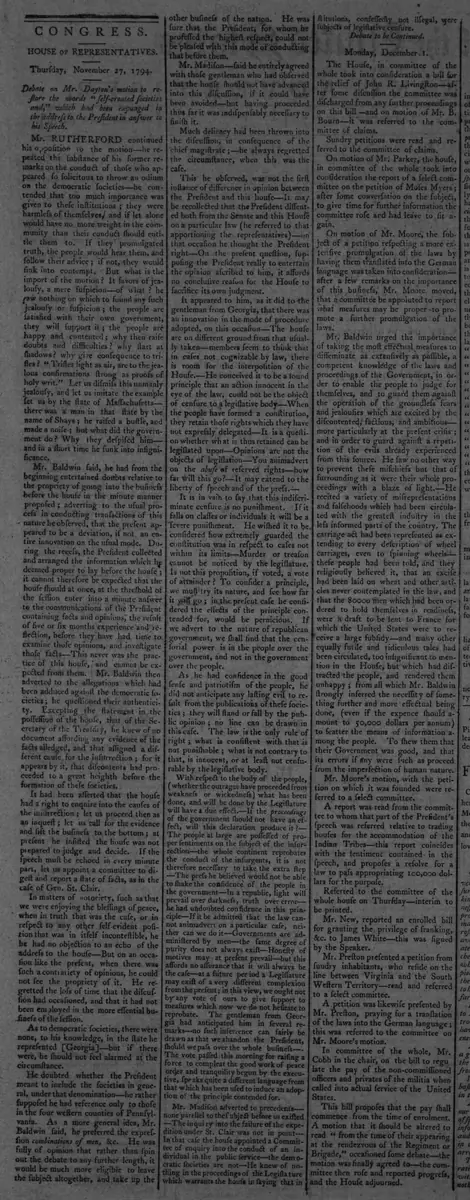
HOUSE OF REPRESENTATIVES.
Thursday, November 27, 1794.
Debate on Mr. Dayton's motion to restore the words "self-created societies and," which had been expunged in the address to the President in answer to his Speech.
Mr. RUTHERFORD continued his opposition to the motion—he repeated the substance of his former remarks on the conduct of those who appeared so solicitous to throw an odium on the democratic societies—he contended that too much importance was given to these institutions; they were harmless of themselves, and if let alone would have no more weight in the community than their conduct should entitle them to. If they promulgated truth, the people would hear them, and follow their advice; if not, they would sink into contempt.—But what is the import of the motion? It savors of jealousy, a mere suspicion—of what? he saw nothing on which to found any such jealousy or suspicion; the people are satisfied with their own government, they will support it; the people are happy and contented; why then raise doubts and difficulties? why start at shadows? why give consequence to trifles? "Trifles light as air, are to the jealous confirmations strong as proofs of holy writ." Let us dismiss this unmanly jealousy, and let us imitate the example set us by the state of Massachusetts—there was a man in that state by the name of Shays; he raised a bustle, and made a noise; but what did the government do? Why they despised him—and in a short time he sunk into insignificance.
Mr. Baldwin said, he had from the beginning entertained doubts relative to the propriety of going into the business before the house in the minute manner proposed; adverting to the usual process in conducting transactions of this nature he observed, that the present appeared to be a deviation, if not an entire innovation on the usual mode. During the recess, the President collected and arranged the information which he deemed proper to lay before the house; it cannot therefore be expected that the house should at once, at the threshold of the session enter into a minute answer to the communications of the President containing facts and opinions, the result of five or six months experience and reflection, before they have had time to examine those opinions, and investigate those facts—This never was the practice of this house, and cannot be expected from them. Mr. Baldwin then adverted to the allegations which had been adduced against the democratic societies: he questioned their authenticity. Excepting the statement in the possession of the house, that of the Secretary of the Treasury, he knew of no document affording any evidence of the facts alleged, and that assigned a different cause for the insurrection; for it appears by it, that discontents had proceeded to a great height before the formation of these societies.
It had been asserted that the house had a right to enquire into the causes of the insurrection; let us proceed then as an inquest; let us call for the evidence and sift the business to the bottom; at present he insisted the house was not prepared to judge and decide. If the speech must be echoed in every minute part, let us appoint a committee to digest and report a state of facts, as in the case of Gen. St. Clair.
In matters of notoriety, such as that we were enjoying the blessings of peace, when in truth that was the case, or in respect to any other self-evident position that was in itself incontestable, he had no objection to an echo of the address to the house—But on an occasion like the present, when there was such a contrariety of opinions, he could not see the propriety of it. He regretted the loss of time that the discussion had occasioned, and that it had not been employed in the more essential business of the session.
As to democratic societies, there were none, to his knowledge, in the state he represented [Georgia]—but if there were, he should not feel alarmed at the circumstance.
He doubted whether the President meant to include the societies in general, under that denomination—he rather supposed he had reference only to those in the four western counties of Pennsylvania. As a more general idea, Mr. Baldwin said, he preferred the expression combinations of men, &c. He was fully of opinion that rather than spin out the debate to any further length, it would be much more eligible to leave the subject altogether, and take up the other business of the nation. He was sure that the President, for whom he professed the highest respect, could not be pleased with this mode of conducting that before them.
Mr. Madison—said he entirely agreed with those gentlemen who had observed that the house should not have advanced into this discussion, if it could have been avoided—but having proceeded thus far it was indispensably necessary to finish it.
Much delicacy had been thrown into the discussion, in consequence of the chief magistrate;—he always regretted the circumstance, when this was the case.
This he observed, was not the first instance of difference in opinion between the President and this house—It may be recollected that the President dissented both from the Senate and this House on a particular law (he referred to that apportioning the representatives)—on that occasion he thought the President right—On the present question, supposing the President really to entertain the opinion ascribed to him, it affords no conclusive reason for the House to sacrifice its own judgment.
It appeared to him, as it did to the gentleman from Georgia, that there was an innovation in the mode of procedure adopted, on this occasion—The house are on different ground from that usually taken—members seem to think that in cases not cognizable by law, there is room for the interposition of the House.—He conceived it to be a sound principle that an action innocent in the eye of the law, could not be the object of censure to a legislative body—When the people have formed a constitution, they retain those rights which they have not expressly delegated—It is a question whether what is thus retained can be legislated upon—Opinions are not the objects of legislation—You animadvert on the abuse of reserved rights—how far will this go?—It may extend to the liberty of speech and of the press.
It is in vain to say that this indiscriminate censure is no punishment. If it falls on classes or individuals it will be a severe punishment. He wished it to be considered how extremely guarded the constitution was in respect to cases not within its limits—Murder or treason cannot be noticed by the legislature.
Is not this proposition, if voted, a vote of attainder? To consider a principle, we must try its nature, and see how far it will go; in the present case he considered the effects of the principle contended for, would be pernicious. If we advert to the nature of republican government, we shall find that the censorial power is in the people over the government, and not in the government over the people.
As he had confidence in the good sense and patriotism of the people, he did not anticipate any lasting evil to result from the publications of these societies; they will stand or fall by the public opinion; no line can be drawn in this case. The law is the only rule of right; what is consistent with that is not punishable; what is not contrary to that, is innocent, or at least not censurable by the legislative body.
With respect to the body of the people, (whether the outrages have proceeded from weakness or wickedness) what has been done, and will be done by the Legislature will have a due effect.—If the proceedings of the government should not have an effect, will this declaration produce it?—The people at large are possessed of proper sentiments on the subject of the insurrection—the whole continent reprobates the conduct of the insurgents, it is not therefore necessary to take the extra step—The press he believed would not be able to shake the confidence of the people in the government—In a republic, light will prevail over darkness, truth over error—he had undoubted confidence in this principle—If it be admitted that the law cannot animadvert on a particular case, neither can we do it—Governments are administered by men—the same degree of purity does not always exist—Honesty of motives may at present prevail—but this affords no assurance that it will always be the case—at a future period a Legislature may exist of a very different complexion from the present; in this view, we ought not by any vote of ours to give support to measures which now we do not hesitate to reprobate. The gentleman from Georgia had anticipated him in several remarks—no such inference can fairly be drawn as that we abandon the President, should we pass over the whole business—.
The vote passed this morning for raising a force to complete the good work of peace order and tranquility begun by the executive, speaks quite a different language from that which has been used to induce an adoption of the principle contended for.
Mr. Madison adverted to precedents—none parallel to this subject before us existed—The enquiry into the failure of the expedition under St. Clair was not in point—In that case the house appointed a Committee of enquiry into the conduct of an individual in the public service—the democratic societies are not—He knew of nothing in the proceedings of the Legislature which warranted the house in saying that institutions, confessedly not illegal, were subjects of legislative censure.
Debate to be Continued.
What sub-type of article is it?
What themes does it cover?
What keywords are associated?
What entities or persons were involved?
Where did it happen?
Story Details
Key Persons
Location
U.S. House Of Representatives
Event Date
1794 11 27
Story Details
Debate in the House on restoring criticism of self-created democratic societies in the response to the President's speech addressing the Whiskey Rebellion insurrection. Opponents like Rutherford, Baldwin, and Madison argue against overemphasizing the societies, questioning evidence, procedural norms, and constitutional limits on legislative censure of non-illegal actions.