Thank you for visiting SNEWPapers!
Sign up free
The Madison Daily Leader
Madison, Lake County, South Dakota
What is this article about?
On March 1, the U.S. House debated and passed a compromise Puerto Rico tariff bill with a 15% duty rate, defeating Democratic substitutes and recommit motions. Porto Rican delegates protested the unfair treatment compared to British Trinidad, while the President accepted it due to revenue retention provisions.
Merged-components note: These components provide continued coverage of the Puerto Rico tariff bill debate and passage in Congress, forming a single logical news article.
Clipping
OCR Quality
Full Text
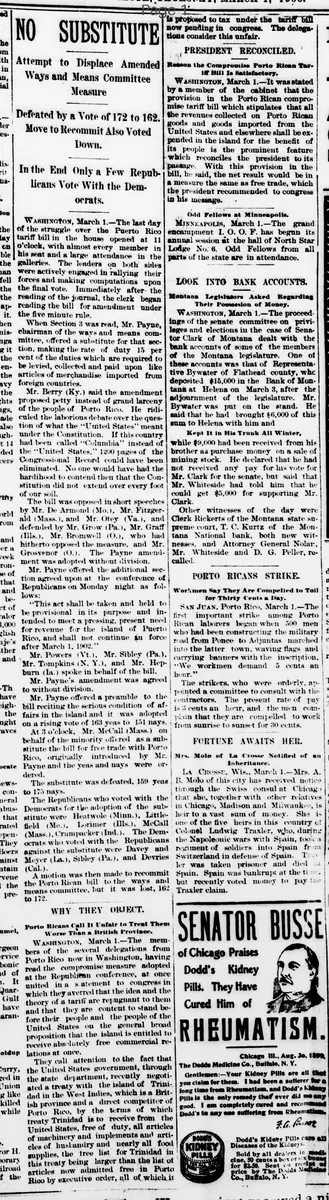
Attempt to Displace Amended Ways and Means Committee Measure Defeated by a Vote of 172 to 162.
Move to Recommit Also Voted Down.
In the End Only a Few Republicans Vote With the Democrats.
Washington, March 1.—The last day of the struggle over the Puerto Rico tariff bill in the house opened at 11 o'clock, with almost every member in his seat and a large attendance in the galleries. The leaders on both sides were actively engaged in rallying their forces and making computations upon the final vote. Immediately after the reading of the journal, the clerk began reading the bill for amendment under the five minute rule.
When Section 3 was read, Mr. Payne, chairman of the ways and means committee, offered a substitute for that section, making the rate of duty 15 per cent of the duties which are required to be levied, collected and paid upon like articles of merchandise imported from foreign countries.
Mr. Berry (Ky.) said the amendment proposed petty instead of grand larceny of the people of Porto Rico. He ridiculed the laborious debate over the question of what the "United States" meant under the Constitution. If this country had been called "Columbia" instead of the "United States," 200 pages of the Congressional Record could have been eliminated. No one would have had the hardihood to contend then that the Constitution did not extend over every foot of our soil.
The bill was opposed in short speeches by Mr. De Armond (Mo.), Mr. Fitzgerald (Mass.), and Mr. Otey (Va.), and defended by Mr. Grow (Pa.), Mr. Graff (Ills.), Mr. Bromwell (O.), who had hitherto opposed the measure, and Mr. Grosvenor (O.). The Payne amendment was adopted without division.
Mr. Payne offered the additional section agreed upon at the conference of Republicans on Monday night as follows:
"This act shall be taken and held to be provisional in its purpose and intended to meet a pressing, present need for revenue for the island of Puerto Rico, and shall not continue in force after March 1, 1902."
Mr. Powers (Vt.), Mr. Sibley (Pa.), Mr. Tompkins (N. Y.), and Mr. Hepburn (Ia.) spoke in behalf of the bill. Mr. Payne's amendment was agreed to without division.
Mr. Payne offered a preamble to the bill reciting the serious condition of affairs in the island and it was adopted on a rising vote of 163 yeas to 151 nays.
At 3 o'clock, Mr. McCall (Mass.) on behalf of the minority offered as a substitute the bill for free trade with Porto Rico, originally introduced by Mr. Payne and the yeas and nays were ordered.
The substitute was defeated, 159 yeas to 175 nays.
The Republicans who voted with the Democrats for the adoption of the substitute were Heatwole (Minn.), Littlefield (Me.), Lorimer (Ills.), McCall (Mass.), Crumpacker (Ind.). The Democrats who voted with the Republicans against the substitute were Davey and Meyer (La.), Sibley (Pa.), and Devries (Cal.).
A motion was then made to recommit the Porto Rican bill to the ways and means committee, but it was lost, 162 to 172.
WHY THEY OBJECT.
Porto Ricans Call It Unfair to Treat Them Worse Than a British Province.
Washington, March 1.—The members of the several delegations from Porto Rico now in Washington, having read the compromise measure adopted at the Republican conference, at once united in a statement to congress in which they averred that the idea and the theory of a tariff are repugnant to them and that they are content to stand before their people and the people of the United States on the general broad proposition that the island is entitled to receive absolutely free commercial relations at once.
They call attention to the fact that the United States government, through the state department, recently negotiated a treaty with the island of Trinidad in the West Indies, which is a British province and a direct competitor of Porto Rico, by the terms of which treaty Trinidad is to receive from the United States, free of duty, all articles of machinery and implements and articles of husbandry and nearly all food supplies, the free list for Trinidad in this treaty being larger than the list of articles now admitted free in Porto Rico by executive order, all of which it is proposed to tax under the tariff bill now pending in congress. The delegations consider this unfair.
PRESIDENT RECONCILED.
Reason the Compromise Porto Rican Tariff Bill Is Satisfactory.
Washington, March 1.—It was stated by a member of the cabinet that the provision in the Porto Rican compromise tariff bill which stipulates that all the revenues collected on Porto Rican goods and goods imported from the United States and elsewhere shall be expended in the island for the benefit of its people is the prominent feature which reconciles the president to its passage. With this provision in the bill, he said, the net result would be in a measure the same as free trade, which the president recommended to congress in his message.
What sub-type of article is it?
What keywords are associated?
What entities or persons were involved?
Where did it happen?
Domestic News Details
Primary Location
Washington
Event Date
March 1
Key Persons
Outcome
payne amendment adopted without division; additional section adopted without division; preamble adopted 163-151; mccall substitute defeated 159-175; motion to recommit lost 162-172. bill provides 15% duty, provisional until march 1, 1902, with revenues to benefit puerto rico.
Event Details
The House debated the Puerto Rico tariff bill, adopting Republican amendments for 15% duties and a provisional clause. Democratic substitute for free trade was defeated, with few cross-party votes. Porto Rican delegates protested the tariff as unfair compared to British Trinidad. A cabinet member noted the President's reconciliation due to revenue retention for the island.