Thank you for visiting SNEWPapers!
Sign up free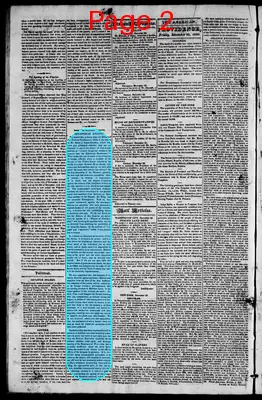
Editorial
December 29, 1820
The Rhode Island American, And General Advertiser
Providence, Providence County, Rhode Island
What is this article about?
The editorial criticizes South Carolina Senator Smith's undignified Senate speeches defending slavery during Missouri debates, his vicious attacks on opponents including editors, and fears it harms U.S. reputation abroad, urging South Carolina to address his poor representation.
Clipping
OCR Quality
98%
Excellent
Full Text
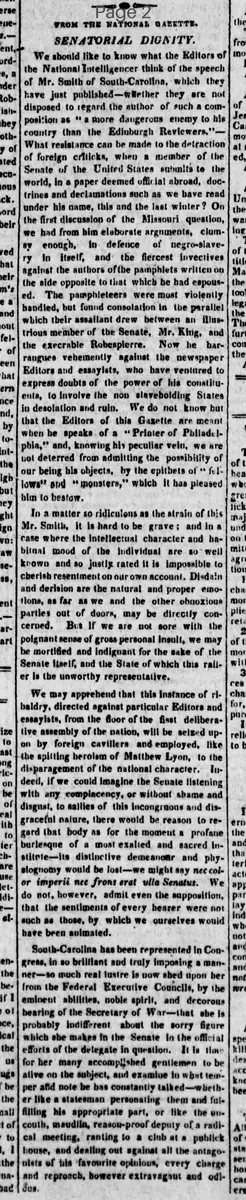
FROM THE NATIONAL GAZETTE.
SENATORIAL DIGNITY.
We should like to know what the Editors of the National Intelligencer think of the speech of Mr. Smith of South-Carolina, which they have just published-Whether they are not disposed to regard the author of such a composition as "a more dangerous enemy to his country than the Edinburgh Reviewers."
What resistance can be made to the detraction of foreign critics, when a member of the Senate of the United States submits to the world, in a paper deemed official abroad, doctrines and declamations such as we have read under his name, this and the last winter? On the first discussion of the Missouri question, we had from him elaborate arguments, clumsy enough, in defence of negro-slavery in itself, and the fiercest invectives against the authors of the pamphlets written on the side opposite to that which he had espoused. The pamphleteers were most violently handled, but found consolation in the parallel which their assailant drew between an illustrious member of the Senate, Mr. King, and the execrable Robespierre. Now he harangues vehemently against the newspaper Editors and essayists, who have ventured to express doubts of the power of his constituents, to involve the non slaveholding States in desolation and ruin. We do not know but that the Editors of this Gazette are meant when he speaks of a "Printer of Philadelphia," and, knowing his peculiar vein, we are not deterred from admitting the possibility of our being his objects, by the epithets of "fellows" and "monsters," which it has pleased him to bestow.
In a matter so ridiculous as the strain of this Mr. Smith, it is hard to be grave; and in a case where the intellectual character and habitual mood of the individual are so well known and so justly rated it is impossible to cherish resentment on our own account. Disdain and derision are the natural and proper emotions, as far as we and the other obnoxious parties out of doors, may be directly concerned. But if we are not sore with the poignant sense of gross personal insult, we may be mortified and indignant for the sake of the Senate itself, and the State of which this railer is the unworthy representative.
We may apprehend that this instance of ribaldry, directed against particular Editors and essayists, from the floor of the first deliberative assembly of the nation, will be seized upon by foreign cavillers and employed, like the spitting heroism of Matthew Lyon, to the disparagement of the national character. Indeed, if we could imagine the Senate listening with any complacency, or without shame and disgust, to sallies of this incongruous and disgraceful nature, there would be reason to regard that body as for the moment a profane burlesque of a most exalted and sacred institution-its distinctive demeanour and physiognomy would be lost-we might say nec color imperii nec frons erat ulla Senatus. We do not, however, admit even the supposition, that the sentiments of every hearer were not such as those, by which we ourselves would have been animated.
South-Carolina has been represented in Congress, in so brilliant and truly imposing a manner-so much real lustre is now shed upon her from the Federal Executive Councils, by the eminent abilities, noble spirit, and decorous bearing of the Secretary of War-that she is probably indifferent about the sorry figure which she makes in the Senate in the official efforts of the delegate in question. It is time for her many accomplished gentlemen to be alive on the subject, and examine in what temper and tone he has constantly talked-whether like a statesman personating them and fulfilling his appropriate part, or like the uncouth, maudlin, reason-proof deputy of a radical meeting, ranting to a club at a publick house, and dealing out against all the antagonists of his favourite opinions, every charge and reproach, however extravagant and odious.
SENATORIAL DIGNITY.
We should like to know what the Editors of the National Intelligencer think of the speech of Mr. Smith of South-Carolina, which they have just published-Whether they are not disposed to regard the author of such a composition as "a more dangerous enemy to his country than the Edinburgh Reviewers."
What resistance can be made to the detraction of foreign critics, when a member of the Senate of the United States submits to the world, in a paper deemed official abroad, doctrines and declamations such as we have read under his name, this and the last winter? On the first discussion of the Missouri question, we had from him elaborate arguments, clumsy enough, in defence of negro-slavery in itself, and the fiercest invectives against the authors of the pamphlets written on the side opposite to that which he had espoused. The pamphleteers were most violently handled, but found consolation in the parallel which their assailant drew between an illustrious member of the Senate, Mr. King, and the execrable Robespierre. Now he harangues vehemently against the newspaper Editors and essayists, who have ventured to express doubts of the power of his constituents, to involve the non slaveholding States in desolation and ruin. We do not know but that the Editors of this Gazette are meant when he speaks of a "Printer of Philadelphia," and, knowing his peculiar vein, we are not deterred from admitting the possibility of our being his objects, by the epithets of "fellows" and "monsters," which it has pleased him to bestow.
In a matter so ridiculous as the strain of this Mr. Smith, it is hard to be grave; and in a case where the intellectual character and habitual mood of the individual are so well known and so justly rated it is impossible to cherish resentment on our own account. Disdain and derision are the natural and proper emotions, as far as we and the other obnoxious parties out of doors, may be directly concerned. But if we are not sore with the poignant sense of gross personal insult, we may be mortified and indignant for the sake of the Senate itself, and the State of which this railer is the unworthy representative.
We may apprehend that this instance of ribaldry, directed against particular Editors and essayists, from the floor of the first deliberative assembly of the nation, will be seized upon by foreign cavillers and employed, like the spitting heroism of Matthew Lyon, to the disparagement of the national character. Indeed, if we could imagine the Senate listening with any complacency, or without shame and disgust, to sallies of this incongruous and disgraceful nature, there would be reason to regard that body as for the moment a profane burlesque of a most exalted and sacred institution-its distinctive demeanour and physiognomy would be lost-we might say nec color imperii nec frons erat ulla Senatus. We do not, however, admit even the supposition, that the sentiments of every hearer were not such as those, by which we ourselves would have been animated.
South-Carolina has been represented in Congress, in so brilliant and truly imposing a manner-so much real lustre is now shed upon her from the Federal Executive Councils, by the eminent abilities, noble spirit, and decorous bearing of the Secretary of War-that she is probably indifferent about the sorry figure which she makes in the Senate in the official efforts of the delegate in question. It is time for her many accomplished gentlemen to be alive on the subject, and examine in what temper and tone he has constantly talked-whether like a statesman personating them and fulfilling his appropriate part, or like the uncouth, maudlin, reason-proof deputy of a radical meeting, ranting to a club at a publick house, and dealing out against all the antagonists of his favourite opinions, every charge and reproach, however extravagant and odious.
What sub-type of article is it?
Slavery Abolition
Partisan Politics
Press Freedom
What keywords are associated?
Senatorial Dignity
Mr Smith
South Carolina
Missouri Question
Negro Slavery
Newspaper Editors
National Character
Senate Misconduct
What entities or persons were involved?
Mr. Smith Of South Carolina
Senate Of The United States
Mr. King
Editors Of The National Intelligencer
Printer Of Philadelphia
South Carolina
Edinburgh Reviewers
Robespierre
Matthew Lyon
Secretary Of War
Editorial Details
Primary Topic
Criticism Of Senator Smith's Undignified Defense Of Slavery And Attacks On Opponents
Stance / Tone
Indignant Disdain And Derision
Key Figures
Mr. Smith Of South Carolina
Senate Of The United States
Mr. King
Editors Of The National Intelligencer
Printer Of Philadelphia
South Carolina
Edinburgh Reviewers
Robespierre
Matthew Lyon
Secretary Of War
Key Arguments
Smith's Speech Defends Negro Slavery With Clumsy Arguments
Smith Uses Fierce Invectives Against Anti Slavery Pamphleteers
Smith Compares Senator King To Robespierre
Smith Harangues Against Newspaper Editors Doubting His Constituents' Power
Smith's Ribaldry Disparages The National Character Abroad
Senate Should Feel Shame For Such Conduct
South Carolina's Representation Suffers From Smith's Maudlin Style