Thank you for visiting SNEWPapers!
Sign up free
Editorial
May 21, 1824
Constitutional Whig
Richmond, Virginia
What is this article about?
Editorial defends Mr. Lowrie in controversy over Gen. Jackson's letter to President Monroe advising against party spirit in cabinet appointments. Critiques Jackson's anti-party views as undermining Republican principles amid his presidential candidacy. Analyzes innocence of Lowrie, Monroe, and implications of Jackson's correspondence.
Clipping
OCR Quality
98%
Excellent
Full Text
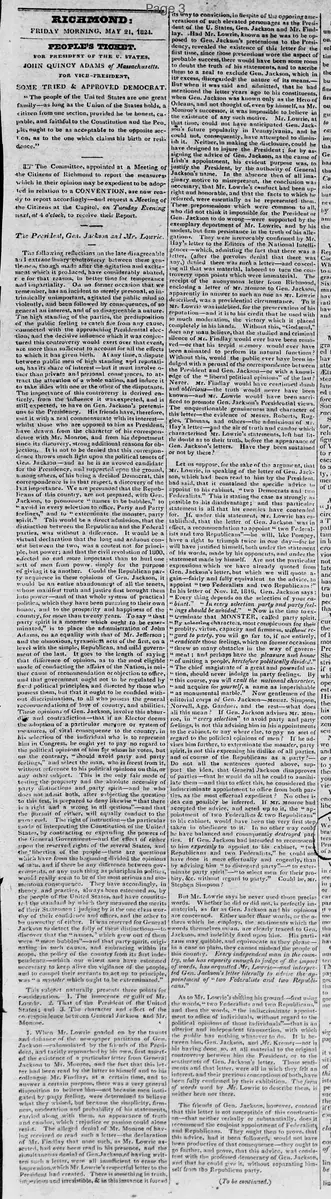
The President, Gen. Jackson and Mr. Lowrie.
The following reflections on the late disagreeable and extraordinary controversy between these gentlemen, though made after the agitation and excitement which it produced, have considerably abated, and for that reason, in better time for temperance and impartiality. On no former occasion that we remember, has an incident so merely personal, so intrinsically unimportant, agitated the public mind so violently, and been followed by consequences, of so general an interest, and of so disagreeable a nature. The high standing of the parties, the predisposition of the public feeling to catch fire from any cause, connected with the approaching Presidential election, and the decisive influence which it was conjectured this controversy would exert over that event, are more than sufficient to account for all the effects to which it has given birth. At any time, a dispute between public men of high standing and reputation, has its share of interest--but it must involve other than private and personal consequences, to attract the attention of a whole nation, and induce it to take sides with one or the other of the disputants. The importance of this controversy is derived entirely, from the influence it was expected, and is still expected, to have on Gen. Jackson's pretensions to the Presidency. His friends have, therefore, met it with a zeal commensurate with its interest-- whilst those who are opposed to him as President, have drawn from the character of his correspondence with Mr. Monroe, and from his deportment since its discovery, strong additional reasons for objection. It is not to be denied that this correspondence throws much light upon the political tenets of Gen. Jackson--and as he is an avowed candidate for the Presidency, and supported upon the ground, among others, of his being a decided Democrat, this correspondence is in that respect, a discovery of the first importance. We are persuaded that the Republicans of this country, are not prepared, with Gen. Jackson, to pronounce "names to be bubbles," to "avoid in every selection to office, Party and Party feelings," and to "exterminate the monster, party spirit." This would be a direct admission, that the distinction between the Republican and the Federal parties, was without a difference. It would be a virtual declaration that the long and arduous contest between the two, was a contest not for principle, but power; and that the civil revolution of 1800, effected no end more important than to hurl one set of men from power, simply for the purpose of giving it to another. Could the Republican party acquiesce in these opinions of Gen. Jackson, it would be an entire abandonment of all the tenets, whose manifest truth and justice first brought them into power--and of that whole system of practical politics, which they have been pursuing to their own honor, and to the prosperity and happiness of the country, for more than twenty years. To say "that party spirit is a monster which ought to be exterminated," is to place the administration of John Adams, on an equality with that of Mr. Jefferson; and the obnoxious, tyrannical acts of the first, on a level with the simple, Republican, and mild government of the last. It goes to the length of saying that difference of opinion, as to the most eligible mode of conducting the affairs of the Nation, is neither cause of recommendation or objection to office, and that government ought not to be regulated by fixed political principles, and directed by those who possess them, but that it ought to be confided without discrimination, to all who possess the general recommendations of love of country, and abilities. These opinions of Gen. Jackson, involve this absurdity and contradiction--that if an Elector deems the adoption of a particular measure or system of measures, of vital consequence to the country, in his selection of the individual who is to represent him in Congress, he ought yet to pay no regard to the political opinions of him for whom he votes, but on the contrary, "should avoid party and party feelings," and select the man, who is freest from it, without reference to his political opinions on this, or any other subject. This is the only fair mode of testing the propriety and the absolute necessity of party distinctions and party spirit--and he who does not admit both, after subjecting the question to this test, is prepared to deny likewise "that there is a right and a wrong in all questions"--and that the pursuit of either, will equally conduct to the same end. The right of instruction--the particular mode of interpreting the Constitution of the United States, by contracting or expanding the powers of the General Government--and the effect of either upon the reserved rights of the several States, and the liberties of the people--these are questions which have from the beginning divided the opinions of men, and if there be any difference between governments, or any such thing as principles in politics, would really seem to be of the most serious and momentous consequence. They have accordingly, in theory and practice, always been esteemed so, by the people of the United States, and have constituted the standard by which they measured the merits of their Statesmen: judging by it the one class worthy of their confidence and offices, and the other to be unworthy of either. It was reserved for General Jackson to detect the folly of these distinctions--to discover that the "names," which grew out of them were "mere bubbles"--and that party-spirit, originating in such causes, and embracing within its scope, the policy of the country from its first independence--which our wisest men have esteemed necessary to keep alive the vigilance of the people, and to compel their servants to act up to principle, was "a monster which ought to be exterminated." This subject naturally presents three points for consideration. 1. The innocence or guilt of Mr. Lowrie. 2. That of the President of the United States: and 3. The character and effect of the correspondence between General Jackson and Mr. Monroe.
1. When Mr. Lowrie goaded on by the taunts and defiance of the newspaper partizans of Gen. Jackson--calumniated by the friends of the President, and tacitly reproached by his own, first asserted the existence of a particular letter from General Jackson to Mr. Monroe, and the fact that this letter had been read by the latter to himself and to his colleague Mr. Findlay, at a certain time, and to answer a certain purpose, there was a very general disposition to believe him--not because men instigated by party feeling, were determined to believe what they wished, but because the simplicity, firmness, moderation and probability of his statements, carried along with them, an appearance of truth and candor, which prejudice or passion could alone resist. The alleged denial of Mr. Monroe of having received or read such a letter--the declaration of Mr. Findlay that none such, as Mr. Lowrie asserted, had ever been read in his presence, and the simultaneous denial of Gen. Jackson, of having written such a letter, were all insufficient to erase the impression, which Mr. Lowrie's respectful letter to the President had created. There is something in truth, imperious and irresistible, & in this instance it forced its way to conviction, in despite of the opposing asseverations of such elevated personages as the President of the U. States, Gen. Jackson and Mr. Findlay. Had Mr. Lowrie, known as he was to be opposed to Gen. Jackson's pretensions to the Presidency, revealed the existence of this letter for the first time, since those pretensions wore the aspect of probable success, there would have been some room to doubt the truth of his statements, and to ascribe them to a zeal to exclude Gen. Jackson, which in its excess, disregarded the nature of its means. But when it was said and admitted, that he had mentioned the letter years ago to his constituents, when Gen. Jackson was known only as the Hero of Orleans, and not thought of, even by himself, as Mr. Monroe's successor, it was impossible to believe in the existence of any such motive. Mr. Lowrie, at that time, could not have anticipated Gen. Jackson's future popularity in Pennsylvania, and he could not, consequently, have attempted to diminish it. Neither, in making the disclosure, could he have designed to injure the President; or by assigning the advice of Gen. Jackson, as the cause of Ingham's appointment, his evident purpose was, to justify the President, by the authority of General Jackson's name. In the absence then of all imaginary motive to misrepresent, the conclusion was necessary, that Mr. Lowrie's conduct had been upright and honorable, and that the acts to which he referred, were essentially as he represented them. These prepossessions which were common to all, who did not think it impossible for the President or Gen. Jackson to do wrong--were supported by the exemplary deportment of Mr. Lowrie, and by his modest, but firm persistence in the truth of his allegations. They were irrevocably confirmed by Mr. Hay's letter to the Editors of the National Intelligencer--which, admitting the fact that there was a letter, (after the previous denial that there was any,) denied there was such a letter--and conceding all that was material, labored to turn the controversy upon points which were immaterial. The receipt of the anonymous letter from Richmond, enclosing a letter of Mr. Monroe to Gen. Jackson, apparently in answer to such one as Mr. Lowrie described, was a providential circumstance. To it Mr. Lowrie was indebted, for the preservation of his reputation--and it is to his credit that he used with so much moderation, the victory which it placed completely in his hands. Without this, "Godsend," does any man believe, that the studied and criminal silence of Mr. Findlay would ever have been removed--or that his torpid memory would ever have been animated to perform its natural functions? Without this, would the public ever have been indulged with a perusal of the correspondence between the President and Gen. Jackson--or with a knowledge of the "liberal political opinions" of the last? Never. Mr. Findlay would have continued dumb and oblivious--the truth would never have been known--and Mr. Lowrie would have been sacrificed to promote Gen. Jackson's Presidential views. The unquestionable genuineness and character of this letter--the evidence of Messrs. Roberts, Ruggles, Thomas, and others--the admissions of Mr. Hay's letter--and the air of truth and candor which characterised Mr. Lowrie's statements, left but little doubt as to their truth, before the appearance of Gen. Jackson's letters. Have they been sustained or not by these? Let us suppose, for the sake of the argument, that Mr. Lowrie, in speaking of the letter of Gen. Jackson, which had been read to him by the President, had said, that it contained the specific advice to appoint to his cabinet, "two Democrats and two Federalists." This is stating the case as strongly as possible to his disadvantage; and thus particular statement is all that his enemies have contended for. If, under this statement, Mr. Lowrie has established, that the letter of Gen. Jackson was in effect, a recommendation to appoint "two Federalists and two Republicans"--he will, like Pompey, have a right to triumph twice in one day--for he will have justified himself, both under the statement of his words, made by his opponents, and under the statement made by himself. Are not the particular expressions which we have already quoted from Gen. Jackson's letter, but which we will quote again--fairly and fully equivalent to the advice, to appoint "two Federalists and two Republicans?" In his letter of Nov. 12, 1816, Gen. Jackson says: "Every thing depends on the selection of your cabinet." "In every selection party and party feelings should be avoided." "Now is the time to exterminate that MONSTER, called party spirit. By selecting characters, most conspicuous for their probity, virtue, capacity and firmness, without regard to party, you will go far to, if not entirely, eradicate those feelings, which on former occasions threw so many obstacles in the way of government; and perhaps have the pleasure and honor of uniting a people, heretofore politically divided." The chief magistrate of a great and powerful nation, should never indulge in party feelings. By this course, you will recall the national character, and acquire to yourself, a name as imperishable as monumental marble." Now gentlemen of the editorial corps of Gen. Jackson--Messrs. Simpson, Norvell, Agg Gardner, and the rest--what does all this mean? If Gen. Jackson advises Mr. Monroe, in "every selection" to avoid party and party feelings, is not this advising him in his appointments to the cabinet, or any where else, to pay no sort of regard to the political opinions of men? If he advises him further, to exterminate the monster, party spirit, is not this expressing his dislike of all parties, and of course of the Republicans as a party? Do not all the sentences quoted above, support the idea, that General Jackson disapproves of parties--that he would do all he could to annihilate them--and that to effect this, he considered the indiscriminate appointment to office from both parties, as the most effectual expedient? No other idea can possibly be inferred. If Mr. Monroe had accepted the advice, and acted up to it, the "appointment of two Federalists & two Republicans to his cabinet, would have been the very first step taken in obedience to it. In no other way could he have balanced and consequently destroyed parties. If Gen. Jackson had intended to recommend to him expressly to appoint to his cabinet, "two Republicans and two Federalists," he could not have done it more effectually and cogently, than by advising him "to disregard party"--"to exterminate party spirit"--"to select men on their probity, &c. without regard to party." Could he, Mr. Stephen Simpson? But Mr. Lowrie says he never used those precise words. Whether he did or did not, is perfectly immaterial, as far as Gen. Jackson and his opinions are concerned. Either under those words, or the others which he employs, the sentiments which the words themselves mean, are clearly traced to Gen. Jackson, and indelibly fixed upon him. His partizans may quibble, and equivocate as they please-- in a case so plain, they cannot mislead the people of this country. Every independent man in the country, who has capacity enough to judge of the import of words, has acquitted Mr. Lowrie--and interpreted Gen. Jackson's letter literally to advise the appointment of "two Federalists and two Republicans." As to Mr. Lowrie's shifting his ground.--first using the words, "two Federalists and two Republicans," and then the words, "the indiscriminate appointment to office of individuals, without regard to the political opinions of those individuals"--that is an ulterior and independent transaction, with which the public has nothing whatever to do. It is between him, Gen. Jackson, and Mr. Kremer--not in his having done so, at all material to the original controversy between him the President, or to the sentiments of Gen. Jackson's letter. Those sentiments and that letter, were all in which they felt an interest, and their previous conceptions of both, have been fully confirmed by their exhibition. The form of words used by Mr. Lowrie to describe them, is neither here nor there. The friends of Gen. Jackson, however, contend that this letter is not susceptible of this construction--that neither verbally or substantially, does it recommend the conjoint appointment of Federalists and Republicans. They ought then to prove, that this advice, had it been followed, would not have been productive of that consequence--they ought to go further, and prove, that this advice, was consistent with the professed democracy of Gen. Jackson, and that he could give it, without separating himself from the Republican party.
(To be continued.)
The following reflections on the late disagreeable and extraordinary controversy between these gentlemen, though made after the agitation and excitement which it produced, have considerably abated, and for that reason, in better time for temperance and impartiality. On no former occasion that we remember, has an incident so merely personal, so intrinsically unimportant, agitated the public mind so violently, and been followed by consequences, of so general an interest, and of so disagreeable a nature. The high standing of the parties, the predisposition of the public feeling to catch fire from any cause, connected with the approaching Presidential election, and the decisive influence which it was conjectured this controversy would exert over that event, are more than sufficient to account for all the effects to which it has given birth. At any time, a dispute between public men of high standing and reputation, has its share of interest--but it must involve other than private and personal consequences, to attract the attention of a whole nation, and induce it to take sides with one or the other of the disputants. The importance of this controversy is derived entirely, from the influence it was expected, and is still expected, to have on Gen. Jackson's pretensions to the Presidency. His friends have, therefore, met it with a zeal commensurate with its interest-- whilst those who are opposed to him as President, have drawn from the character of his correspondence with Mr. Monroe, and from his deportment since its discovery, strong additional reasons for objection. It is not to be denied that this correspondence throws much light upon the political tenets of Gen. Jackson--and as he is an avowed candidate for the Presidency, and supported upon the ground, among others, of his being a decided Democrat, this correspondence is in that respect, a discovery of the first importance. We are persuaded that the Republicans of this country, are not prepared, with Gen. Jackson, to pronounce "names to be bubbles," to "avoid in every selection to office, Party and Party feelings," and to "exterminate the monster, party spirit." This would be a direct admission, that the distinction between the Republican and the Federal parties, was without a difference. It would be a virtual declaration that the long and arduous contest between the two, was a contest not for principle, but power; and that the civil revolution of 1800, effected no end more important than to hurl one set of men from power, simply for the purpose of giving it to another. Could the Republican party acquiesce in these opinions of Gen. Jackson, it would be an entire abandonment of all the tenets, whose manifest truth and justice first brought them into power--and of that whole system of practical politics, which they have been pursuing to their own honor, and to the prosperity and happiness of the country, for more than twenty years. To say "that party spirit is a monster which ought to be exterminated," is to place the administration of John Adams, on an equality with that of Mr. Jefferson; and the obnoxious, tyrannical acts of the first, on a level with the simple, Republican, and mild government of the last. It goes to the length of saying that difference of opinion, as to the most eligible mode of conducting the affairs of the Nation, is neither cause of recommendation or objection to office, and that government ought not to be regulated by fixed political principles, and directed by those who possess them, but that it ought to be confided without discrimination, to all who possess the general recommendations of love of country, and abilities. These opinions of Gen. Jackson, involve this absurdity and contradiction--that if an Elector deems the adoption of a particular measure or system of measures, of vital consequence to the country, in his selection of the individual who is to represent him in Congress, he ought yet to pay no regard to the political opinions of him for whom he votes, but on the contrary, "should avoid party and party feelings," and select the man, who is freest from it, without reference to his political opinions on this, or any other subject. This is the only fair mode of testing the propriety and the absolute necessity of party distinctions and party spirit--and he who does not admit both, after subjecting the question to this test, is prepared to deny likewise "that there is a right and a wrong in all questions"--and that the pursuit of either, will equally conduct to the same end. The right of instruction--the particular mode of interpreting the Constitution of the United States, by contracting or expanding the powers of the General Government--and the effect of either upon the reserved rights of the several States, and the liberties of the people--these are questions which have from the beginning divided the opinions of men, and if there be any difference between governments, or any such thing as principles in politics, would really seem to be of the most serious and momentous consequence. They have accordingly, in theory and practice, always been esteemed so, by the people of the United States, and have constituted the standard by which they measured the merits of their Statesmen: judging by it the one class worthy of their confidence and offices, and the other to be unworthy of either. It was reserved for General Jackson to detect the folly of these distinctions--to discover that the "names," which grew out of them were "mere bubbles"--and that party-spirit, originating in such causes, and embracing within its scope, the policy of the country from its first independence--which our wisest men have esteemed necessary to keep alive the vigilance of the people, and to compel their servants to act up to principle, was "a monster which ought to be exterminated." This subject naturally presents three points for consideration. 1. The innocence or guilt of Mr. Lowrie. 2. That of the President of the United States: and 3. The character and effect of the correspondence between General Jackson and Mr. Monroe.
1. When Mr. Lowrie goaded on by the taunts and defiance of the newspaper partizans of Gen. Jackson--calumniated by the friends of the President, and tacitly reproached by his own, first asserted the existence of a particular letter from General Jackson to Mr. Monroe, and the fact that this letter had been read by the latter to himself and to his colleague Mr. Findlay, at a certain time, and to answer a certain purpose, there was a very general disposition to believe him--not because men instigated by party feeling, were determined to believe what they wished, but because the simplicity, firmness, moderation and probability of his statements, carried along with them, an appearance of truth and candor, which prejudice or passion could alone resist. The alleged denial of Mr. Monroe of having received or read such a letter--the declaration of Mr. Findlay that none such, as Mr. Lowrie asserted, had ever been read in his presence, and the simultaneous denial of Gen. Jackson, of having written such a letter, were all insufficient to erase the impression, which Mr. Lowrie's respectful letter to the President had created. There is something in truth, imperious and irresistible, & in this instance it forced its way to conviction, in despite of the opposing asseverations of such elevated personages as the President of the U. States, Gen. Jackson and Mr. Findlay. Had Mr. Lowrie, known as he was to be opposed to Gen. Jackson's pretensions to the Presidency, revealed the existence of this letter for the first time, since those pretensions wore the aspect of probable success, there would have been some room to doubt the truth of his statements, and to ascribe them to a zeal to exclude Gen. Jackson, which in its excess, disregarded the nature of its means. But when it was said and admitted, that he had mentioned the letter years ago to his constituents, when Gen. Jackson was known only as the Hero of Orleans, and not thought of, even by himself, as Mr. Monroe's successor, it was impossible to believe in the existence of any such motive. Mr. Lowrie, at that time, could not have anticipated Gen. Jackson's future popularity in Pennsylvania, and he could not, consequently, have attempted to diminish it. Neither, in making the disclosure, could he have designed to injure the President; or by assigning the advice of Gen. Jackson, as the cause of Ingham's appointment, his evident purpose was, to justify the President, by the authority of General Jackson's name. In the absence then of all imaginary motive to misrepresent, the conclusion was necessary, that Mr. Lowrie's conduct had been upright and honorable, and that the acts to which he referred, were essentially as he represented them. These prepossessions which were common to all, who did not think it impossible for the President or Gen. Jackson to do wrong--were supported by the exemplary deportment of Mr. Lowrie, and by his modest, but firm persistence in the truth of his allegations. They were irrevocably confirmed by Mr. Hay's letter to the Editors of the National Intelligencer--which, admitting the fact that there was a letter, (after the previous denial that there was any,) denied there was such a letter--and conceding all that was material, labored to turn the controversy upon points which were immaterial. The receipt of the anonymous letter from Richmond, enclosing a letter of Mr. Monroe to Gen. Jackson, apparently in answer to such one as Mr. Lowrie described, was a providential circumstance. To it Mr. Lowrie was indebted, for the preservation of his reputation--and it is to his credit that he used with so much moderation, the victory which it placed completely in his hands. Without this, "Godsend," does any man believe, that the studied and criminal silence of Mr. Findlay would ever have been removed--or that his torpid memory would ever have been animated to perform its natural functions? Without this, would the public ever have been indulged with a perusal of the correspondence between the President and Gen. Jackson--or with a knowledge of the "liberal political opinions" of the last? Never. Mr. Findlay would have continued dumb and oblivious--the truth would never have been known--and Mr. Lowrie would have been sacrificed to promote Gen. Jackson's Presidential views. The unquestionable genuineness and character of this letter--the evidence of Messrs. Roberts, Ruggles, Thomas, and others--the admissions of Mr. Hay's letter--and the air of truth and candor which characterised Mr. Lowrie's statements, left but little doubt as to their truth, before the appearance of Gen. Jackson's letters. Have they been sustained or not by these? Let us suppose, for the sake of the argument, that Mr. Lowrie, in speaking of the letter of Gen. Jackson, which had been read to him by the President, had said, that it contained the specific advice to appoint to his cabinet, "two Democrats and two Federalists." This is stating the case as strongly as possible to his disadvantage; and thus particular statement is all that his enemies have contended for. If, under this statement, Mr. Lowrie has established, that the letter of Gen. Jackson was in effect, a recommendation to appoint "two Federalists and two Republicans"--he will, like Pompey, have a right to triumph twice in one day--for he will have justified himself, both under the statement of his words, made by his opponents, and under the statement made by himself. Are not the particular expressions which we have already quoted from Gen. Jackson's letter, but which we will quote again--fairly and fully equivalent to the advice, to appoint "two Federalists and two Republicans?" In his letter of Nov. 12, 1816, Gen. Jackson says: "Every thing depends on the selection of your cabinet." "In every selection party and party feelings should be avoided." "Now is the time to exterminate that MONSTER, called party spirit. By selecting characters, most conspicuous for their probity, virtue, capacity and firmness, without regard to party, you will go far to, if not entirely, eradicate those feelings, which on former occasions threw so many obstacles in the way of government; and perhaps have the pleasure and honor of uniting a people, heretofore politically divided." The chief magistrate of a great and powerful nation, should never indulge in party feelings. By this course, you will recall the national character, and acquire to yourself, a name as imperishable as monumental marble." Now gentlemen of the editorial corps of Gen. Jackson--Messrs. Simpson, Norvell, Agg Gardner, and the rest--what does all this mean? If Gen. Jackson advises Mr. Monroe, in "every selection" to avoid party and party feelings, is not this advising him in his appointments to the cabinet, or any where else, to pay no sort of regard to the political opinions of men? If he advises him further, to exterminate the monster, party spirit, is not this expressing his dislike of all parties, and of course of the Republicans as a party? Do not all the sentences quoted above, support the idea, that General Jackson disapproves of parties--that he would do all he could to annihilate them--and that to effect this, he considered the indiscriminate appointment to office from both parties, as the most effectual expedient? No other idea can possibly be inferred. If Mr. Monroe had accepted the advice, and acted up to it, the "appointment of two Federalists & two Republicans to his cabinet, would have been the very first step taken in obedience to it. In no other way could he have balanced and consequently destroyed parties. If Gen. Jackson had intended to recommend to him expressly to appoint to his cabinet, "two Republicans and two Federalists," he could not have done it more effectually and cogently, than by advising him "to disregard party"--"to exterminate party spirit"--"to select men on their probity, &c. without regard to party." Could he, Mr. Stephen Simpson? But Mr. Lowrie says he never used those precise words. Whether he did or did not, is perfectly immaterial, as far as Gen. Jackson and his opinions are concerned. Either under those words, or the others which he employs, the sentiments which the words themselves mean, are clearly traced to Gen. Jackson, and indelibly fixed upon him. His partizans may quibble, and equivocate as they please-- in a case so plain, they cannot mislead the people of this country. Every independent man in the country, who has capacity enough to judge of the import of words, has acquitted Mr. Lowrie--and interpreted Gen. Jackson's letter literally to advise the appointment of "two Federalists and two Republicans." As to Mr. Lowrie's shifting his ground.--first using the words, "two Federalists and two Republicans," and then the words, "the indiscriminate appointment to office of individuals, without regard to the political opinions of those individuals"--that is an ulterior and independent transaction, with which the public has nothing whatever to do. It is between him, Gen. Jackson, and Mr. Kremer--not in his having done so, at all material to the original controversy between him the President, or to the sentiments of Gen. Jackson's letter. Those sentiments and that letter, were all in which they felt an interest, and their previous conceptions of both, have been fully confirmed by their exhibition. The form of words used by Mr. Lowrie to describe them, is neither here nor there. The friends of Gen. Jackson, however, contend that this letter is not susceptible of this construction--that neither verbally or substantially, does it recommend the conjoint appointment of Federalists and Republicans. They ought then to prove, that this advice, had it been followed, would not have been productive of that consequence--they ought to go further, and prove, that this advice, was consistent with the professed democracy of Gen. Jackson, and that he could give it, without separating himself from the Republican party.
(To be continued.)
What sub-type of article is it?
Partisan Politics
What keywords are associated?
Jackson Monroe Correspondence
Party Spirit
Presidential Election
Lowrie Controversy
Republican Principles
Federalist Republicans
Cabinet Appointments
What entities or persons were involved?
Gen. Jackson
Mr. Lowrie
President Monroe
Mr. Findlay
Mr. Hay
Mr. Kremer
John Adams
Mr. Jefferson
Editorial Details
Primary Topic
Controversy Over Jackson's Anti Party Letter To Monroe And Its Impact On His Presidential Bid
Stance / Tone
Critical Of Jackson's Views On Party Spirit, Supportive Of Lowrie And Republican Party Principles
Key Figures
Gen. Jackson
Mr. Lowrie
President Monroe
Mr. Findlay
Mr. Hay
Mr. Kremer
John Adams
Mr. Jefferson
Key Arguments
Jackson's Letter Advises Avoiding Party In Appointments, Effectively Recommending Balanced Federalist Republican Cabinet
Anti Party Views Undermine Republican Principles And Equate Adams And Jefferson Administrations
Lowrie's Statements About The Letter Are Truthful And Motivated Honorably
Correspondence Reveals Jackson's Political Tenets Incompatible With Democratic Support
Party Distinctions Are Essential For Principled Government And Vigilance