Thank you for visiting SNEWPapers!
Sign up free
Story
October 12, 1840
Alexandria Gazette
Alexandria, Alexandria County, District Of Columbia
What is this article about?
An anonymous opinion piece from the 1840s advocates retrocession of Alexandria, D.C., to Virginia, criticizing Congress for neglecting local legislation, imposing taxation without representation, and prioritizing partisan issues over District needs.
Clipping
OCR Quality
95%
Excellent
Full Text
RETROCESSION.
NO. III.
LEGISLATION.
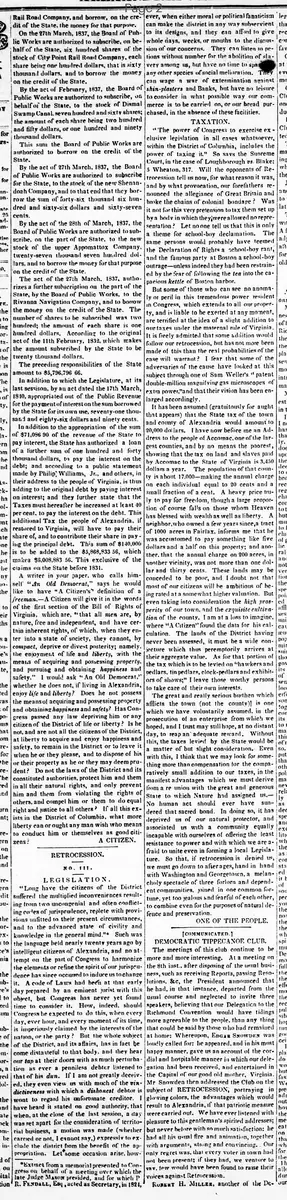
"Long have the citizens of the District suffered the multiplied inconveniences resulting from two uncongenial and often conflicting codes of jurisprudence, replete with provisions unfitted to their present circumstances, and to the advanced state of civility and knowledge in the general mind."* Such was the language held nearly twenty years ago by intelligent citizens of Alexandria, and no attempt on the part of Congress to harmonize the elements or refine the spirit of our jurisprudence has since occurred to induce us to change it. A code of Laws had been at that early day prepared by an eminent jurist with this object, but Congress has never yet found time to consider it. How, indeed, should Congress be expected to do this, when every day, every hour, and every moment of its time, is imperiously claimed by the interests of the nation, or the party? But the whole subject of the District, and its affairs, has in fact become distasteful to that body, and they hear our tap at their doors with as much perturbation as ever a penniless debtor listened to that of his dun. If I am not greatly deceived, they even view us with much of the vindictiveness with which a dishonest debtor is wont to regard his unfortunate creditor. I have heard it stated on good authority, that when, at the close of the last session, a day was set apart for the consideration of territorial business, a motion was made (whether carried or not, I cannot say) expressly to exclude the district from the benefit of the appropriation. Let some occasion arise, however, when either moral or political fanaticism can make the district in any way subservient to its designs, and they can afford to give whole days, weeks, or months to the discussion of our concerns. They can listen to petitions without number for the abolition of slavery among us, but have no time to spare any other species of social melioration. They can wage a war of extermination against shin-plasters and Banks, but have no leisure to consider in what possible way our commerce is to be carried on, or our bread purchased, in the absence of these facilities.
TAXATION.
"The power of Congress to exercise exclusive legislation in all cases whatsoever, within the District of Columbia, includes the power of taxing it." "So says the Supreme Court, in the case of Loughborough vs. Blake: 5 Wheaton, 317. Will the opponents of Retrocession tell us now, for what reason it was and by what provocation, our forefathers renounced the allegiance of Great Britain and broke the chains of colonial bondage? Was it not for this very pretension to tax them set up by a body in which they were allowed no representation? Let no one tell us that this is only a theme for school-boy declamation. The same persons would probably have termed the Declaration of Rights a school-boy rant, and the famous party at Boston a school-boy outrage—unless indeed they had been restrained by the fear of following the tea into the capacious kettle of Boston harbor.
But some of those who can see no anomaly or peril in this tremendous power resident in Congress, which extends to all our property, and is liable to be exerted at any moment, are terrified at the idea of a slight addition to our taxes under the maternal rule of Virginia. It is freely admitted that some addition would follow our retrocession, but has not more been made of this than the real probabilities of the case will warrant? I fear that some of the adversaries of the cause have looked at this subject through one of Sam Weller's "patent double-million magnifying gas microscopes of extra power," and that their vision has been enlarged accordingly.
It has been assumed (gratuitously for aught that appears) that the State tax of the town and county of Alexandria would amount to 20,000 dollars. I have now before me an Address to the people of Accomac, one of the largest counties, and by no means the poorest, showing that the tax on land and slaves paid by Accomac to the State of Virginia is 3,450 dollars a year. The population of that county is about 17,000—making the annual charge on each individual equal to 20 cents and a small fraction of a cent. A heavy price truly to pay for freedom, though a large proportion of course falls on those whom Heaven has blessed with wealth as well as liberty. A neighbor, who owned a few years since, a tract of 1000 acres in Fairfax, informs me that he was accustomed to pay something like five dollars and a half on this property: and another, that the annual charge on 200 acres, in another vicinity, was not more than one dollar and thirty cents. These lands may be conceded to be poor, and I doubt not that most of our citizens will be ambitious of being rated at a somewhat higher valuation. But even taking into consideration the high prosperity of our town, and the exquisite cultivation of the county, I am at a loss to imagine, where "A Citizen" found the data for his calculation. The lands of the District having never been assessed, it must be a wide conjecture which thus peremptorily arrives at their aggregate value. As for that portion of the tax which is to be levied on "hawkers and pedlars, tin pedlars, clock-pedlars and exhibitors of shows:" I leave those worthy persons to take care of their own interests.
The great and really serious burthen which afflicts the town (not the county) is one which we have voluntarily assumed, in the prosecution of an enterprise from which we hoped, and I trust may still hope, at no distant day, to reap an adequate reward. Without this, the taxes levied by the State would be a matter of but slight consideration. Even with this, I think that we may look for something more than compensation for the comparatively small addition to our taxes, in the manifest advantages which we must derive from a re-union with the great and generous State to which Nature had assigned us. No human act should ever have sundered that sacred bond. In doing so, it has deprived us of our natural protector, and associated us with a community equally incapable with ourselves of offering the least resistance to power and with which we are afraid to unite even in forming a local Legislature. So that, if retrocession is denied us, we must go down to after ages, hand in hand with Washington and Georgetown, a melancholy spectacle of three forlorn and dependent communities, joined in one common fortune, yet too jealous and fearful of each other to combine even for the purposes of natural defence and preservation.
ONE OF THE PEOPLE.
*Extract from a memorial presented to Congress on behalf of a meeting over which the late Judge Mason presided, and for which P. R. Fendall, Esq., acted as Secretary, in 1824.
NO. III.
LEGISLATION.
"Long have the citizens of the District suffered the multiplied inconveniences resulting from two uncongenial and often conflicting codes of jurisprudence, replete with provisions unfitted to their present circumstances, and to the advanced state of civility and knowledge in the general mind."* Such was the language held nearly twenty years ago by intelligent citizens of Alexandria, and no attempt on the part of Congress to harmonize the elements or refine the spirit of our jurisprudence has since occurred to induce us to change it. A code of Laws had been at that early day prepared by an eminent jurist with this object, but Congress has never yet found time to consider it. How, indeed, should Congress be expected to do this, when every day, every hour, and every moment of its time, is imperiously claimed by the interests of the nation, or the party? But the whole subject of the District, and its affairs, has in fact become distasteful to that body, and they hear our tap at their doors with as much perturbation as ever a penniless debtor listened to that of his dun. If I am not greatly deceived, they even view us with much of the vindictiveness with which a dishonest debtor is wont to regard his unfortunate creditor. I have heard it stated on good authority, that when, at the close of the last session, a day was set apart for the consideration of territorial business, a motion was made (whether carried or not, I cannot say) expressly to exclude the district from the benefit of the appropriation. Let some occasion arise, however, when either moral or political fanaticism can make the district in any way subservient to its designs, and they can afford to give whole days, weeks, or months to the discussion of our concerns. They can listen to petitions without number for the abolition of slavery among us, but have no time to spare any other species of social melioration. They can wage a war of extermination against shin-plasters and Banks, but have no leisure to consider in what possible way our commerce is to be carried on, or our bread purchased, in the absence of these facilities.
TAXATION.
"The power of Congress to exercise exclusive legislation in all cases whatsoever, within the District of Columbia, includes the power of taxing it." "So says the Supreme Court, in the case of Loughborough vs. Blake: 5 Wheaton, 317. Will the opponents of Retrocession tell us now, for what reason it was and by what provocation, our forefathers renounced the allegiance of Great Britain and broke the chains of colonial bondage? Was it not for this very pretension to tax them set up by a body in which they were allowed no representation? Let no one tell us that this is only a theme for school-boy declamation. The same persons would probably have termed the Declaration of Rights a school-boy rant, and the famous party at Boston a school-boy outrage—unless indeed they had been restrained by the fear of following the tea into the capacious kettle of Boston harbor.
But some of those who can see no anomaly or peril in this tremendous power resident in Congress, which extends to all our property, and is liable to be exerted at any moment, are terrified at the idea of a slight addition to our taxes under the maternal rule of Virginia. It is freely admitted that some addition would follow our retrocession, but has not more been made of this than the real probabilities of the case will warrant? I fear that some of the adversaries of the cause have looked at this subject through one of Sam Weller's "patent double-million magnifying gas microscopes of extra power," and that their vision has been enlarged accordingly.
It has been assumed (gratuitously for aught that appears) that the State tax of the town and county of Alexandria would amount to 20,000 dollars. I have now before me an Address to the people of Accomac, one of the largest counties, and by no means the poorest, showing that the tax on land and slaves paid by Accomac to the State of Virginia is 3,450 dollars a year. The population of that county is about 17,000—making the annual charge on each individual equal to 20 cents and a small fraction of a cent. A heavy price truly to pay for freedom, though a large proportion of course falls on those whom Heaven has blessed with wealth as well as liberty. A neighbor, who owned a few years since, a tract of 1000 acres in Fairfax, informs me that he was accustomed to pay something like five dollars and a half on this property: and another, that the annual charge on 200 acres, in another vicinity, was not more than one dollar and thirty cents. These lands may be conceded to be poor, and I doubt not that most of our citizens will be ambitious of being rated at a somewhat higher valuation. But even taking into consideration the high prosperity of our town, and the exquisite cultivation of the county, I am at a loss to imagine, where "A Citizen" found the data for his calculation. The lands of the District having never been assessed, it must be a wide conjecture which thus peremptorily arrives at their aggregate value. As for that portion of the tax which is to be levied on "hawkers and pedlars, tin pedlars, clock-pedlars and exhibitors of shows:" I leave those worthy persons to take care of their own interests.
The great and really serious burthen which afflicts the town (not the county) is one which we have voluntarily assumed, in the prosecution of an enterprise from which we hoped, and I trust may still hope, at no distant day, to reap an adequate reward. Without this, the taxes levied by the State would be a matter of but slight consideration. Even with this, I think that we may look for something more than compensation for the comparatively small addition to our taxes, in the manifest advantages which we must derive from a re-union with the great and generous State to which Nature had assigned us. No human act should ever have sundered that sacred bond. In doing so, it has deprived us of our natural protector, and associated us with a community equally incapable with ourselves of offering the least resistance to power and with which we are afraid to unite even in forming a local Legislature. So that, if retrocession is denied us, we must go down to after ages, hand in hand with Washington and Georgetown, a melancholy spectacle of three forlorn and dependent communities, joined in one common fortune, yet too jealous and fearful of each other to combine even for the purposes of natural defence and preservation.
ONE OF THE PEOPLE.
*Extract from a memorial presented to Congress on behalf of a meeting over which the late Judge Mason presided, and for which P. R. Fendall, Esq., acted as Secretary, in 1824.
What sub-type of article is it?
Historical Event
What themes does it cover?
Justice
Misfortune
Fortune Reversal
What keywords are associated?
Retrocession
District Of Columbia
Legislation
Taxation
Congress
Virginia
Alexandria
What entities or persons were involved?
One Of The People
Judge Mason
P. R. Fendall
A Citizen
Where did it happen?
District Of Columbia, Alexandria, Virginia
Story Details
Key Persons
One Of The People
Judge Mason
P. R. Fendall
A Citizen
Location
District Of Columbia, Alexandria, Virginia
Event Date
Nearly Twenty Years Ago (Referring To 1824)
Story Details
Advocacy for retrocession of Alexandria to Virginia, highlighting Congress's neglect of District legislation, taxation without representation echoing colonial grievances, and low Virginia tax rates compared to exaggerated fears.