Thank you for visiting SNEWPapers!
Sign up free
Editorial
June 30, 1851
Portage Sentinel
Ravenna, Portage County, Ohio
What is this article about?
This editorial critiques English legislation over centuries for favoring landowners and manufacturers through corn laws, unequal taxation, tariffs, and monopolies, subjugating labor to capital and causing widespread pauperism in Britain, where 1.5 million paupers outnumber the 109,000 with incomes over $75.
Clipping
OCR Quality
75%
Good
Full Text
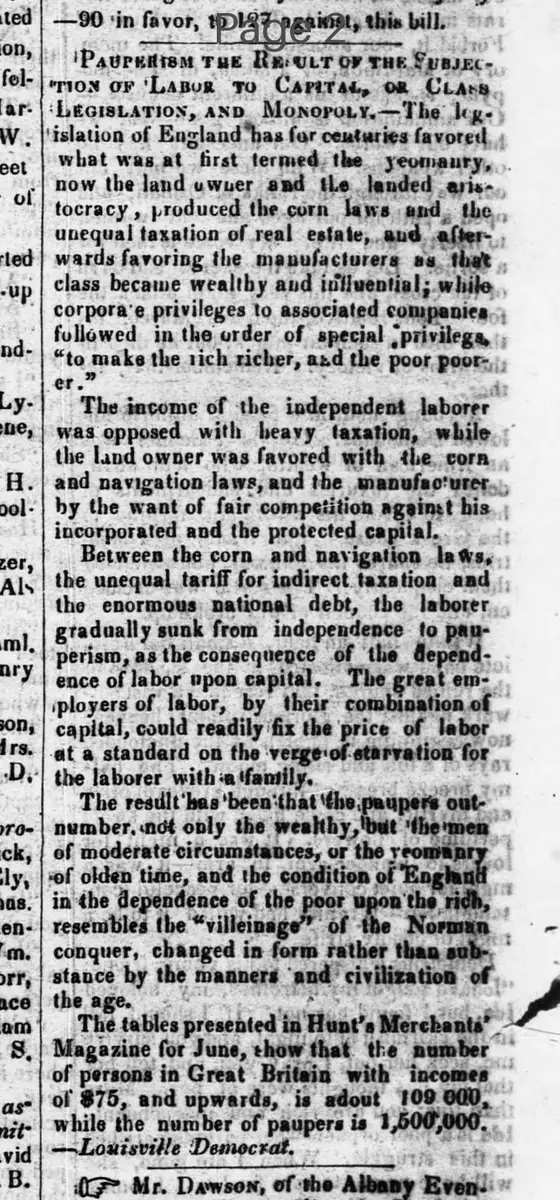
PAUPERISM THE RESULT OF THE SUBJECTION OF LABOR TO CAPITAL, OR CLASS LEGISLATION, AND MONOPOLY. The legislation of England has for centuries favored what was at first termed the yeomanry, now the land owner and the landed aristocracy, produced the corn laws and the unequal taxation of real estate, and afterwards favoring the manufacturers as that class became wealthy and influential; while corporate privileges to associated companies followed in the order of special privilege "to make the rich richer, and the poor poorer."
The income of the independent laborer was oppressed with heavy taxation, while the land owner was favored with the corn and navigation laws, and the manufacturer by the want of fair competition against his incorporated and the protected capital. Between the corn and navigation laws, the unequal tariff or indirect taxation and the enormous national debt, the laborer gradually sunk from independence to pauperism as the consequence of the dependence of labor upon capital. The great employers of labor, by their combination of capital, could readily fix the price of labor at a standard on the verge of starvation for the laborer with a family.
The result has been that the paupers outnumber, not only the wealthy, but the men of moderate circumstances, or the yeomanry of olden time, and the condition of England resembles the villeinage of the Norman conqueror, changed in form rather than substance by the manners and civilization of the age.
The tables presented in Hunt's Merchants Magazine for June, show that the number of persons in Great Britain with incomes of $75, and upwards, is about 109,000 while the number of paupers is 1,500,000. --Louisville Democrat.
The income of the independent laborer was oppressed with heavy taxation, while the land owner was favored with the corn and navigation laws, and the manufacturer by the want of fair competition against his incorporated and the protected capital. Between the corn and navigation laws, the unequal tariff or indirect taxation and the enormous national debt, the laborer gradually sunk from independence to pauperism as the consequence of the dependence of labor upon capital. The great employers of labor, by their combination of capital, could readily fix the price of labor at a standard on the verge of starvation for the laborer with a family.
The result has been that the paupers outnumber, not only the wealthy, but the men of moderate circumstances, or the yeomanry of olden time, and the condition of England resembles the villeinage of the Norman conqueror, changed in form rather than substance by the manners and civilization of the age.
The tables presented in Hunt's Merchants Magazine for June, show that the number of persons in Great Britain with incomes of $75, and upwards, is about 109,000 while the number of paupers is 1,500,000. --Louisville Democrat.
What sub-type of article is it?
Economic Policy
Labor
Taxation
What keywords are associated?
Pauperism
Labor Subjection
Class Legislation
Monopoly
Corn Laws
Unequal Taxation
Capital Vs Labor
English Economy
What entities or persons were involved?
English Landowners
Manufacturers
Laborers
Paupers
Hunt's Merchants Magazine
Louisville Democrat
Editorial Details
Primary Topic
Pauperism As Result Of Subjection Of Labor To Capital Through Class Legislation And Monopoly
Stance / Tone
Critical Of English Legislation Favoring Capital Over Labor
Key Figures
English Landowners
Manufacturers
Laborers
Paupers
Hunt's Merchants Magazine
Louisville Democrat
Key Arguments
English Legislation Favored Yeomanry Then Landowners With Corn Laws And Unequal Taxation Of Real Estate
Later Favored Manufacturers With Protections And Corporate Privileges To Enrich The Rich And Impoverish The Poor
Heavy Taxation Oppressed Independent Laborers While Landowners And Manufacturers Benefited From Corn Laws, Navigation Laws, And Lack Of Competition
Unequal Tariffs, Indirect Taxation, And National Debt Caused Laborers To Sink From Independence To Pauperism Due To Dependence On Capital
Capital Combinations Allowed Employers To Fix Labor Prices At Starvation Levels
Paupers Now Outnumber Wealthy And Moderate Classes, Resembling Norman Villeinage In Substance