Thank you for visiting SNEWPapers!
Sign up free
United Automobile Worker
Detroit, Wayne County, Michigan
What is this article about?
A bill dubbed the Federal Industrial Relations Act, drafted by corporation attorneys and introduced by reactionary Senators, aims to permanently impose wartime labor restrictions, undermining the Wagner Act, right to strike, and union rights. Despite claims of helping labor, it faces opposition in Congress as an indicator of conservative intentions near war's end.
Clipping
OCR Quality
Full Text
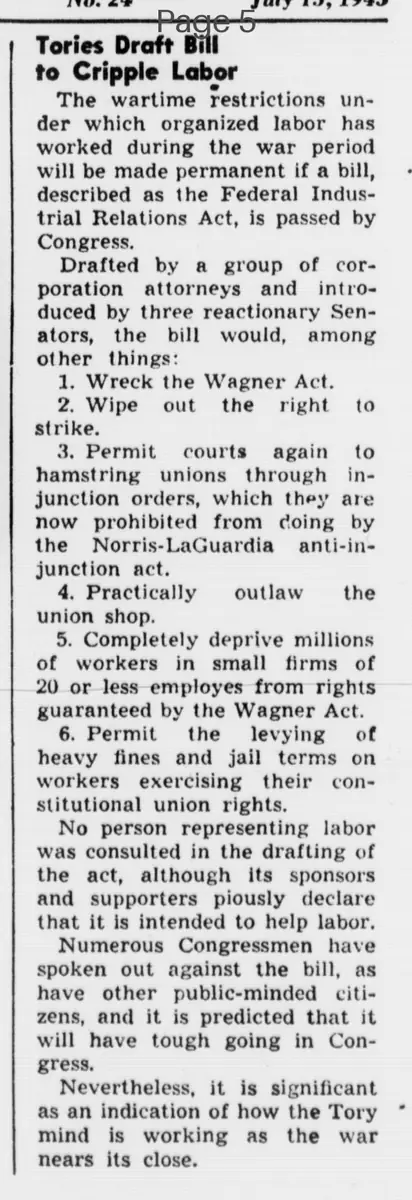
to Cripple Labor
The wartime restrictions under which organized labor has worked during the war period will be made permanent if a bill, described as the Federal Industrial Relations Act, is passed by Congress.
Drafted by a group of corporation attorneys and introduced by three reactionary Senators, the bill would, among other things:
1. Wreck the Wagner Act.
2. Wipe out the right to strike.
3. Permit courts again to hamstring unions through injunction orders, which they are now prohibited from doing by the Norris-LaGuardia anti-injunction act.
4. Practically outlaw the union shop.
5. Completely deprive millions of workers in small firms of 20 or less employees from rights guaranteed by the Wagner Act.
6. Permit the levying of heavy fines and jail terms on workers exercising their constitutional union rights.
No person representing labor was consulted in the drafting of the act, although its sponsors and supporters piously declare that it is intended to help labor.
Numerous Congressmen have spoken out against the bill, as have other public-minded citizens, and it is predicted that it will have tough going in Congress.
Nevertheless, it is significant as an indication of how the Tory mind is working as the war nears its close.
What sub-type of article is it?
What themes does it cover?
What keywords are associated?
Where did it happen?
Story Details
Location
Congress
Event Date
Wartime Period, As The War Nears Its Close
Story Details
Drafted without labor input, the bill seeks to dismantle key labor protections like the Wagner Act and right to strike, allowing injunctions and penalties against unions, while falsely claiming to aid workers; it faces strong opposition in Congress.