Thank you for visiting SNEWPapers!
Sign up free
Literary
September 7, 1805
Herald Of The United States
Warren, Bristol County, Rhode Island
What is this article about?
In this moral tale, Jemima, a virtuous young woman, is deceived by the scheming Lothario into a mock private marriage. He convinces her to leave her aunt's home for secret lodgings, where she lives happily unaware of the betrayal, while he plans to dishonor her.
Clipping
OCR Quality
95%
Excellent
Full Text
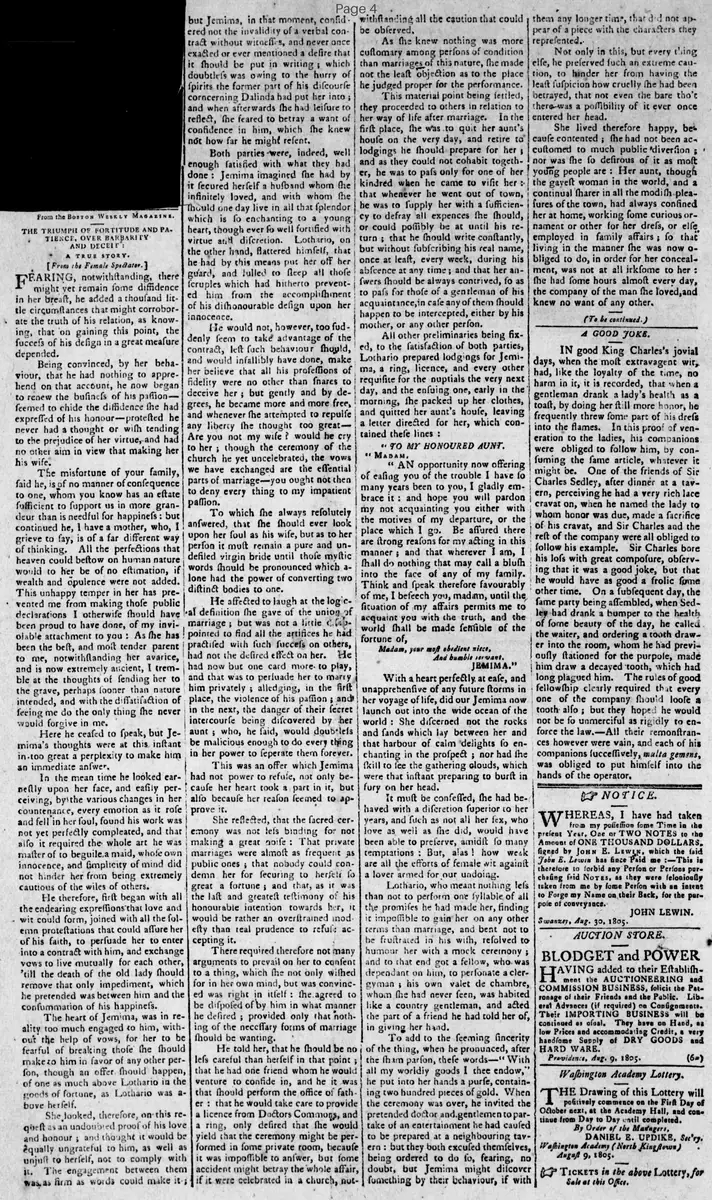
From the Boston Weekly Magazine.
THE TRIUMPH OF FORTITUDE AND PATIENCE, OVER BARBARITY AND DECEIT:
A TRUE STORY.
[From the Female Spectator.]
FEARING, notwithstanding, there might yet remain some diffidence in her breast, he added a thousand little circumstances that might corroborate the truth of his relation, as knowing that on gaining this point, the success of his design in a great measure depended.
Being convinced, by her behaviour, that he had nothing to apprehend on that account, he now began to renew the business of his passion—seemed to chide the diffidence she had expressed of his honour—protested he never had a thought or wish tending to the prejudice of her virtue, and had no other aim in view than making her his wife.
The misfortune of your family, said he, is of no manner of consequence to one, whom you know has an estate sufficient to support us in more grandeur than is needful for happiness: but continued he, I have a mother, who, I grieve to say, is of a far different way of thinking. All the perfections that heaven could bestow on human nature would to her be of no estimation, if wealth and opulence were not added.
This unhappy temper in her has prevented me from making those public declarations I otherwise should have been proud to have done, of my inviolable attachment to you: As she has been the best, and most tender parent to me, notwithstanding her avarice, and is now extremely ancient, I tremble at the thoughts of sending her to the grave, perhaps sooner than nature intended, and with the dissatisfaction of seeing me do the only thing she never would forgive in me.
Here he ceased to speak, but Jemima's thoughts were at this instant in too great a perplexity to make him an immediate answer.
In the mean time he looked earnestly upon her face, and easily perceiving, by the various changes in her countenance, every emotion as it rose and fell in her soul, found his work was not yet perfectly completed, and that also it required the whole art he was master of to beguile a maid, whose own innocence, and simplicity of mind did not hinder her from being extremely cautious of the wiles of others.
He therefore, first began with all the endearing expressions that love and wit could form, joined with all the solemn protestations that could assure her of his faith, to persuade her to enter into a contract with him, and exchange vows to live mutually for each other, 'till the death of the old lady should remove that only impediment, which he pretended was between him and the consummation of his happiness.
The heart of Jemima, was in reality too much engaged to him, without the help of vows, for her to be fearful of breaking those she should make to him in favor of any other person, though an offer should happen, of one as much above Lothario in the goods of fortune, as Lothario was above herself.
She looked, therefore, on this request as an undoubted proof of his love and honour; and thought it would be equally ungrateful to him, as well as unjust to herself, not to comply with it. The engagement between them was as firm as words could make it—
but Jemima, in that moment, considered not the invalidity of a verbal contract without witness, and never once exacted or ever mentioned a desire that it should be put in writing; which doubtless was owing to the hurry of spirits the former part of his discourse concerning Dalinda had put her into; and when afterwards she had leisure to reflect, she feared to betray a want of confidence in him, which he knew not how far he might resent.
Both parties were, indeed, well enough satisfied with what they had done: Jemima imagined she had by it secured herself a husband whom she infinitely loved, and with whom she should one day live in all that splendor which is so enchanting to a young heart, though ever so well fortified with virtue and discretion. Lothario, on the other hand, flattered himself, that he had by this means put her off her guard, and lulled to sleep all those scruples which had hitherto prevented him from the accomplishment of his dishonourable design upon her innocence.
He would not, however, too suddenly seem to take advantage of the contract, lest such behaviour should, and would infallibly have done, make her believe that all his professions of fidelity were no other than snares to deceive her; but gently and by degrees, he became more and more free, and whenever she attempted to repulse any liberty she thought too great—
Are you not my wife? would he cry to her; though the ceremony of the church he yet uncelebrated, the vows we have exchanged are the essential parts of marriage you ought not then to deny every thing to my impatient passion.
To which she always resolutely answered, that she should ever look upon her soul as his wife, but as to her person it must remain a pure and undefiled virgin bride until those mystic words should be pronounced which alone had the power of converting two distinct bodies to one.
He affected to laugh at the logical definition she gave of the union of marriage; but was not a little chagrined to find all the artifices he had practised with such success on others, had not the desired effect on her. He had now but one card more to play, and that was to persuade her to marry him privately; alleging, in the first place, the violence of his passion; and in the next, the danger of their secret intercourse being discovered by her aunt; who, he said, would doubtless be malicious enough to do every thing in her power to separate them forever.
This was an offer which Jemima had not power to refuse, not only because her heart took a part in it, but also because her reason seemed to approve it.
She reflected, that the sacred ceremony was not less binding for not making a great noise: That private marriages were almost as frequent as public ones; that nobody could condemn her for securing to herself so great a fortune; and that, as it was the last and greatest testimony of his honourable intention towards her, it would be rather an overstrained modesty than real prudence to refuse: accepting it.
There required therefore not many arguments to prevail on her to consent to a thing, which she not only wished for in her own mind, but was convinced was right in itself: she agreed to be disposed of by him in what manner he desired; provided only that nothing of the necessary forms of marriage should be wanting.
He told her, that he should be no less careful than herself in that point; that he had one friend whom he would venture to confide in, and he it was that should perform the office of father: that he would take care to provide a licence from Doctors Commons, and a ring, only desired that she would yield that the ceremony might be performed in some private room, because it was impossible to answer, but some accident might betray the whole affair, if it were celebrated in a church, notwithstanding all the caution that could be observed.
As she knew nothing was more customary among persons of condition than marriages of this nature, she made not the least objection as to the place he judged proper for the performance.
This material point being settled, they proceeded to others in relation to her way of life after marriage. In the first place, she was to quit her aunt's house on the very day, and retire to lodgings he should prepare for her; and as they could not cohabit together, he was to pass only for one of her kindred when he came to visit her: that whenever he went out of town, he was to supply her with a sufficiency to defray all expences she should, or could possibly be at until his return; that he should write constantly, but without subscribing his real name, once at least, every week, during his absence at any time; and that her answers should be always contrived, so as to pass for those of a gentleman of his acquaintance, in case any of them should happen to be intercepted, either by his mother, or any other person.
All other preliminaries being fixed, to the satisfaction of both parties, Lothario prepared lodgings for Jemima, a ring, licence, and every other requisite for the nuptials the very next day, and the ensuing one, early in the morning, he packed up her clothes, and quitted her aunt's house, leaving a letter directed for her, which contained these lines:
"TO MY HONOURED AUNT."
"Madam,
"AN opportunity now offering of easing you of the trouble I have so many years been to you, I gladly embrace it: and hope you will pardon my not acquainting you either with the motives of my departure, or the place which I go. Be assured there are strong reasons for my acting in this manner; and that wherever I am, I shall do nothing that may call a blush into the face of any of my family.
Think and speak therefore favourably of me, I beseech you, madam, until the situation of my affairs permits me to acquaint you with the truth, and the world shall be made sensible of the fortune of,
Madam, your most obedient niece,
And humble servant.
JEMIMA."
With a heart perfectly at ease, and unapprehensive of any future storms in her voyage of life, did our Jemima now launch out into the wide ocean of the world: She discerned not the rocks and sands which lay between her and that harbour of calm delights so enchanting in the prospect; nor had she skill to see the gathering clouds, which were that instant preparing to burst in fury on her head.
It must be confessed, she had behaved with a discretion superior to her years, and such as not all her sex, who love as well as she did, would have been able to preserve, amidst so many temptations: But, alas! how weak are all the efforts of female wit against a lover armed for our undoing.
Lothario, who meant nothing less than not to perform one syllable of all the promises he had made her, finding it impossible to gain her on any other terms than marriage, and bent not to be frustrated in his wish, resolved to humour her with a mock ceremony; and to that end got a fellow, who was dependant on him, to personate a clergyman; his own valet de chambre, whom she had never seen, was habited like a country gentleman, and acted the part of a friend he had told her of, in giving her hand.
To add to the seeming sincerity of the thing, when he pronounced, after the usual form, these words—"With all my worldly goods I thee endow." he put into her hands a purse, containing two hundred pieces of gold. When the ceremony was over, he invited the pretended doctor and gentleman to partake of an entertainment he had caused to be prepared at a neighbouring tavern: but they both excused themselves, being ordered to do so, fearing, no doubt, but Jemima might discover something by their behaviour, if with them any longer time, that did not appear of a piece with the characters they represented.
Not only in this, but every thing else, he preserved such an extreme caution, to hinder her from having the least suspicion how cruelly she had been betrayed, that not even the bare thought there was a possibility of it ever once entered her head.
She lived therefore happy, because contented; she had not been accustomed to much public diversion; nor was she so desirous of it as most young people are: Her aunt, though the gayest woman in the world, and a continual Sharer in all the modish pleasures of the town, had always confined her at home, working some curious ornament or other for her dress, or else employed in family affairs; so that living in the manner she was now obliged to do, in order for her concealment, was not at all irksome to her: she had some hours almost every day, the company of the man she loved, and knew no want of any other.
(To be continued.)
THE TRIUMPH OF FORTITUDE AND PATIENCE, OVER BARBARITY AND DECEIT:
A TRUE STORY.
[From the Female Spectator.]
FEARING, notwithstanding, there might yet remain some diffidence in her breast, he added a thousand little circumstances that might corroborate the truth of his relation, as knowing that on gaining this point, the success of his design in a great measure depended.
Being convinced, by her behaviour, that he had nothing to apprehend on that account, he now began to renew the business of his passion—seemed to chide the diffidence she had expressed of his honour—protested he never had a thought or wish tending to the prejudice of her virtue, and had no other aim in view than making her his wife.
The misfortune of your family, said he, is of no manner of consequence to one, whom you know has an estate sufficient to support us in more grandeur than is needful for happiness: but continued he, I have a mother, who, I grieve to say, is of a far different way of thinking. All the perfections that heaven could bestow on human nature would to her be of no estimation, if wealth and opulence were not added.
This unhappy temper in her has prevented me from making those public declarations I otherwise should have been proud to have done, of my inviolable attachment to you: As she has been the best, and most tender parent to me, notwithstanding her avarice, and is now extremely ancient, I tremble at the thoughts of sending her to the grave, perhaps sooner than nature intended, and with the dissatisfaction of seeing me do the only thing she never would forgive in me.
Here he ceased to speak, but Jemima's thoughts were at this instant in too great a perplexity to make him an immediate answer.
In the mean time he looked earnestly upon her face, and easily perceiving, by the various changes in her countenance, every emotion as it rose and fell in her soul, found his work was not yet perfectly completed, and that also it required the whole art he was master of to beguile a maid, whose own innocence, and simplicity of mind did not hinder her from being extremely cautious of the wiles of others.
He therefore, first began with all the endearing expressions that love and wit could form, joined with all the solemn protestations that could assure her of his faith, to persuade her to enter into a contract with him, and exchange vows to live mutually for each other, 'till the death of the old lady should remove that only impediment, which he pretended was between him and the consummation of his happiness.
The heart of Jemima, was in reality too much engaged to him, without the help of vows, for her to be fearful of breaking those she should make to him in favor of any other person, though an offer should happen, of one as much above Lothario in the goods of fortune, as Lothario was above herself.
She looked, therefore, on this request as an undoubted proof of his love and honour; and thought it would be equally ungrateful to him, as well as unjust to herself, not to comply with it. The engagement between them was as firm as words could make it—
but Jemima, in that moment, considered not the invalidity of a verbal contract without witness, and never once exacted or ever mentioned a desire that it should be put in writing; which doubtless was owing to the hurry of spirits the former part of his discourse concerning Dalinda had put her into; and when afterwards she had leisure to reflect, she feared to betray a want of confidence in him, which he knew not how far he might resent.
Both parties were, indeed, well enough satisfied with what they had done: Jemima imagined she had by it secured herself a husband whom she infinitely loved, and with whom she should one day live in all that splendor which is so enchanting to a young heart, though ever so well fortified with virtue and discretion. Lothario, on the other hand, flattered himself, that he had by this means put her off her guard, and lulled to sleep all those scruples which had hitherto prevented him from the accomplishment of his dishonourable design upon her innocence.
He would not, however, too suddenly seem to take advantage of the contract, lest such behaviour should, and would infallibly have done, make her believe that all his professions of fidelity were no other than snares to deceive her; but gently and by degrees, he became more and more free, and whenever she attempted to repulse any liberty she thought too great—
Are you not my wife? would he cry to her; though the ceremony of the church he yet uncelebrated, the vows we have exchanged are the essential parts of marriage you ought not then to deny every thing to my impatient passion.
To which she always resolutely answered, that she should ever look upon her soul as his wife, but as to her person it must remain a pure and undefiled virgin bride until those mystic words should be pronounced which alone had the power of converting two distinct bodies to one.
He affected to laugh at the logical definition she gave of the union of marriage; but was not a little chagrined to find all the artifices he had practised with such success on others, had not the desired effect on her. He had now but one card more to play, and that was to persuade her to marry him privately; alleging, in the first place, the violence of his passion; and in the next, the danger of their secret intercourse being discovered by her aunt; who, he said, would doubtless be malicious enough to do every thing in her power to separate them forever.
This was an offer which Jemima had not power to refuse, not only because her heart took a part in it, but also because her reason seemed to approve it.
She reflected, that the sacred ceremony was not less binding for not making a great noise: That private marriages were almost as frequent as public ones; that nobody could condemn her for securing to herself so great a fortune; and that, as it was the last and greatest testimony of his honourable intention towards her, it would be rather an overstrained modesty than real prudence to refuse: accepting it.
There required therefore not many arguments to prevail on her to consent to a thing, which she not only wished for in her own mind, but was convinced was right in itself: she agreed to be disposed of by him in what manner he desired; provided only that nothing of the necessary forms of marriage should be wanting.
He told her, that he should be no less careful than herself in that point; that he had one friend whom he would venture to confide in, and he it was that should perform the office of father: that he would take care to provide a licence from Doctors Commons, and a ring, only desired that she would yield that the ceremony might be performed in some private room, because it was impossible to answer, but some accident might betray the whole affair, if it were celebrated in a church, notwithstanding all the caution that could be observed.
As she knew nothing was more customary among persons of condition than marriages of this nature, she made not the least objection as to the place he judged proper for the performance.
This material point being settled, they proceeded to others in relation to her way of life after marriage. In the first place, she was to quit her aunt's house on the very day, and retire to lodgings he should prepare for her; and as they could not cohabit together, he was to pass only for one of her kindred when he came to visit her: that whenever he went out of town, he was to supply her with a sufficiency to defray all expences she should, or could possibly be at until his return; that he should write constantly, but without subscribing his real name, once at least, every week, during his absence at any time; and that her answers should be always contrived, so as to pass for those of a gentleman of his acquaintance, in case any of them should happen to be intercepted, either by his mother, or any other person.
All other preliminaries being fixed, to the satisfaction of both parties, Lothario prepared lodgings for Jemima, a ring, licence, and every other requisite for the nuptials the very next day, and the ensuing one, early in the morning, he packed up her clothes, and quitted her aunt's house, leaving a letter directed for her, which contained these lines:
"TO MY HONOURED AUNT."
"Madam,
"AN opportunity now offering of easing you of the trouble I have so many years been to you, I gladly embrace it: and hope you will pardon my not acquainting you either with the motives of my departure, or the place which I go. Be assured there are strong reasons for my acting in this manner; and that wherever I am, I shall do nothing that may call a blush into the face of any of my family.
Think and speak therefore favourably of me, I beseech you, madam, until the situation of my affairs permits me to acquaint you with the truth, and the world shall be made sensible of the fortune of,
Madam, your most obedient niece,
And humble servant.
JEMIMA."
With a heart perfectly at ease, and unapprehensive of any future storms in her voyage of life, did our Jemima now launch out into the wide ocean of the world: She discerned not the rocks and sands which lay between her and that harbour of calm delights so enchanting in the prospect; nor had she skill to see the gathering clouds, which were that instant preparing to burst in fury on her head.
It must be confessed, she had behaved with a discretion superior to her years, and such as not all her sex, who love as well as she did, would have been able to preserve, amidst so many temptations: But, alas! how weak are all the efforts of female wit against a lover armed for our undoing.
Lothario, who meant nothing less than not to perform one syllable of all the promises he had made her, finding it impossible to gain her on any other terms than marriage, and bent not to be frustrated in his wish, resolved to humour her with a mock ceremony; and to that end got a fellow, who was dependant on him, to personate a clergyman; his own valet de chambre, whom she had never seen, was habited like a country gentleman, and acted the part of a friend he had told her of, in giving her hand.
To add to the seeming sincerity of the thing, when he pronounced, after the usual form, these words—"With all my worldly goods I thee endow." he put into her hands a purse, containing two hundred pieces of gold. When the ceremony was over, he invited the pretended doctor and gentleman to partake of an entertainment he had caused to be prepared at a neighbouring tavern: but they both excused themselves, being ordered to do so, fearing, no doubt, but Jemima might discover something by their behaviour, if with them any longer time, that did not appear of a piece with the characters they represented.
Not only in this, but every thing else, he preserved such an extreme caution, to hinder her from having the least suspicion how cruelly she had been betrayed, that not even the bare thought there was a possibility of it ever once entered her head.
She lived therefore happy, because contented; she had not been accustomed to much public diversion; nor was she so desirous of it as most young people are: Her aunt, though the gayest woman in the world, and a continual Sharer in all the modish pleasures of the town, had always confined her at home, working some curious ornament or other for her dress, or else employed in family affairs; so that living in the manner she was now obliged to do, in order for her concealment, was not at all irksome to her: she had some hours almost every day, the company of the man she loved, and knew no want of any other.
(To be continued.)
What sub-type of article is it?
Prose Fiction
What themes does it cover?
Love Romance
Moral Virtue
Social Manners
What keywords are associated?
Deceitful Lover
Mock Marriage
Virtuous Maiden
Private Vows
Betrayal
Moral Tale
Female Innocence
What entities or persons were involved?
[From The Female Spectator.]
Literary Details
Title
The Triumph Of Fortitude And Patience, Over Barbarity And Deceit: A True Story.
Author
[From The Female Spectator.]
Subject
A True Story Of Deceit And Virtue In Love.
Form / Style
Moral Narrative In Prose.
Key Lines
Are You Not My Wife? Would He Cry To Her; Though The Ceremony Of The Church He Yet Uncelebrated, The Vows We Have Exchanged Are The Essential Parts Of Marriage You Ought Not Then To Deny Every Thing To My Impatient Passion.
To Which She Always Resolutely Answered, That She Should Ever Look Upon Her Soul As His Wife, But As To Her Person It Must Remain A Pure And Undefiled Virgin Bride Until Those Mystic Words Should Be Pronounced Which Alone Had The Power Of Converting Two Distinct Bodies To One.
With A Heart Perfectly At Ease, And Unapprehensive Of Any Future Storms In Her Voyage Of Life, Did Our Jemima Now Launch Out Into The Wide Ocean Of The World: She Discerned Not The Rocks And Sands Which Lay Between Her And That Harbour Of Calm Delights So Enchanting In The Prospect;
But, Alas! How Weak Are All The Efforts Of Female Wit Against A Lover Armed For Our Undoing.
"With All My Worldly Goods I Thee Endow."