Thank you for visiting SNEWPapers!
Sign up free
Editorial
June 15, 1804
The National Intelligencer And Washington Advertiser
Washington, District Of Columbia
What is this article about?
The editorial praises the Navy Department's efficiency in fitting out five U.S. Navy ships in the Eastern Branch (Washington) in under two months in 1804, faster than similar efforts in New York, Boston, and Philadelphia. It defends the site's suitability against criticisms of distance and navigation, attributing objections to prejudice or misinformation.
Clipping
OCR Quality
95%
Excellent
Full Text
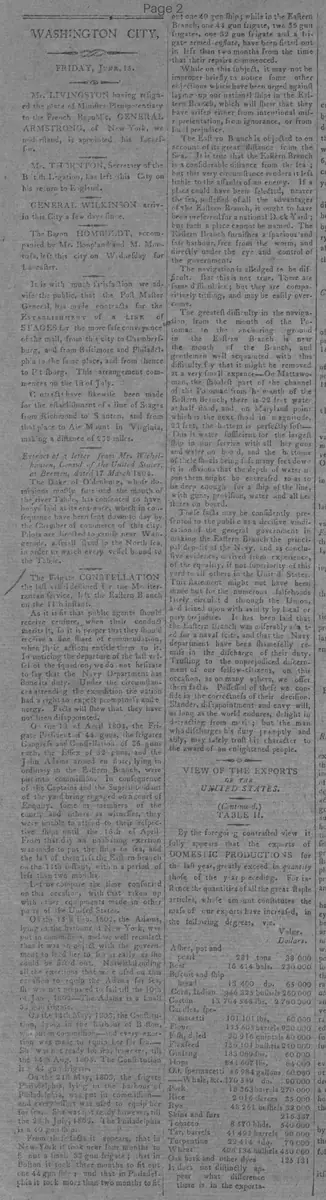
As it is fit that public agents should receive censure, when their conduct merits it, so it is proper that they should receive a due share of commendation, when their actions entitle them to it. In noticing the departure of the last vessel of the squadron, we do not hesitate to say that the Navy Department has done its duty. Under the circumstances attending the expedition the nation had a right to expect promptness and energy. Facts will show that they have not been disappointed.
On the 1st of April 1804, the Frigate President of 44 guns, the Frigates Congress and Constellation of 36 guns each, the Essex of 32 guns, and the John Adams armed en flute, lying in ordinary in the Eastern Branch, were put into commission. In consequence of the Captains and the Superintendent of the yard being engaged on a court of Enquiry, some as members of the Court, and others as witnesses, they were unable to attend to their respective ships until the 16th of April. From that day an unabating exertion was made to put the ships to sea, and the last of them left the Eastern Branch on the 11th instant, within a period of less than two months.
Let us compare the time consumed on this occasion, with that taken up with other equipments made in other ports of the United States.
On the 15th Feb. 1802, the Adams, lying in the harbour of New York, was put in commission, and we well recollect that it was an object with the government to lead her to sea as early as she could be fitted out. Notwithstanding all the exertions that were used on this occasion to equip the Adams for sea, the work was not prepared to sail till the 10th of June 1802. The Adams is a small 32 gun frigate.
On the 14th May 1803, the Constitution, lying in the harbour of Boston, was put in commission—and every exertion was made to equip her for sea. She was not ready for sea, however, till the 14th Aug. 1803. The Constitution is a 44 gun frigate.
On the 21st May, 1803, the frigate Philadelphia, lying in the harbour of Philadelphia, was put in commission and every effort was used to equip her for sea. She was not ready however, till the 28th July, 1803. The Philadelphia is a 40 gun ship.
From these facts it appears, that in New-York it took near four months to fit out a small 32 gun frigate; that in Boston it took three months to fit out one 44 gun ship; and that in Philadelphia it took more than two months to fit out one 40 gun ship: while in the Eastern Branch, one 44 gun frigate, two 36 gun frigates, one 32 gun frigate and a frigate-armed en flute, have been fitted out in less than two months from the time that their repairs commenced.
While on this subject, it may not be improper briefly to notice some other objections which have been urged against laying up our national ships in the Eastern Branch, which will show that they have arisen either from intentional misrepresentation, from ignorance, or from local prejudice.
The Eastern Branch is objected to on account of its great distance from the Sea. It is true that the Eastern Branch is a considerable distance from the sea; but this very circumstance renders it less liable to the assaults of an enemy. If a place could have been selected, nearer the sea, possessed of all the advantages of the Eastern Branch, it ought to have been preferred for a national Dock Yard; but such a place cannot be named. The Eastern Branch furnishes a spacious and safe harbour, free from the worm, and directly under the eye and control of the government.
The navigation is alledged to be difficult. But this is not true. There are some difficulties; but they are comparatively trifling, and may be easily overcome.
The greatest difficulty in the navigation from the mouth of the Potomac to the anchoring ground in the Eastern Branch is near the mouth of the Branch, and gentlemen well acquainted with this difficulty say that it might be removed at a very small expence. On Mattawoman, the shallowest part of the channel of the Potomac from the mouth of the Eastern Branch, there is 22 feet water at half flood, and on Maryland Point which is the next shoal in magnitude, 23 feet, the bottom is perfectly soft. This is water sufficient for the largest ship in our service with all her guns and water on board, and the bottoms of these shoals being soft many feet down it is obvious that the depth of water upon them might be increased so as to be deep enough for a ship of the line, with guns, provision, water and all her stores on board.
These facts may be confidently presented to the public as a decisive vindication of the general government in making the Eastern Branch the principal depot of the Navy, and as conclusive evidence, arrived from experience, of the equality, if not superiority of this yard to all others in the United States.
This statement might not have been made but for the numerous falsehoods lately circulated through the Union, and seized upon with avidity by local or party prejudice. It has been said that the Eastern Branch was miserably adapted for a naval site, and that the Navy department have been shamefully remiss in the discharge of their duty. Trusting to the unprejudiced discernment of our fellow-citizens, on this occasion, as on many others, we offer them facts. Possessed of these we confide in the correctness of their decision. Slander, disappointment and envy will, as long as the world endures, delight in detracting from merit; but the man who discharges his duty promptly and ably, may safely trust his character to the award of an enlightened people.
On the 1st of April 1804, the Frigate President of 44 guns, the Frigates Congress and Constellation of 36 guns each, the Essex of 32 guns, and the John Adams armed en flute, lying in ordinary in the Eastern Branch, were put into commission. In consequence of the Captains and the Superintendent of the yard being engaged on a court of Enquiry, some as members of the Court, and others as witnesses, they were unable to attend to their respective ships until the 16th of April. From that day an unabating exertion was made to put the ships to sea, and the last of them left the Eastern Branch on the 11th instant, within a period of less than two months.
Let us compare the time consumed on this occasion, with that taken up with other equipments made in other ports of the United States.
On the 15th Feb. 1802, the Adams, lying in the harbour of New York, was put in commission, and we well recollect that it was an object with the government to lead her to sea as early as she could be fitted out. Notwithstanding all the exertions that were used on this occasion to equip the Adams for sea, the work was not prepared to sail till the 10th of June 1802. The Adams is a small 32 gun frigate.
On the 14th May 1803, the Constitution, lying in the harbour of Boston, was put in commission—and every exertion was made to equip her for sea. She was not ready for sea, however, till the 14th Aug. 1803. The Constitution is a 44 gun frigate.
On the 21st May, 1803, the frigate Philadelphia, lying in the harbour of Philadelphia, was put in commission and every effort was used to equip her for sea. She was not ready however, till the 28th July, 1803. The Philadelphia is a 40 gun ship.
From these facts it appears, that in New-York it took near four months to fit out a small 32 gun frigate; that in Boston it took three months to fit out one 44 gun ship; and that in Philadelphia it took more than two months to fit out one 40 gun ship: while in the Eastern Branch, one 44 gun frigate, two 36 gun frigates, one 32 gun frigate and a frigate-armed en flute, have been fitted out in less than two months from the time that their repairs commenced.
While on this subject, it may not be improper briefly to notice some other objections which have been urged against laying up our national ships in the Eastern Branch, which will show that they have arisen either from intentional misrepresentation, from ignorance, or from local prejudice.
The Eastern Branch is objected to on account of its great distance from the Sea. It is true that the Eastern Branch is a considerable distance from the sea; but this very circumstance renders it less liable to the assaults of an enemy. If a place could have been selected, nearer the sea, possessed of all the advantages of the Eastern Branch, it ought to have been preferred for a national Dock Yard; but such a place cannot be named. The Eastern Branch furnishes a spacious and safe harbour, free from the worm, and directly under the eye and control of the government.
The navigation is alledged to be difficult. But this is not true. There are some difficulties; but they are comparatively trifling, and may be easily overcome.
The greatest difficulty in the navigation from the mouth of the Potomac to the anchoring ground in the Eastern Branch is near the mouth of the Branch, and gentlemen well acquainted with this difficulty say that it might be removed at a very small expence. On Mattawoman, the shallowest part of the channel of the Potomac from the mouth of the Eastern Branch, there is 22 feet water at half flood, and on Maryland Point which is the next shoal in magnitude, 23 feet, the bottom is perfectly soft. This is water sufficient for the largest ship in our service with all her guns and water on board, and the bottoms of these shoals being soft many feet down it is obvious that the depth of water upon them might be increased so as to be deep enough for a ship of the line, with guns, provision, water and all her stores on board.
These facts may be confidently presented to the public as a decisive vindication of the general government in making the Eastern Branch the principal depot of the Navy, and as conclusive evidence, arrived from experience, of the equality, if not superiority of this yard to all others in the United States.
This statement might not have been made but for the numerous falsehoods lately circulated through the Union, and seized upon with avidity by local or party prejudice. It has been said that the Eastern Branch was miserably adapted for a naval site, and that the Navy department have been shamefully remiss in the discharge of their duty. Trusting to the unprejudiced discernment of our fellow-citizens, on this occasion, as on many others, we offer them facts. Possessed of these we confide in the correctness of their decision. Slander, disappointment and envy will, as long as the world endures, delight in detracting from merit; but the man who discharges his duty promptly and ably, may safely trust his character to the award of an enlightened people.
What sub-type of article is it?
Military Affairs
Infrastructure
What keywords are associated?
Navy Department
Eastern Branch
Ship Fitting
Naval Yard
Washington Navy
Frigates
Potomac Navigation
Government Defense
What entities or persons were involved?
Navy Department
Eastern Branch
Frigate President
Frigates Congress And Constellation
Essex
John Adams
General Government
New York
Boston
Philadelphia
Editorial Details
Primary Topic
Efficiency Of Navy Department In Fitting Out Ships At Eastern Branch
Stance / Tone
Commendatory And Defensive Of Government Actions
Key Figures
Navy Department
Eastern Branch
Frigate President
Frigates Congress And Constellation
Essex
John Adams
General Government
New York
Boston
Philadelphia
Key Arguments
Navy Department Demonstrated Promptness And Energy In Fitting Out Five Ships In Under Two Months
Eastern Branch Outfit Time Shorter Than In New York (4 Months For Adams), Boston (3 Months For Constitution), Philadelphia (2+ Months For Philadelphia)
Distance From Sea Protects Against Enemy Assaults
Eastern Branch Offers Safe Harbor Free From Worm Under Government Control
Navigation Difficulties Are Trifling And Easily Overcome
Shoals Have Sufficient Soft Bottom Depth For Largest Ships, Improvable For Ships Of The Line
Objections Stem From Misrepresentation, Ignorance, Or Prejudice
Facts Vindicate Choice Of Eastern Branch As Principal Naval Depot