Thank you for visiting SNEWPapers!
Sign up free
Letter to Editor
February 7, 1832
Richmond Enquirer
Richmond, Richmond County, Virginia
What is this article about?
A correspondent critiques speeches in the Enquirer opposing Mr. Randolph's proposition to free slave offspring, arguing it violates constitutional property rights by confiscating private property without compensation, comparing slave children to livestock young under the maxim 'partus sequitur ventrem'.
Clipping
OCR Quality
98%
Excellent
Full Text
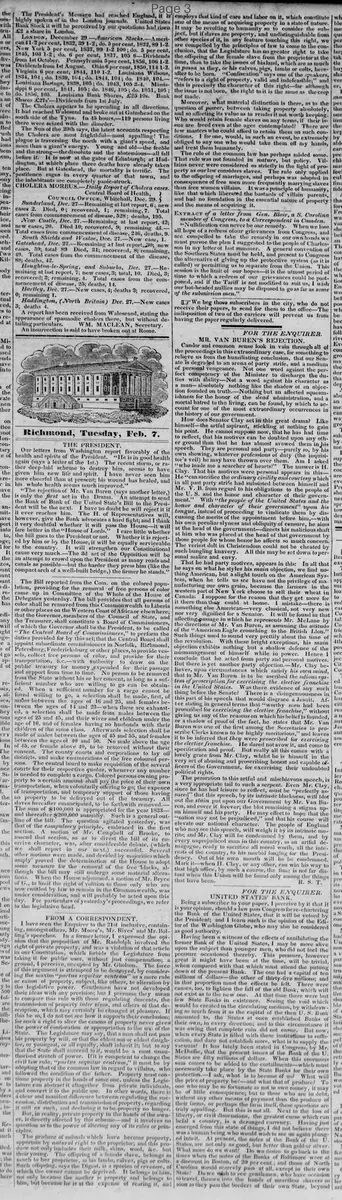
FROM A CORRESPONDENT.
I have seen the Enquirer to the 21st inclusive, containing, amongst others, Mr. Moore's, Mr. Rives' and Mr. Bolling's speeches. In a former letter, I expressed the opinion that the proposition of Mr. Randolph involved the right of private property, and was a violation of that article in our Constitution, which forbids the Legislature from taking it for public uses, without just compensation; a ground, I perceive, occupied by Mr. Gholson.
The force of this argument is attempted to be destroyed, by considering the maxim "partus sequitur ventrem" as a mere rule or canon of property, subject, like others, to alteration by the legislative power. Gentlemen have not developed their ideas with any precision; but I presume they mean to compare this rule with those regulating descents, the transmission of property inter vivos, and others of that description, which may certainly be changed at pleasure. If this be so, I do not see how it supports their conclusion; for such a right to alter the canons of property never gives the power of confiscation or appropriation to the use of the State. The Legislature may say, that a man shall not pass his property by will, or that the eldest son or eldest daughter, or youngest, or all equally, shall inherit it; but to say that the State shall succeed to it, would be a most unauthorised stretch of power.
If it is competent to change the civil law rule, "partus sequitur ventrem," it must be by adopting that of the common law in regard to villains, who followed the condition of the father. "Property must continue property in the hands of some one, unless the Legislature can abstract it altogether from private individuals, and convert it to the public use. In other words, there is a clear and manifest difference between regulating the succession, distribution and transmission of property, regarding it still as such, and declaring it to be property no longer.
But, in reality, private property in the hands of the owner, is directly affected by this scheme—and it involves no question as to the power of altering any of its rules or principles. The produce of animals which have become property, appertain by natural right to the proprietor; and this produce not only includes their milk, skins, wool, &c. but their young."
The offspring of a female slave, belongs as much to her proprietor, as his lambs, calves, pigs or colts. Such offspring, says the Digest, is a species of revenue, of which the owner cannot be deprived. It belongs to him, not only because the mother is property and belongs to him, but because he is at the expense of rearing it, and employs that kind of care and labor on it, which constitute one of the means of acquiring property in a state of nature. It may be revolting to humanity so to consider the subject, but if slaves are property, and undistinguishable from other species of it, in any feature touching this right, we are compelled by the principles of law to come to the conclusion, that the Legislature has no greater right to take the offspring of the female slave from the proprietor at the time, than to take the issues of his land, which are as much in posse as they, or his calves, pigs, lambs or colts, hereafter to be born.""Confiscation"says one of the speakers, "refers to a right of property, valid and indefeasible;" and this is precisely the character of this right-for although the issue is not born, the right to it is the same as the crop not made.
Moreover, what material distinction is there, as to the question of power, between taking property absolutely, and so affecting its value as to render it not worth keeping. Who would retain female slaves on any terms, if their issue are freed even at the ages contemplated? There are few masters who could afford to retain them on such conditions. I for one, would, in such an event, be extremely obliged to any one who would take them off my hands, and treat them humanely.
The rule of the common law has perhaps misled some. That rule was not founded in nature, but policy. Villains never were considered so strictly in the light of property as our law considers slaves. The rule only applied to the offspring of marriages, and perhaps was adopted in consequence of free men more frequently marrying slaves than free women villains. It was a principle of humanity, like that which liberated the bastards of villain parents, and had no foundation in the essential nature of property and the means of acquiring it.
I have seen the Enquirer to the 21st inclusive, containing, amongst others, Mr. Moore's, Mr. Rives' and Mr. Bolling's speeches. In a former letter, I expressed the opinion that the proposition of Mr. Randolph involved the right of private property, and was a violation of that article in our Constitution, which forbids the Legislature from taking it for public uses, without just compensation; a ground, I perceive, occupied by Mr. Gholson.
The force of this argument is attempted to be destroyed, by considering the maxim "partus sequitur ventrem" as a mere rule or canon of property, subject, like others, to alteration by the legislative power. Gentlemen have not developed their ideas with any precision; but I presume they mean to compare this rule with those regulating descents, the transmission of property inter vivos, and others of that description, which may certainly be changed at pleasure. If this be so, I do not see how it supports their conclusion; for such a right to alter the canons of property never gives the power of confiscation or appropriation to the use of the State. The Legislature may say, that a man shall not pass his property by will, or that the eldest son or eldest daughter, or youngest, or all equally, shall inherit it; but to say that the State shall succeed to it, would be a most unauthorised stretch of power.
If it is competent to change the civil law rule, "partus sequitur ventrem," it must be by adopting that of the common law in regard to villains, who followed the condition of the father. "Property must continue property in the hands of some one, unless the Legislature can abstract it altogether from private individuals, and convert it to the public use. In other words, there is a clear and manifest difference between regulating the succession, distribution and transmission of property, regarding it still as such, and declaring it to be property no longer.
But, in reality, private property in the hands of the owner, is directly affected by this scheme—and it involves no question as to the power of altering any of its rules or principles. The produce of animals which have become property, appertain by natural right to the proprietor; and this produce not only includes their milk, skins, wool, &c. but their young."
The offspring of a female slave, belongs as much to her proprietor, as his lambs, calves, pigs or colts. Such offspring, says the Digest, is a species of revenue, of which the owner cannot be deprived. It belongs to him, not only because the mother is property and belongs to him, but because he is at the expense of rearing it, and employs that kind of care and labor on it, which constitute one of the means of acquiring property in a state of nature. It may be revolting to humanity so to consider the subject, but if slaves are property, and undistinguishable from other species of it, in any feature touching this right, we are compelled by the principles of law to come to the conclusion, that the Legislature has no greater right to take the offspring of the female slave from the proprietor at the time, than to take the issues of his land, which are as much in posse as they, or his calves, pigs, lambs or colts, hereafter to be born.""Confiscation"says one of the speakers, "refers to a right of property, valid and indefeasible;" and this is precisely the character of this right-for although the issue is not born, the right to it is the same as the crop not made.
Moreover, what material distinction is there, as to the question of power, between taking property absolutely, and so affecting its value as to render it not worth keeping. Who would retain female slaves on any terms, if their issue are freed even at the ages contemplated? There are few masters who could afford to retain them on such conditions. I for one, would, in such an event, be extremely obliged to any one who would take them off my hands, and treat them humanely.
The rule of the common law has perhaps misled some. That rule was not founded in nature, but policy. Villains never were considered so strictly in the light of property as our law considers slaves. The rule only applied to the offspring of marriages, and perhaps was adopted in consequence of free men more frequently marrying slaves than free women villains. It was a principle of humanity, like that which liberated the bastards of villain parents, and had no foundation in the essential nature of property and the means of acquiring it.
What sub-type of article is it?
Persuasive
Political
Ethical Moral
What themes does it cover?
Slavery Abolition
Constitutional Rights
Politics
What keywords are associated?
Slavery
Property Rights
Partus Sequitur Ventrem
Constitution
Legislature
Slave Offspring
Confiscation
Common Law
What entities or persons were involved?
A Correspondent
Letter to Editor Details
Author
A Correspondent
Main Argument
the legislative proposition to free the offspring of female slaves violates constitutional protections against taking private property without just compensation, as such offspring constitute property akin to the young of livestock, protected under the maxim 'partus sequitur ventrem' and natural rights.
Notable Details
References Speeches By Mr. Moore, Mr. Rives, Mr. Bolling, Mr. Randolph, Mr. Gholson
Cites Maxim 'Partus Sequitur Ventrem'
Compares To Common Law On Villains
References The Digest On Offspring As Revenue
Discusses Economic Impact On Slaveholders