Thank you for visiting SNEWPapers!
Sign up free
The Caledonian
Saint Johnsbury, Caledonia County, Vermont
What is this article about?
In a U.S. Senate speech on January 28, 1840, Gov. Davis of Massachusetts opposes the Sub-Treasury Bill, arguing it would harm the economy by reducing wages and property values, blaming past Administration policies for financial crises, and defending the role of banks and credit in supporting laborers and business.
Merged-components note: This is a continuation of the speech by Gov. Davis on the Sub-Treasury Bill across pages 1 and 2; relabeled to 'story' as it is a reported political speech rather than an editorial.
Clippings
1 of 2
OCR Quality
Full Text
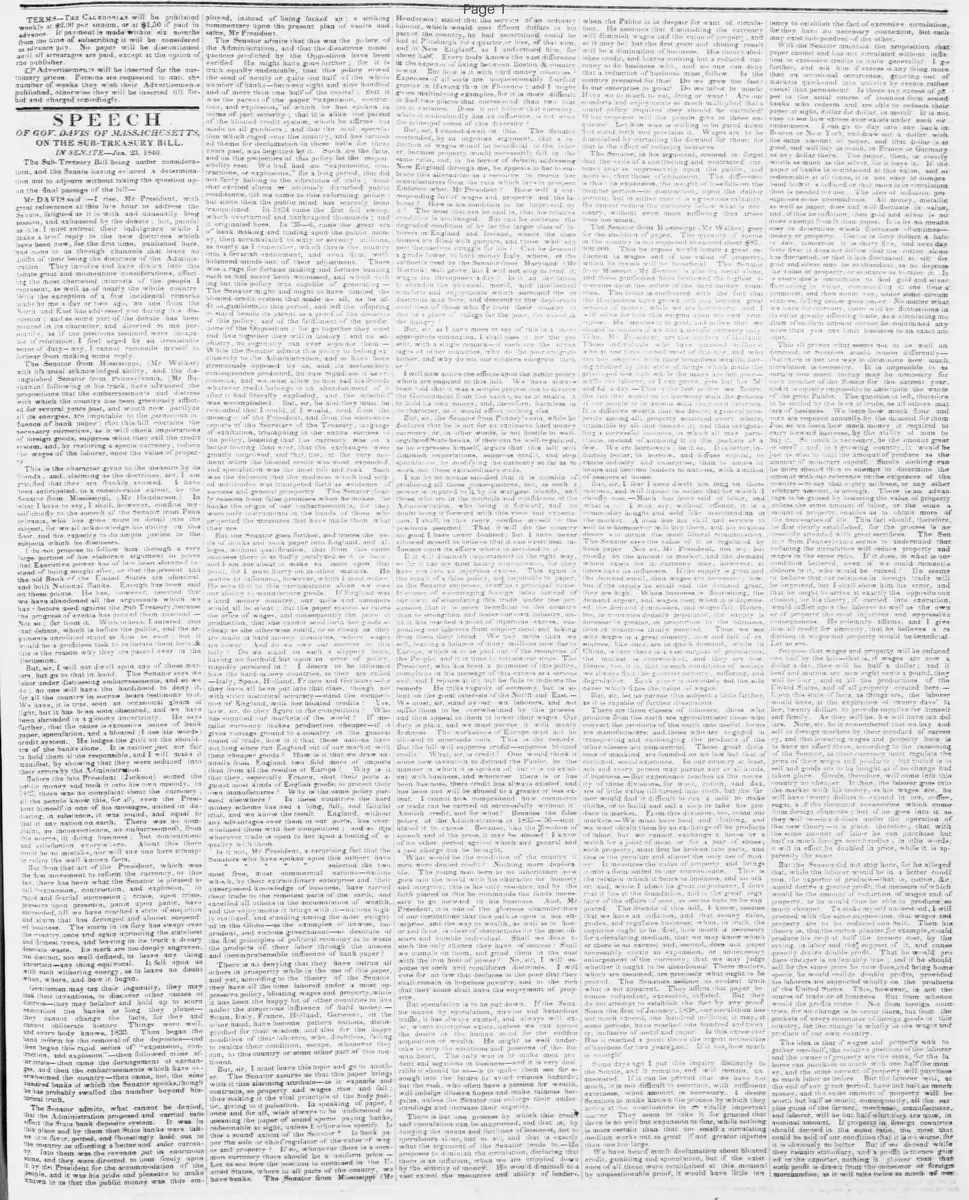
ON THE SUB-TREASURY BILL.
IN SENATE—Jan. 28, 1840.
The Sub-Treasury Bill being under consideration, and the Senate having evinced a determination not to adjourn without taking the question upon the final passage of the bill—
Mr. DAVIS said—I rise, Mr. President, with great reluctance at this late hour to address the Senate, fatigued as it is with an unusually long session, and exhausted by the debate; but, painful as it is, I must entreat their indulgence while I make a brief reply to the new doctrines which have been now, for the first time, published here, and come to us through channels that leave no doubt of their being the doctrines of the Administration. They involve and have drawn into this debate great and momentous considerations, affecting the most cherished interests of the people I represent, as well as of nearly the whole country.
With the exception of a few incidental remarks made by me a day or two ago, no one from the North and East has addressed you during this discussion; and as some part of the debate has been pointed in its character, and directed to me personally, as if the positions issued were incapable of refutation, I feel urged by an irresistible sense of duty—nay, I cannot reconcile myself to—to bear from making some reply.
The Senator from Mississippi, (Mr. Walker,) with his usual acknowledged ability, and the distinguished Senator from Pennsylvania, (Mr. Buchanan,) following in his track, have advanced the propositions that the embarrassments and distress with which the country has been grievously afflicted for several years past, and which now paralyze all its energies, are imputable to the pernicious influence of bank paper; that this bill contains the necessary corrective, as it will check importations of foreign goods, suppress what they call the credit system, and, by restoring a specie currency, reduce the wages of the laborer, once the value of property.
This is the character given to the measure by its friends, and, alarming as the doctrines are, I am gratified that they are frankly avowed. I have been anticipated, to a considerable extent, by the Senator from Mississippi, (Mr. Henderson.) In what I have to say, I shall, however, confine myself chiefly to the speech of the Senator from Pennsylvania, who has gone more into detail into the subject, for we all acknowledge his ability on this floor, and his capacity to do ample justice to the subjects which he discusses.
I do not propose to follow him through a very large portion of his elaborate argument to prove that Executive power has of late been shunned instead of being sought after, or that the present and the old Bank of the United States are identical, and both National Banks. Enough has been said on these points. He has, however, asserted that we have abandoned all the arguments which we heretofore used against the Sub-Treasury, because the progress of events has proved them unsound—
Not so; far from it. With others, I entered into that debate, which is before the public, and the arguments unrefuted stand as firm as ever; but it would be a profitless task to reiterate them here; and this is the reason why they are passed over in the discussion.
But, sir, I will not dwell upon any of these matters, but go to that in hand. The Senator says we labor under distressing embarrassments, and so we do; no one will have the hardihood to deny it, for all the country in sorrow bears testimony to it. We have, it is true, seen an occasional gleam of light, but it has been soon obscured, and we have been shrouded in a gloomy uncertainty. He says further, that the cause is excessive issues of bank paper, speculation, and a bloated (I use his words) credit system. He lodges the guilt on the shoulders of the banks alone. It is neither just nor fair to hold them all one responsible, and I will make it manifest, by showing that they were seduced into their errors by the Administration.
Before the late President Jackson seized the public money and took it into his own custody, in '34, there was no complaint about the currency; and the people know this, for all, even the President himself in one of his messages, united in declaring, in substance, it was sound, and equal to that of any nation on earth. There was no complaint, no inconvenience, no embarrassment, from this source, in doing business; but contentment and satisfaction everywhere. About this there can be no mistake, nor will any one here attempt a refutation of the well known facts.
But from that act of the President, which was the first movement to reform the currency, to this day, there has been what the Senator is pleased to call 'expansion, contraction, and explosion,' in rapid and fearful succession; crisis upon crisis, succeeded, till we have reached a state of suspicion, pressure upon pressure, panic upon panic, have come and alarm that has deranged and almost suspended business. The storm in its fury has swept over the country, once and again uprooting the stateliest and firmest trees, and leaving in its track a dreary desolate waste. Its marks are too deeply engraven, too distinct, too well defined, to leave any thing uncertain—any thing equivocal. It fell upon us with such withering energy, as to leave no doubt when, where, and how it began.
Gentlemen may tax their ingenuity, they may task their inventions, to discover other causes of distress—they may belabor and hold up to scorn and execration the banks as long they please—they cannot obliterate history. Things were well, and everybody knows it, in '34. Then began the bank reform by the removal of the deposits—and then began this rapid series of contraction, and explosion”—then followed crisis after crisis—then came the embarrassments which have overwhelmed the country—then came too a hundred banks of which the Senator speaks, though he has probably swelled the number beyond his historical truth.
The Senator admits, what cannot be denied, that the Administration proposed and carried into effect the State bank deposit system; that in this place and by them that State banks were taken into favor and boastingly held up to the country as affording a better and safer currency. Into them was the revenue put in enormous sums, and they were directed to loan it by the President for the accommodation of the people, and it was his pride and pleasure to make known to us that the public money was thus employed, instead of being locked up; a striking commentary upon the present plan of vaults and safes, Mr. President.
The Senator admits that this was the policy of the Administration, and that the disastrous consequences predicted by the Opposition have been verified. He might have gone further; for it is truth equally undeniable, that this policy sowed the seed of nearly or quite one half of the whole number of banks—between eight and nine hundred—and of more than one half of the capital; that it was the parent of the paper 'expansion, contraction, and explosion,' of which he has spoken in terms of just severity; that it is alike the parent of the bloated credit system, which he affirms has made us all gamblers; and that the most speculation which raged over the country, and has furnished theme for declamation in these halls for three years past, was begotten by it. Such are the facts, and on the proprietors of this policy let the responsibility rest. We had had no 'expansions, contractions, or explosions,' for a long period, that did not fairly belong to the vibrations of trade; none that excited alarm or seriously disturbed public confidence, till we came to this reforming policy; but since then the public mind has scarcely been tranquilized. In '34 came the first fell swoop, which overturned and bankrupted thousands; and it originated here. In '35—'6, came the great era of 'bank making and trading upon the public money,' then accumulated to sixty or seventy millions, as nearly as I remember, which threw the country into a feverish excitement, and even firm, well-balanced minds out of their adjustment. There was a rage for fortune making and fortune hunting such as had never been witnessed, and which nothing but this policy was capable of generating—
The Senator might and ought to have imputed the bloated credit system that made us all, as he affirms, gamblers, to this period, and let the offspring stand beside its parent as a proof of the disasters of this policy, and of the fulfillment of the predictions of the Opposition: they go together they must and live together they will in history; and no sophistry, no ingenuity can ever separate them—
While the Senator admits this policy to belong exclusively to the Administration, and to have been strenuously opposed by us, and its melancholy consequences predicted, he now regards it as erroneous, and we must allow him and his friends whatever credit belongs to its abandonment after it had literally exploded, and the mischief was accomplished. But, sir, he adds they must be reminded that I could, if I would, cite the messages of the President, and from the successive reports of the Secretary of the Treasury, language of exultation, triumphing in the entire success of the policy, boasting that the currency was on a better footing than ever, that the exchanges were greatly improved, and that, too, at the very moment when the bloated credit was most expanded and speculation was the most rife and rank such was the delusion that the madness which had wasted multitudes was trumpeted forth as evidence of success and general prosperity.
The Senator reasons from false premises when he makes the banks the origin of our embarrassments, for they were only instruments in the hands of those who projected the measures that have made them what they are.
But the Senator goes farther, and traces the evils of banks and bank paper into England and all large countries, without qualification, that from this cause business there is as badly paralyzed as it is here; and I am not about to make an assault upon that point, for I must hurry on to other matters. He alludes in inferences however, which I must notice. He says that to this circumstance alone we owe our ability to manufacture goods. If England was a hard money country, our mills and hammers would all be silent; but the paper system so raises the price of wages, and consequently the price of production, that she cannot send forth her goods so cheap as she otherwise could, or so cheap as they are made in hard money countries, where wages are lower. And do we owe our money to this fully—Do we stand on such a slippery basis, having no foothold but upon an error of policy stupidly persisted in? I desire to be informed how the hard-money countries, as they are called—Italy, Spain, Holland, France and Germany—they have all been put into that class, though not with strict historical accuracy—stand the competition of England, with her bloated credits? Yes, how, sir, do they figure in the competition: Who has supplied our markets of the world? If metallic currency makes production cheaper—if it gives vantage ground to a country in the general round of trade, how is it that these nations have not long since run England out of our market with their cheaper goods? How is it that we draw annually from England two fold more of imports than from all the residue of Europe? Why is it that they, especially France, shut their ports against most kinds of English goods, to protect their own manufactures? Why is the same policy pursued elsewhere? In these countries the hard money scheme has had a long, full, and faithful trial, and we know the result. 'England, without any advantages over them in our ports, has overwhelmed them with her competition; and so it is wherever trade is open to her upon a footing of equality.'
Is it not, Mr. President, a surprising fact that the Senators who have spoken upon this subject have selected the two most free, most commercial nations—nations which, by their extraordinary enterprise and their unsurpassed knowledge of business, have carried their trade to the remotest parts of the earth, and excelled all others in the accumulation of wealth, and the enjoyments it brings with it—nations highly civilized, and standing among the most enlightened in the Globe—as the examples of unwise, imprudent, and vicious government—so destitute of the first principles of political economy as to waste the products of their labor through the unseen and incomprehensible influence of bank paper?
There is no denying that they have outrun all others in prosperity while in the use of this paper, and yet, according to the theory of the Senator, they have all the time labored under a most oppressive policy, bloating wages and property, while under the auspicious influence of hard money—it has been the happy lot of other countries to live; on the other hand, have become pattern nations, distinguished for their wisdom and also for their happy condition of their laborers, who, doubtless, failing to realize their condition, escape, whenever they can, to this country or some other part of this continent.
But, sir, I must leave this topic and go to another. But, sir, I must leave this topic and go to another—contracts, so property and wages rise and fall; with it this alarming attribute—as it expands and contracts, thus making it the vital principle of the body politic, giving to it pulsation. In speaking of paper, I once and for all, wish always to be understood as meaning the paper of sound specie paying banks, redeemable at sight, unless I otherwise specify. Is this a sound axiom of the Senator—is bank paper the sole or chief regulator of the value of wages and property? If so, whenever there is a common currency there should be a uniform price.—
Let us see how the position is sustained in the United States, where in all parts of the country, we have banks. The Senator from Mississippi (Mr. Henderson) stated that the service of an ordinary laborer, which would cost fifteen dollars in his part of the country, he had ascertained could be had at Pittsburgh for a quarter, or less, of that sum, and in New England, as I understood him, for about half. Every body knows the vast difference in the expense of living between Boston & country towns. But how is it with hard money countries? Expenses of all sorts are unquestionably fourfold greater in Havana than in Florence; and I might go on multiplying examples, for it is more difficult to find two places that correspond than two that differ in this respect. Does it not follow that currency, while it undoubtedly has an influence, is not even the principal cause of this diversity?
But, sir, I cannot dwell on this. The Senator contended, by an ingenious argument, that a reduction of wages would be beneficial to the laborer, because property would necessarily fall in the same ratio, and, in no terror of debt, distressing New England through me, he appraises what to embrace this alternative as a recourse to rescue her manufacturers from the ruin which has in prospect. Embrace what, Mr. President? How will a corresponding fall in wages and property and the laborer? How is his condition to be improved by it? The most that can be said is, that his relative condition is unchanged. But can he embrace the degraded condition of by far the larger class of the laborer in England and Ireland, where the alms houses are filled with paupers, and those who support themselves struggle for life? Can he descend in grads lower, to hard money Italy where, as the Senator from Maryland (Mr. Merrick) will prove, but I will not stop to cite it, wages are threepence a day? Is this an invitation to abandon the physical, moral, and intellectual enjoyments which surround the industrious man here and descend to the deplorable condition of those who fly from their country to this as a place of refuge for the poor, the distressed, the hungry?
But, as I have more to say on this in a more appropriate connection, I shall pass it for the present, with a single remark—such are the workings of other countries, why do the poor emigrate hither, and why do our citizens emigrate thither?
I will now notice the effects upon the public policy which are imputed to this bill. We have always been told that it was a simple proposition to divorce the Government from the bank, so as to enable it to hold its own money, and, therefore, harmless in its character, as it would affect nothing else. But, sir, the Senator from Pennsylvania, while he declares that he is not for an exclusive hard money currency, or, in other words, is not hostile to well-regulated State banks, if they can be well-regulated, as he expresses himself, argues that this bill will diminish importations, suppress credit, and stop speculation, by modifying the currency so far as to work out these extraordinary ends.
I am by no means satisfied that it is capable of producing all these consequences, but, as such a power is imputed to it by its warmest friends, and those who are in the councils and confidence of the Administration, who bring it forward, and will doubtless bring it forward with this view and expectation, I shall, in this reply confine myself to the positions assumed. That it will do the country no good I have never doubted; but I have never allowed myself to believe that it can exert these influences upon its affairs when attached to it.
If it will diminish importations it is the right way. It has run into an injurious excess. This again is the result of a false policy, not unmingled with paper, as the Senator supposes, but paper is not the principal cause. I cannot think of augmenting foreign by diminishing our own: of stimulating this trade under the persuasion that it is more beneficial to the country than to strengthen and sustain our own industry, until it has reached a point of injurious excess, corresponding to a displacement of laborers from employing capital and taking from them their bread. We buy more than we sell, leaving a balance of many millions now due to Europe, which is to be paid out of the resources of the people: and it is time to retrench our style. The President, who has been a promoter of this policy, complains in his message of this excess as a serious evil, and I rejoice at it; but he fails to indicate the remedy. He talks vaguely of economy, but is silent on the great interests of the North and East.—
We must, sir, stand by our own laborers, and not allow them to be overwhelmed by this process and then appeal to them to lower their wages. Our duty is plain, and we must pursue it with manly firmness. The workshops of Europe must not be allowed to supersede ours. This is the remedy.
But the bill will suppress credit—suppress bloated credit. What, sir, is credit? One would think it some new invention to defraud the public, by the manner in which it is spoken of, but it is co-existent with business, and wherever there is or has been business, there credit has always existed, and has been and will be abused to a greater or less extent. I cannot now comprehend how commerce or trade can be carried on successfully without it. Abolish credit, and for what? Because the false policy of the Administration in '35—'36 stimulated it to excess. Because, like the freedom of speech and of the press, it may be abused. I know of no other period against which any general and just charge can be brought.
What would be the condition of the country if men were denied credit? Nothing more deplorable. The young man born to no inheritance now goes into the world with his character for honesty and integrity; this is his only resource, and by the faith placed in this he commands the funds necessary to go forward in his business. And, Mr. President, it is one of the glorious characteristics of our institutions that this path is open to his enterprise and the way to wealth, as well as to honor and fame, is clear of obstructions for the most obscure and humble individual. Shall we deny to such the only chance they have of success? shall we trample on them, and grind them in the dust with the iron heel of power? No, sir, I will espouse no such anti-republican doctrines. I will vote for no law that declares to the poor that they shall remain in hopeless poverty, and to the rich that they alone shall have the employment of property.
But speculation is to be put down. If the Senator means by speculation, in wise and hazardous traffic, it has always existed, and always will exist, where enterprise exists, unless we can uproot the desire in the human mind for the sudden acquisition of wealth. He might as well undertake to stop the emotions and passions of the human heart. The only way is to make men prudent and sagacious in business; and it is very desirable it should be so—is to make them see far enough into the future to avoid ruinous hazards. But the rich, who often have a passion for wealth, will indulge illusive hopes and make ruinous bargains, unless the Senator can enlarge their understandings and increase their sagacity.
There is but one process by which this credit and speculation can be suppressed, and that is, by denying the means and facilities of business, not to speculators alone, but to all; and that is exactly what the argument of the senator tends to—He proposes to diminish the circulation, declaring that there is an inflation, when we are crippled down by the scarcity of money. He would diminish to a vast extent the resources and ability of lender, when the Public is in despair for want of circulation. He assumes that diminishing the currency will diminish wages and the value of property, and so it may be: but the first great and abiding result will be a diminution of business. His theory abolishes credit, and leaves nothing but a reduced currency to do business with, and no one can deny that a reduction of business must follow.
Is the country prepared for this? Do we grow too fast? Is our enterprise too great? Do we labor too much? Have we too much to eat, drink or wear? Are our comforts and enjoyments so much multiplied that a sound policy requires they should be curtailed? What response will the people give to these enquiries? Let him who is willing to be pared down so stand forth and proclaim it. Wages are to be diminished by curtailing the demand for them; for that is the effect of enlarging business.
The Senator, in his argument, seemed to forget that the evils of a contracting and contracted currency bear as oppressively upon the public, and more so, than those of expansion. The difference is this: in expansion, the weight or bias falls on the creditor portion—in contraction, upon the debtor portion: but in either case it is grievous calamity. We cannot reduce the currency below what is necessary, without even more suffering than arises from too much.
The Senator from Mississippi (Mr. Walker) goes for the abolition of paper. The quantity of specie in the country is not supposed to exceed about $50 million. This he argues would insure a great reduction in wages and of the value of property, which he insists will be beneficial. The Senator from Missouri (Mr. Benton) is also for metal alone, and those gentlemen have bestowed the highest encomiums upon the utility of the hard money congress. They labor enchanted with the idea that the islanders have grown so rich and become great nations on money, while we in our ignorance are poor; and I wish to give them this argument upon our own soil. He mounts it to guide, and admits that we should be rendered safe and stable currency only. Who, Mr. President, are the Hollanders? Those individuals who have amassed millions—yes, at one time avowed meat of this is, and who are bus empires with their boundless wealth, having profited by this state of things which made the privileged few rich while the mass are left poor—while the laborer, is I fear prove gets but his 3 and 4d a day—This the hand policy we hear of the world be in harmony with the genius of our people or in unison with their own interests.
It is diffusive wealth that we desire; a general prosperity among all, property scattered everywhere, attainable by all classes of it and thus invigorating a successful business, in which all may participate, instead of absorbing it in the pockets of a few. We are borrowers. Be it so. It is better, infinitely better, to borrow and diffuse capital, to excite industry and enterprise, than to hoard in heaps and become lenders to nations, with a nation of paupers at home.
But, sir, I fear I have dwelt too long on these matters, and will hasten to close that for which I chiefly rose—Much has been said at large, and what I may say, without offense, it is a common duty bought and sold like merchandise in the market. A man has his skill and service to sell to whomsoever will buy them, and aims desirous to obtain the most liberal compensation. The Senator says the value of it is regulated by bank paper. Not so, Mr. President, not so; but chiefly by the amount in market, and the demand which exists for it. Currency may, however, at times have its influence. If the supply is great and the demand small, then wages are necessarily low: but if the supply be small and the demand great, they are high. When business is flourishing, the demand urgent, and wages rise; when it is depressed, the demand diminishes, and wages fall. Hence, too, in countries densely populated, the supply is necessarily greater, in proportion to the business, than in countries thinly peopled. Thus we see why wages in a great country, by and full in sources, like ours, are in quick demand, while in China, where there is a vast surplus of population, the market is overstocked, and they are low.
Hence, too, it is that in such conditions of society we always find the greatest poverty suffering, and degradation. Bank paper is doubtless not the sole cause which fixes the value of wages.
But, sir, let us pursue this subject a little further, as it is capable of further illustration. There are three classes of laborers; those who produce from the earth are agriculturists; those who convert the products of the earth into useful forms are manufacturers; and those who are engaged in transporting and exchanging the products of the other classes are commercial. These great divisions of mankind are founded on no law but that of civilized, social existence. In our country at least, where every person may pursue any or all kinds of business—But experience teaches us the necessity of these divisions, for wool, cotton, and flax, are of little value till turned into cloth, but the farmer would find it difficult to run a mill to make cloths, or to build and sail a ship to take his produce to market. From this division, too, come our markets—We must have food and clothing, and we must obtain them by an exchange of the products of labor. but we cannot exchange a horse or a watch for a pint of milk or for a pair of shoes, such property, must first be broken into parts, and this is the peculiar and almost the only use of money. It measures the value of property and brings it into a form suited to our convenience. This is the relation which it bears to business, and no other: and, while I admit its great importance, I deny that it lies at the foundation, and is the great regulator of the others of men, it seems here to be supposed. The friends of this bill, I know, assume that we have an inflation, and that money rules, guides, and regulates business; when, in truth, the inquiries ought to be, first, how much is necessary the circulating medium, that we may know whether there is an excess; and, second, does not paper necessarily create an expansion, or unnecessary enlargement of the currency, that we may judge whether it ought to be abandoned? These matters, which are assumed, are precisely what ought to be proved. The Senators assume as evident truth what is not apparent. They affirm that paper becomes redundant, excessive, inflated. But they do not attempt to establish the fact by any proof.
Since the first of January, I say, our circulation has not much exceeded, one hundred millions; it may, at some periods, have reached one hundred and twenty, inclusive of metal and paper. Is this excessive? Has it reached a point above the urgent necessities of business for two years past? If it has, how much is enough?
Some days ago I put this inquiry distinctly to the Senate, and it remains, and will remain, unanswered. If it can be proved that we have too much, it is not difficult to ascertain, with sufficient exactness, what amount is necessary. I desire Senators to make known the process by which they arrive at the conclusions in so vitally important a matter. They seem to make it for granted that there is no evil but expansion to fear, while nothing is more certain than that too small a circulating medium works out as great if not greater injuries than one too large.
We have heard much declamation about bloated credit, gambling and speculation, but if the existence of all these were established at this moment by unquestionable proof, it would have little tendency to establish the fact of excessive circulation, for they have no necessary connection, but each may exist independent of the other.
Will the Senator maintain the proposition that paper cannot and has not circulated without inflation or excessive credits in trade generally: I go further, and ask him if excess is any thing more than an accidental occurrence, growing out of markets quickened into activity by events rather casual than permanent? Is there any excess of paper in the usual course of business from sound banks who redeem and are able to redeem their paper at sight, dollar for dollar, in metal? It is not easy to see how excess ever exists under such circumstances. I can go to day into any bank in Boston or New York, and draw out a dollar with the same amount in paper, and that dollar is as good, and will buy as much, in France or Germany as any dollar there. The paper, then, is nearly worth as much as the silver, since it buys it. If the paper of banks is maintained at this value, and so redeemable at all times, it is not easy to comprehend how it is bad or that more is in circulation than is needed for use. The idea of inflation presupposes some unsoundness. All money, metallic as well as paper, does and will fluctuate in value, and, if this be what is meant, then gold and silver is no more exempt from it than paper. It is by no means easy to determine which fluctuates oftenest—money or property. Cotton is sixty dollars a bale to day, tomorrow it is thirty five, and next day forty five; it does not follow that the cotton alone has fluctuated, or that it was inflated at sixty for gold and silver may be so abundant as to depress the value of property or so scarce as to raise it. It is every day's experience to find gold and silver fluctuating in value, commanding at one time a premium, and then none: nay, under some circumstances, falling below good paper. No matter what we have for currency, there will be fluctuations in its value greatly affecting trade and a circulating medium of uniform amount cannot be maintained any more than you can limit business to an exact amount.
This ill proves what seems not to be well understood, or senators would reason differently—that there is but one way to determine how much. circulation is necessary. It is impossible to ascertain how much money may be necessary for each member of the Senate for the current year, and it is equally impossible to anticipate the wants of the great Public. The question is left, therefore, to be settled by the laws of trade, as all others matters of business. We learn how much flour and iron are required annually by the demand for them. Just so we learn how much money is required to carry forward business, by the ability of men to buy it. So much is necessary, be the amount great or small: and in a growing country, it would be just as wise to limit the amount of produce as the amount of monetary capital. Surely nothing can be more absurd than to attempt to determine the amount without reference to the exigencies of the country—to say that eighty millions, or any other arbitrary amount, is enough. There is no advantage to be gained by lowering the value of property unless the same amount of labor, or the same amount of property, enables us to obtain more of the necessaries of life. This fact should, therefore, be first clearly established, for the process is necessarily attended with great sacrifices. The Senator from Pennsylvania seems to understand that reducing the circulation will reduce property and wages in the same ratio. If it does, in what is our condition bettered, even if we could reconcile debtors to it, who would be ruined? He seems to believe that our relations in foreign trade will be improved, but I shall show him his error, and that he ought to arrive at exactly the opposite conclusion, or his theory, if carried into execution, would inflict upon the laborer as well as the owner of property the most injurious and oppressive consequences. He solemnly affirms, and I give him all credit for sincerity, that he believes a reduction in wages and property would be beneficial. Let us see.
Suppose that wages and property will be reduced one half by the bill—that is, if wages are now a dollar a day, they will be half a dollar; and if beef and mutton are now eight cents a pound, they will be four; and of all the productions of the United States, and of all property created here—
Upon this state of facts, as things are, the laborer would have, at the expiration of twenty days' labor, twenty dollars, to provide supplies for himself and family. As they will be, he will have ten dollars. Now, sir, be it remembered that we buy and sell in foreign markets by their standard of currency, and that lowering wages and property here is to have no effect there, according to the reasoning of the Senator, as their currency must regulate the price of their wages and products: but cotton is to sell and goods are to be bought as if no change had taken place. Goods, therefore, will come into this country no cheaper. If, then, the laborer goes into the market with his money, as his wages are, he will have twenty dollars to expend in tea, coffee, sugar, and the thousand necessaries which come from foreign countries; but if he goes into it as they will be—ten dollars under the operation of the new theory—it is plain therefore, that with the same amount of labor he can purchase but half as much foreign merchandise, in other words, it will in effect be doubled in price, while it is apparently the same.
But the Senator did not stop here, for he alleged that, while the laborer would be in a better condition, the exporter of produce—that is, cotton, &c., would derive a greater profit, the measure of which would be the amount of reduction of wages and of property, as he would thus be able to produce so much cheaper. To make myself understood, I will proceed with the same supposition, that wages and property are to be reduced one half. Then his theory is, that the cotton planter, for example, would produce his crop at half the present cost, by the saving in labor and the support of it, and consequently derive double profit. That he would produce cheaper is undeniably true; and if he should sell for the same price he now does, and bring home specie, he would realize double profits, provided his laborers are supported wholly on the products of the United States. This, however, is not the course of trade or of business. But from whence would the profits come? Not from foreign countries, for no change is to occur there, but from the pockets of every consumer of foreign goods in this country, for the change is wholly in the wages and produce of our own country.
The truth is that if wages and property sink together one-half, the relative positions of the laborer and the owner of property are the same, for the laborer can purchase as much with one half the money, and the same amount of property will purchase as much labor as before. But the laborer will, at the end of any given period, have but half as much money, and the same amount of property will be worth but half as much; consequently, all the surplus gains of the farmer, mechanic, manufacturer, and laborer, will be but half what they are now, in nominal amount. If property in foreign countries should descend in the same ratio, the most that could be said of our condition that it is no worse, for it is obviously no better. But if we descend while they remain stationary, and a profit is thence gained to the exporter, nothing is plainer than that such profit is drawn from the consumer of foreign merchandise, as it will make things twice as much of price.
labor or products to buy it as is now required. If the theory establishes the fact that the exporter is to reap double profits for cotton, it establishes beyond controversy the fact also that that profit will be a tax upon every man that consumes a foreign article, and that it will be wholly drawn from their pockets. The Senator has led himself into an error, by supposing that foreign productions are to come to us cheaper, while our exports are to keep up where they are. He thinks the importer sells in a market inflated by paper, and realizes an extraordinary profit. But he must perceive that the low and depressed state of the working classes in Europe is proof enough that no excessive profit is obtained here upon goods-none that can bear essential reduction; and that while raw cotton maintains its price, foreign goods must also maintain theirs. In the great competition of trade; this idea of excessive profit to the importer is fallacious ; and as the notion of a reduction is founded on that, that is also fallacious.
To follow out the case I have supposed : The income of every man, except the exporter, is to be reduced one half in the value of wages and property, while all foreign merchandise will cost the same, which will obviously, in effect, double the price, as it will take twice the amount of the products of labor, to purchase it.
I do not ascribe this power to the bill, but it is enough for me that its friends do. What response will the farmers, mechanics, manufacturers, and laborers make to such a flagitious proposition ? Can they be reconciled to such a measure of oppression ? one that extorts from the fruits of their industry to professedly enrich the planter who now enjoys a prosperity unequalled in the rest of the country ? 'No, sir, such plans of sectional aggrandizement, and such a disregard of the interest of the greatest and most powerful class of people in our country. can only excite their disgust and indignation Thus, sir, I have traced the benefits of this bill, if it have any, as interpreted by its friends, to the rich and powerful. I have, if I mistake not, demonstrated that they are to be made richer by a tax upon their less fortunate, but more industrious and more necessitous fellow citizens- a tax that they never can and never will submit to. so long as their power can be felt through the ballot box.
But, sir, this is not all. While we are thus to have intolerable burdens loaded upon us, to add to the weight of our embarrassments, and to increase our sufferings; and while the debtor portion of the Public are to be crushed and ground to dust between the upper & nether millstone of this process, the man of money is not only to escape unharmed, but to have his property doubled. He who holds cash, or its equivalent in notes, bonds, or stock, will be able to buy double the amount of property with it, and will therefore have its value doubled on his hands; for, while wages and property are to go down, money is to go up in the same ratio.
If the friends of this bill have given to it a true construction, it is a bill of privileges to the rich, but a scourge to all others.
What is the debtor portion of the Public ? Is it so insignificant as to be disregarded ? Sir, I will venture to assert that the amount of existing indebtedness in any commercial country is nearly, if not quite, equal to the value of all property in that country, whether it be rich or poor prosperous or unprosperous, and you cannot change, to the extent gentlemen have supposed, the relation of debtor and creditor, or thus diminish the resources of the debtors without a crash, a waste, and desolation such as has never been experienced. Suppose a man has purchased $10,000 worth of property at present prices, and given his bond for it ; you reduce its value one half, and it is worth $5,000. How is it possible that, with resources thus reduced, most debtors can ever pay ?
But, sir, you cannot maintain a state of things such as has been supposed. You may embarrass and distress us, as you have done, but this bill, in the end, works out no such advantages as are anticipated for the planters. The theory contains in itself a principle that will defeat the end in view. Go on sir. if you please, and so legislate as to bring to the cotton planters the extraordinary profits anticipated, at the expense of the other branches of industry ; how long will it be before that pursuit will be overloaded with competitors, till the market will be inundated with cotton. and its price fall just in the ratio you have stimulated its production?--Down it will--down it must, by the laws of trade, come to a level with the fall of other productions.
And what will be gained by the whole process? Nothing; absolutely nothing, except that it will take more of our labor and more of our productions to buy foreign merchandise; our gain will turn literally into a loss. This is capable, I think, of demonstration. if it does not already sufficiently appear, but I have no time to enlarge, interesting and all important as the subject is.
What motive can we have, sir , to reduce wages and the value of property? When did the sun ever shine upon a laboring people so blessed as those of our country have been! Where have they ever been able by industry to feed, clothe, and educate themselves so well? The history of the world proves nothing more certainly- nothing with clearer demonstration, than that where wages are lowest there is the greatest poverty and suffering; there the condition of the laborer is most forlorn and wretched, there is the least moral and intellectual culture; and there our race is sunk into the depths of political degradation, incapable of raising itself to that lofty elevation attained by a free, enlightened People, capable of governing their own affairs. It tends to the opposite of every thing dearest to us, for the descent will carry with it not only wages, but all the high qualities which fit us to be what we are-free and independent. This is a sufficient answer to all that can be said upon the subject.
Such is the remedy for the disease which afflicts our country: and, while its advocates shall show forth its evils far beyond any conception of mine, if the bill be carried into effect, as has been proposed here, I must confess that I see in it nothing to sooth or relieve the Public-nothing to restore confidence, which is the great and desirable end-nothing to avert future panics-- nothing to stop this scramble after the gold and silver going on between us and other countries --nothing that has healing power enough to revive and maintain prosperity.
But, sir, much as remains to be said, I must draw to a close, as my object was merely to notice some leading remarks of Senators which have developed the new and extraordinary doctrines of this Administration. I was anxious to vindicate the rights of the great mass-of the People, who acquire their support by labor, and whose interests, as laying at the basis of all prosperity, I have at all times and on all fitting occasions espoused and maintained with whatever prof ability I possess. In this, sir, I have taken great and sincere satisfaction, believing it to be the great end of our free Government, and the only sure means of sustaining it. In the name and in behalf of that great, powerful, and enlightened class of my fellow citizens of Massachusetts, whom I have the honor to represent, I enter my solemn protest against the doctrines here advanced; and if my voice could reach them in their dwellings, their shops, and on the decks of their vessels, I would exhort them not to be deceived by false theories leading them on to ruin, but to rouse up their energies, and, at the ballot
What sub-type of article is it?
What themes does it cover?
What keywords are associated?
What entities or persons were involved?
Where did it happen?
Story Details
Key Persons
Location
U.S. Senate
Event Date
Jan. 28, 1840
Story Details
Gov. Davis delivers a speech opposing the Sub-Treasury Bill, refuting claims that bank paper caused economic distress and arguing that Administration policies since 1834 initiated crises; he defends credit and banks, warns against reducing wages and property values which would harm laborers and debtors while benefiting exporters and the rich, and protests on behalf of Northern interests.