Thank you for visiting SNEWPapers!
Sign up free
Smyrna Times
Smyrna, Kent County, Delaware
What is this article about?
The Chinese government has relocated its capital from Nanking to Honan-fu (Loyang), a historically significant city south of the Yellow River, for better defense against invading forces. Honan-fu, with a population of 20,000, was an ancient capital where paper was invented and served multiple dynasties.
Clipping
OCR Quality
Full Text
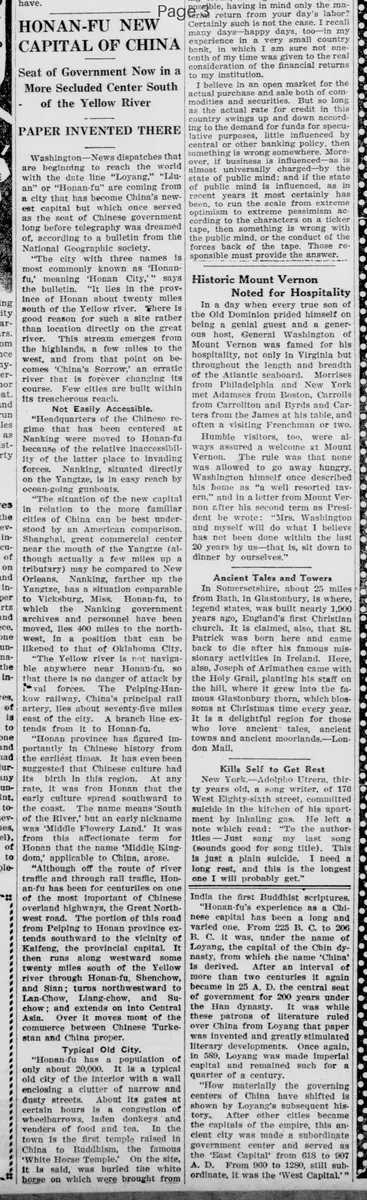
Capital of China
Seat of Government Now in a
More Secluded Center South
of the Yellow River
PAPER INVENTED THERE
Washington-News dispatches that
are beginning to reach the world
with the date line "Loyang," "Liu-
nan" or "Honan-fu" are coming from
a city that has become China's new-
est capital but which once served
as the seat of Chinese government
long before telegraphy was dreamed
of, according to a bulletin from the
National Geographic society.
The city with three names is
most commonly known as 'Honan-
fu,' meaning 'Honan City,'" says
the bulletin.
"It lies in the prov-
ince of Honan about twenty miles
south of the Yellow river. Here is
good reason for such a site rather
than location directly on the great
river. This stream emerges from
the highlands, a few miles to the
west, and from that point on be-
comes 'China's Sorrow,' an erratic
river that is forever changing its
course. Few cities are built within
its treacherous reach.
Not Easily Accessible.
"Headquarters of the Chinese re-
gime that has been centered at
Nanking were moved to Honan-fu
because of the relative inaccessibil-
ity of the latter place to invading
forces. Nanking, situated directly
on the Yangtze, is in easy reach by
ocean-going gunboats.
"The situation of the new capital
in relation to the more familiar
cities of China can be best under-
stood by an American comparison.
Shanghai, great commercial center
near the mouth of the Yangtze (al-
though actually a few miles up a
tributary) may be compared to New
Orleans. Nanking, farther up the
Yangtze, has a situation comparable
to Vicksburg, Miss. Honan-fu, to
which the Nanking government
archives and personnel have been
moved, lies 400 miles to the north-
west, in a position that can be
likened to that of Oklahoma City.
"The Yellow river is not naviga-
ble anywhere near Honan-fu, so
that there is no danger of attack by
naval forces. The Peiping-Han-
kow railway, China's principal rail
artery, lies about seventy-five miles
east of the city. A branch line ex-
tends from it to Honan-fu.
"Honan province has figured im-
portantly in Chinese history from
the earliest times. It has even been
suggested that Chinese culture had
its birth in this region. At any
rate, it was from Honan that the
early culture spread southward to
the coast. The name means 'South
of the River,' but an early nickname
was 'Middle Flowery Land.' It was
from this affectionate term for
Honan that the name 'Middle King-
dom,' applicable to China, arose.
"Although off the route of river
traffic and through rail traffic, Hon-
an-fu has been for centuries on one
of the most important of Chinese
overland highways, the Great North-
west road. The portion of this road
from Peiping to Honan province ex-
tends southward to the vicinity of
Kaifeng, the provincial capital. It
then runs along westward some
twenty miles south of the Yellow
river through Honan-fu, Shenchow,
and Sian; turns northwestward to
Lan-Chow, Liang-chow, and Su-
chow; and extends on into Central
Asia.
Over it moves most of the
commerce between Chinese Turke-
stan and China proper.
Typical Old City.
"Honan-fu has a population of
only about 20,000. It is a typical
old city of the interior with a wall
enclosing a clutter of narrow and
dusty streets.
About its gates at
certain hours is a congestion of
wheelbarrows, laden donkeys and
vendors of food and tea. In the
town is the first temple raised in
China to Buddhism, the famous
'White Horse Temple.' On the site,
it is said, was buried the white
horse from India the first Buddhist scriptures.
"Honan-fu's experience as a Chi-
nese capital has been a long and
varied one. From 225 B. C. to 206
B. C. it was, under the name of
Loyang, the capital of the Chin dy-
nasty, from which the name 'China'
is derived.
After an interval of
more than two centuries it again
became in 25 A. D. the central seat
of government for 200 years under
the Han dynasty. It was while
these patrons of literature ruled
over China from Loyang that paper
was invented and greatly stimulated
literary developments. Once again,
in 589, Loyang was made imperial
capital and remained such for a
quarter of a century.
"How materially the governing
centers of China have shifted is
shown by Loyang's subsequent his-
tory. After other cities became
the capitals of the empire, this an-
ient city was made a subordinate
government center and served as
the 'East Capital' from 618 to 907
A. D. From 960 to 1120, still sub-
ordinate, it was the 'West Capital.'"
What sub-type of article is it?
What keywords are associated?
Where did it happen?
Foreign News Details
Primary Location
Honan Fu, China
Outcome
chinese government headquarters moved from nanking to honan-fu for strategic inaccessibility to invaders.
Event Details
The Chinese regime relocated its seat of government from Nanking on the Yangtze River to Honan-fu in Honan province, about 20 miles south of the Yellow River, due to the latter's seclusion from naval and easy access by invading forces. Honan-fu, also known as Loyang or Liu-nan, has a rich history as an ancient capital under multiple dynasties, birthplace of paper invention, and lies on important overland trade routes.