Thank you for visiting SNEWPapers!
Sign up free
The New Hampshire Gazette And General Advertiser
Portsmouth, Exeter, Rockingham County, New Hampshire
What is this article about?
Lord Abingdon's speech in the House of Lords on February 4, 1782, criticizes the execution of Col. Haynes in Charlestown as a barbarous murder, comparing it to broader atrocities of the American War, Benedict Arnold's reception, and governmental failures, urging the removal of the 'efficient Cabinet' as the root cause.
Clipping
OCR Quality
Full Text
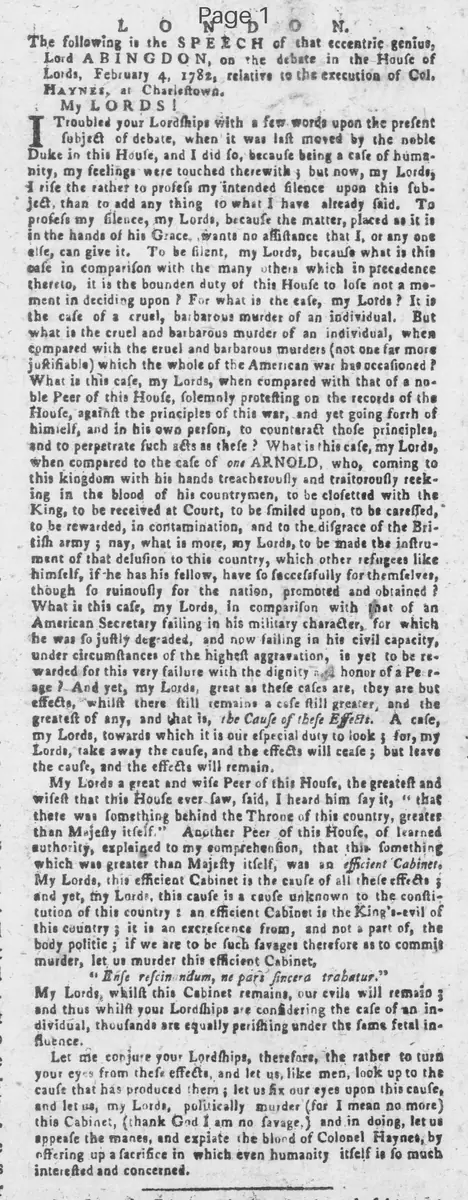
The following is the SPEECH of that eccentric genius, Lord ABINGDON, on the debate in the House of Lords, February 4, 1782, relative to the execution of Col. Haynes, at Charlestown.
My LORDS!
Troubled your Lordships with a few words upon the present subject of debate, when it was last moved by the noble Duke in this House, and I did so, because being a case of humanity, my feelings were touched therewith; but now, my Lords, I rise the rather to profess my intended silence upon this subject, than to add any thing to what I have already said. To profess my silence, my Lords, because the matter, placed as it is in the hands of his Grace, wants no assistance that I, or any one else, can give it. To be silent, my Lords, because what is this case in comparison with the many others which in precedence thereto, it is the bounden duty of this House to lose not a moment in deciding upon? For what is the case, my Lords? It is the case of a cruel, barbarous murder of an individual. But what is the cruel and barbarous murder of an individual, when compared with the cruel and barbarous murders (not one far more justifiable) which the whole of the American war has occasioned? What is this case, my Lords, when compared with that of a noble Peer of this House, solemnly protesting on the records of the House, against the principles of this war, and yet going forth of himself, and in his own person, to counteract those principles, and to perpetrate such acts as these? What is this case, my Lords, when compared to the case of one ARNOLD, who, coming to this kingdom with his hands treacherously and traitorously reeking in the blood of his countrymen, to be closetted with the King, to be received at Court, to be smiled upon, to be caressed, to be rewarded, in contamination, and to the disgrace of the British army; nay, what is more, my Lords, to be made the instrument of that delusion to this country, which other refugees like himself, if he has his fellow, have so successfully for themselves, though so ruinously for the nation, promoted and obtained? What is this case, my Lords, in comparison with that of an American Secretary failing in his military character, for which he was so justly degraded, and now failing in his civil capacity, under circumstances of the highest aggravation, is yet to be rewarded for this very failure with the dignity and honor of a Peerage? And yet, my Lords, great as these cases are, they are but effects, whilst there still remains a case still greater, and the greatest of any, and that is, the Cause of these Effects. A case, my Lords, towards which it is our especial duty to look; for, my Lords, take away the cause, and the effects will cease; but leave the cause, and the effects will remain.
My Lords, a great and wise Peer of this House, the greatest and wisest that this House ever saw, said, I heard him say it, "that there was something behind the Throne of this country, greater than Majesty itself." Another Peer of this House, of learned authority, explained to my comprehension, that this something which was greater than Majesty itself, was an efficient Cabinet. My Lords, this efficient Cabinet is the cause of all these effects; and yet, my Lords, this cause is a cause unknown to the constitution of this country: an efficient Cabinet is the King's-evil of this country; it is an excrescence from, and not a part of, the body politic; if we are to be such savages therefore as to commit murder, let us murder this efficient Cabinet,
"Ene recinandum, ne pars incera trabatur."
My Lords, whilst this Cabinet remains, our evils will remain; and thus whilst your Lordships are considering the case of an individual, thousands are equally perishing under the same fatal influence.
Let me conjure your Lordships, therefore, the rather to turn your eyes from these effects, and let us, like men, look up to the cause that has produced them; let us fix our eyes upon this cause, and let us, my Lords, politically murder (for I mean no more) this Cabinet, (thank God I am no savage) and in doing, let us appease the manes, and expiate the blood of Colonel Hayne, by offering up a sacrifice in which even humanity itself is so much interested and concerned.
What sub-type of article is it?
What keywords are associated?
What entities or persons were involved?
Where did it happen?
Foreign News Details
Primary Location
Charlestown
Event Date
February 4, 1782
Key Persons
Outcome
cruel and barbarous murder of col. haynes; broader american war murders and atrocities; criticism of rewards to arnold and the american secretary
Event Details
Lord Abingdon speaks in the House of Lords on the execution of Col. Haynes in Charlestown, deeming it a barbarous murder, and compares it to the atrocities of the American War, the reception of Benedict Arnold, failures of the American Secretary, and calls for the political removal of the 'efficient Cabinet' as the root cause.