Thank you for visiting SNEWPapers!
Sign up free
The Daily Crescent
New Orleans, Orleans County, Louisiana
What is this article about?
In a June 7, 1849 letter to the Crescent editors from Mobile, Albert Stein defends Samuel J. Peters from blame in the failed closure of the Sauve's crevasse on the Mississippi River. He critiques the pile-driving method, proposes alternatives, and warns of future flooding risks, drawing historical parallels to the Rhine River.
Clipping
OCR Quality
Full Text
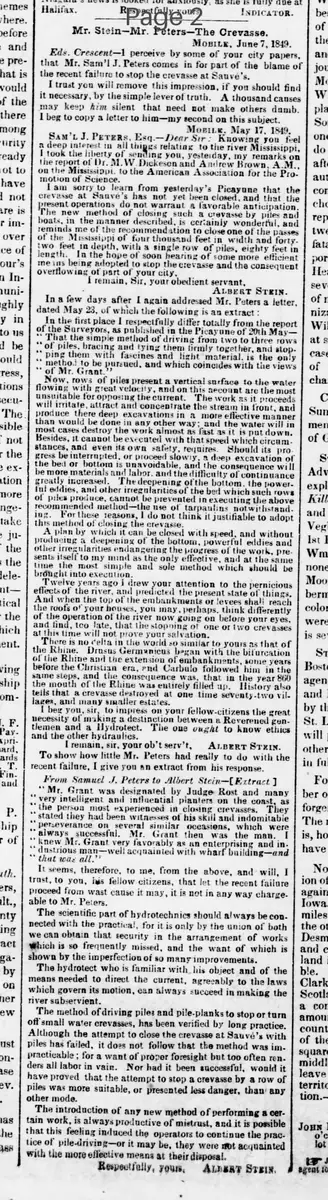
MOBILE, June 7, 1849.
Eds. Crescent—I perceive by some of your city papers, that Mr. Sam'l J. Peters comes in for part of the blame of the recent failure to stop the crevasse at Sauve's. I trust you will remove this impression, if you should find it necessary, by the simple lever of truth. A thousand causes may keep him silent that need not make others dumb. I beg to copy a letter to him—my second on this subject.
SAM'L J. PETERS, Esq.—Dear Sir: Knowing you feel a deep interest in all things relating to the river Mississippi, I took the liberty of sending you, yesterday, my remarks on the report of Dr. M. W. Dickeson and Andrew Brown, A. M., on the Mississippi, to the American Association for the Promotion of Science.
I am sorry to learn from yesterday's Picayune that the crevasse at Sauve's has not yet been closed, and that the present operations do not warrant a favorable anticipation. The new method of closing such a crevasse by piles and boats, in the manner described, is certainly wonderful, and reminds me of the recommendation to close one of the passes of the Mississippi of four thousand feet in width and forty-two feet in depth, with a single row of piles, eighty feet in length. In the hope of soon hearing of some more efficient means being adopted to stop the crevasse and the consequent overflowing of part of your city.
I remain, Sir, your obedient servant,
ALBERT STEIN.
In a few days after I again addressed Mr. Peters a letter, dated May 23, of which the following is an extract:
In the first place I respectfully differ totally from the report of the Surveyors, as published in the Picayune of 20th May—That the simple method of driving from two to three rows of piles, bracing and tying them firmly together, and stopping them with fascines and light material, is the only method to be pursued, and which coincides with the views of Mr. Grant.
Now, rows of piles present a vertical surface to the water flowing with great velocity, and on this account are the most unsuitable for opposing the current. The work as it proceeds will irritate, attract and concentrate the stream in front, and produce there deep excavations in a more effective manner than would be done in any other way; and the water will in most cases destroy the work almost as fast as it is put down. Besides, it cannot be executed with that speed which circumstances, and even its own safety, requires. Should its progress be interrupted, or proceed slowly, a deep excavation of the bed or bottom is unavoidable, and the consequence will be more materials and labor, and the difficulty of continuance greatly increased. The deepening of the bottom, the powerful eddies, and other irregularities of the bed which such rows of piles produce, cannot be prevented in executing the above recommended method—the use of tarpaulins notwithstanding. For these reasons, I do not think it justifiable to adopt this method of closing the crevasse.
A plan by which it can be closed with speed, and without producing a deepening of the bottom, powerful eddies and other irregularities endangering the progress of the work, presents itself to my mind as the only effective, and at the same time the most simple and sole method which should be brought into execution.
Twelve years ago I drew your attention to the pernicious effects of the river, and predicted the present state of things. And when the top of the embankments or levees shall reach the roofs of your houses, you may, perhaps, think differently of the operation of the river now going on before your eyes, and find, too late, that the stopping of one or two crevasses at this time will not prove your salvation.
There is no delta in the world so similar to yours as that of the Rhine. Drusus Germanicus began with the bifurcation of the Rhine and the extension of embankments, some years before the Christian era, and Caracalla followed him in the same steps, and the consequence was, that in the year 860 the mouth of the Rhine was entirely filled up. History also tells that a crevasse destroyed at one time seventy-two villages, and many smaller estates.
I beg you, sir, to impress on your fellow-citizens the great necessity of making a distinction between a Reverend gentleman and a Hydrotechnic. The one ought to know ethics and the other hydraulics.
I remain, sir, your ob't serv't,
ALBERT STEIN.
To show how little Mr. Peters had really to do with the recent failure, I give you an extract from his response.
From Samuel J. Peters to Albert Stein—[Extract]
Mr. Grant was designated by Judge Rost and many very intelligent and influential planters on the coast, as the person most experienced in closing crevasses. They stated they had been witnesses of his skill and indomitable perseverance on several similar occasions, which were always successful. Mr. Grant then was the man. I knew Mr. Grant very favorably as an enterprising and industrious man—well acquainted with wharf building—and that was all.
It seems, therefore, to me, from the above, and will, I trust, to you, his fellow citizens, that let the recent failure proceed from what cause it may, it is not in any way chargeable to Mr. Peters.
The scientific part of hydrotechnics should always be connected with the practical, for it is only by the union of both we can obtain that security in the arrangement of works which is so frequently missed, and the want of which is shown by the imperfection of so many improvements.
The hydrotechnic who is familiar with his object and of the means needed to direct the current, agreeably to the laws which govern its motion, can always succeed in making the river subservient.
The method of driving piles and pile-planks to stop or turn off small water crevasses, has been verified by long practice. Although the attempt to close the crevasse at Sauvé's with piles has failed, it does not follow that the method was impracticable; for a want of proper foresight but too often renders all labor in vain. Nor had it been successful, would it have proved that the attempt to stop a crevasse by a row of piles was more suitable, or presented less danger, than any other mode.
The introduction of any new method of performing a certain work, is always productive of mistrust, and it is possible that this feeling induced the operators to continue the practice of pile-driving—or it may be, they were not acquainted with the more effective means at their disposal.
Respectfully, yours, ALBERT STEIN.
What sub-type of article is it?
What themes does it cover?
What keywords are associated?
What entities or persons were involved?
Letter to Editor Details
Author
Albert Stein
Recipient
Eds. Crescent
Main Argument
samuel j. peters should not be blamed for the failure to close the sauve's crevasse, as he was not directly involved; the pile-driving method is ineffective and dangerous, and better hydrotechnic approaches are needed to manage the mississippi river and prevent future disasters.
Notable Details