Thank you for visiting SNEWPapers!
Sign up free
Story
January 23, 1899
The Times
Washington, District Of Columbia
What is this article about?
Review and announcement of artist Richard N. Brooke's major individual exhibition of 90 oil and pastel works at Washington's S.W.A. galleries, emphasizing his tonal mastery, versatility in landscapes and figures, and the event's significance amid personal circumstances. (198 characters)
Clipping
OCR Quality
98%
Excellent
Full Text
THE BROOKE EXHIBITION
Promise of a Rare Treat to Washington's Art World.
FINE TONE PICTURE WORK
Popularity of Individual Displays—
Excellent Things in Small Proportions—The Remodeled S. W. A. Galleries—Other Notes of Interest to Painters—Versatility and its Surprises.
Richard N. Brooke's exhibition of works in oil and pastel colors will open today in the S. W. A. galleries. It will continue throughout the week and admission will be free. No one interested in the higher things accomplished in strictly local art circles should miss this opportunity to see these excellent pictures. To the fraternity this exhibition is only a little less important than the annual exhibition of the society. Mr. Brooke's reputation is secure and his name stands for the most unswerving devotion to the very highest art ideals. It is, therefore, a matter of great interest to the more serious of local painters what impression this collection of pictures will make upon the Washington public.
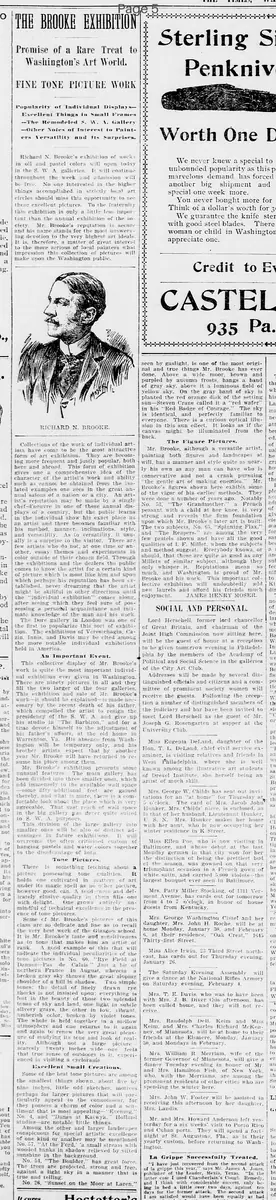
RICHARD N. BROOKE.
Collections of the work of individual artists have come to be the most attractive form of art exhibition. They are becoming more frequent and justly popular, both here and abroad. This form of exhibition gives one a comprehensive idea of the character of the artist's work and ability such as cannot be obtained from the isolated examples one sees in the great annual salons of a nation or a city. An artist's reputation may be made by a single chef-d'oeuvre in one of these annual displays of a country, but the public learns in the individual show his exact place as an artist and there becomes familiar with his method, manner, inclinations, style, and versatility. As to versatility, it usually is a surprise to the visitor. There are few artists who do not, at one time or another, essay themes and experiments in color outside of their chosen field. Through the exhibitions and the dealers the public comes to know the artist for a certain kind of picture which is most like him and upon which perhaps his reputation has been established, never dreaming that the artist might be skillful in other directions until the "individual exhibition" comes along, after seeing which they feel sure of possessing a personal acquaintance and intimate knowledge of the man and his work.
The Dore gallery in London was one of the first to popularize this sort of exhibition. The exhibitions of Verestchagin, Cazin, Inness, and Davis may be cited among the more notable individual exhibitions held in America.
An Important Event.
This collective display of Mr. Brooke's work is quite the most important individual exhibition ever given in Washington. There are ninety pictures in all and they fill the two larger of the four galleries. This exhibition and sale of Mr. Brooke's work—it should be explained—is made necessary by the recent death of his father, which compelled the artist to resign the presidency of the S. W. A. and give up his studio in "The Barbizon," and for a time devote himself to the adjustment of his father's affairs, at the old home in Warrenton, Va. His absence from Washington will be temporary only, and his brother artists expect that by another year Mr. Brooke will have returned to resume his place among them.
Mr. Brooke's exhibition presents some unusual features. The main gallery has been divided into three smaller ones, which add immensely to the available wall space—some fifty additional feet are gained thereby, and what is more, there is a comfortable look about the place which is very agreeable. That vast reach of wall space in the big gallery was never quite suited to S. W. A. purposes.
This division of the large gallery into smaller ones will be also of distinct advantage in future exhibitions. It will overcome the often criticised custom of hanging pastels and water colors together to the disadvantage of both.
Tone Pictures.
There is something fetching about a picture possessing tone qualities. It holds one cultivated in matters of art under its magic spell as no other picture, however good, can. A tenderness and delicately elusive quality in them fills one with delight. One grows entirely unmindful of technical excellence in the presence of tone pictures.
Some of Mr. Brooke's pictures of this class are so delicate and fine as to recall the very best work of the Glasgow school. It is Mr. Brooke's taste and sensitiveness as to tone that makes him an artist of rank. A good example of this that will indicate the individual peculiarities of the tone pictures is No. 60, "Rye Field at Dannes—Pas de Calais." Just a bit of northern France in August, wherein a broken gray sky throws the great sloping shoulder of a hill in shadow. Two simple tones: the detail of finely drawn rye shocks is not insisted upon: everything is lost in the beauty of those two splendid tones of sky and land, one light in subtle silvery grays, the other in low, vibrant, umberish color, broken by violet tones. The whole is held together in a mellow atmosphere and one returns to it again and again to renew the very great pleasure of studying its tone and look of reality. Although not a large picture, scarcely twenty inches wide, one feels that true sense of outdoors in it, experienced in visiting a cyclorama.
Excellent Small Creations.
Some of the best tone pictures are among the smallest things shown, about five by nine inches, little odd sketches, motives perhaps for larger pictures that will particularly appeal to the connoisseur, for they possess a charm of color and a sentiment that is most appealing—"Evening," No. 4, and "Dunes at Katwyk," Holland studies—are notable little things.
Among the other and larger landscapes conspicuous for special artistic excellence of one kind or another may be mentioned No. 57, "At the Ford," a small stream with wooded banks in shadow relieved by sifted sunshine in the background.
No. 54, "The Boulder," has great force. The trees are projected, strong and free, against a light sky in a manner that is true and telling.
No. 26, "Sunset on the Moor at Laren,"
seen by gaslight, is one of the most original and true things Mr. Brooke has ever done. Above a wide moor, brown and purpled by autumn frosts, hangs a band of gray sky, above it a luminous field of yellow sky. On the gray band of sky is planted the red orange disk of the setting sun—Stephen Crane called it a "red wafer" in his "Red Badge of Courage."
The sky is identical, and perfectly familiar to everyone. There is a curious optical illusion in this sun effect. It looks as if the canvas might be illuminated from the back.
The Figure Pictures.
Mr. Brooke, although a versatile artist, painting both figures and landscapes at will, has a manner and style quite as nearly his own as any man can have who is conservative and not a crank pursuing "the gentle art of making enemies."
Mr. Brooke's figures shown here exhibit some of the vigor of his earlier methods. They were done a number of years ago. Notably No. 53, "The Grandmother," a French peasant with a child at her knee, is very strong and reveals the firm foundation upon which Mr. Brooke's later art is built.
The two subjects, No. 65, "Spinning Flax," and "The Reapers," are among the very few pastels shown and have all the good qualities of J. F. Millet, whom the subjects and method suggest. Everybody knows, or should, that these are quite as good as any Millets of similar subject, although they only whisper it. Reputations mean so much, and Washington is proud of Mr. Brooke and his work. This important collective exhibition will undoubtedly add new laurels and afford his friends much enjoyment.
JAMES HENRY MOSER.
Promise of a Rare Treat to Washington's Art World.
FINE TONE PICTURE WORK
Popularity of Individual Displays—
Excellent Things in Small Proportions—The Remodeled S. W. A. Galleries—Other Notes of Interest to Painters—Versatility and its Surprises.
Richard N. Brooke's exhibition of works in oil and pastel colors will open today in the S. W. A. galleries. It will continue throughout the week and admission will be free. No one interested in the higher things accomplished in strictly local art circles should miss this opportunity to see these excellent pictures. To the fraternity this exhibition is only a little less important than the annual exhibition of the society. Mr. Brooke's reputation is secure and his name stands for the most unswerving devotion to the very highest art ideals. It is, therefore, a matter of great interest to the more serious of local painters what impression this collection of pictures will make upon the Washington public.
RICHARD N. BROOKE.
Collections of the work of individual artists have come to be the most attractive form of art exhibition. They are becoming more frequent and justly popular, both here and abroad. This form of exhibition gives one a comprehensive idea of the character of the artist's work and ability such as cannot be obtained from the isolated examples one sees in the great annual salons of a nation or a city. An artist's reputation may be made by a single chef-d'oeuvre in one of these annual displays of a country, but the public learns in the individual show his exact place as an artist and there becomes familiar with his method, manner, inclinations, style, and versatility. As to versatility, it usually is a surprise to the visitor. There are few artists who do not, at one time or another, essay themes and experiments in color outside of their chosen field. Through the exhibitions and the dealers the public comes to know the artist for a certain kind of picture which is most like him and upon which perhaps his reputation has been established, never dreaming that the artist might be skillful in other directions until the "individual exhibition" comes along, after seeing which they feel sure of possessing a personal acquaintance and intimate knowledge of the man and his work.
The Dore gallery in London was one of the first to popularize this sort of exhibition. The exhibitions of Verestchagin, Cazin, Inness, and Davis may be cited among the more notable individual exhibitions held in America.
An Important Event.
This collective display of Mr. Brooke's work is quite the most important individual exhibition ever given in Washington. There are ninety pictures in all and they fill the two larger of the four galleries. This exhibition and sale of Mr. Brooke's work—it should be explained—is made necessary by the recent death of his father, which compelled the artist to resign the presidency of the S. W. A. and give up his studio in "The Barbizon," and for a time devote himself to the adjustment of his father's affairs, at the old home in Warrenton, Va. His absence from Washington will be temporary only, and his brother artists expect that by another year Mr. Brooke will have returned to resume his place among them.
Mr. Brooke's exhibition presents some unusual features. The main gallery has been divided into three smaller ones, which add immensely to the available wall space—some fifty additional feet are gained thereby, and what is more, there is a comfortable look about the place which is very agreeable. That vast reach of wall space in the big gallery was never quite suited to S. W. A. purposes.
This division of the large gallery into smaller ones will be also of distinct advantage in future exhibitions. It will overcome the often criticised custom of hanging pastels and water colors together to the disadvantage of both.
Tone Pictures.
There is something fetching about a picture possessing tone qualities. It holds one cultivated in matters of art under its magic spell as no other picture, however good, can. A tenderness and delicately elusive quality in them fills one with delight. One grows entirely unmindful of technical excellence in the presence of tone pictures.
Some of Mr. Brooke's pictures of this class are so delicate and fine as to recall the very best work of the Glasgow school. It is Mr. Brooke's taste and sensitiveness as to tone that makes him an artist of rank. A good example of this that will indicate the individual peculiarities of the tone pictures is No. 60, "Rye Field at Dannes—Pas de Calais." Just a bit of northern France in August, wherein a broken gray sky throws the great sloping shoulder of a hill in shadow. Two simple tones: the detail of finely drawn rye shocks is not insisted upon: everything is lost in the beauty of those two splendid tones of sky and land, one light in subtle silvery grays, the other in low, vibrant, umberish color, broken by violet tones. The whole is held together in a mellow atmosphere and one returns to it again and again to renew the very great pleasure of studying its tone and look of reality. Although not a large picture, scarcely twenty inches wide, one feels that true sense of outdoors in it, experienced in visiting a cyclorama.
Excellent Small Creations.
Some of the best tone pictures are among the smallest things shown, about five by nine inches, little odd sketches, motives perhaps for larger pictures that will particularly appeal to the connoisseur, for they possess a charm of color and a sentiment that is most appealing—"Evening," No. 4, and "Dunes at Katwyk," Holland studies—are notable little things.
Among the other and larger landscapes conspicuous for special artistic excellence of one kind or another may be mentioned No. 57, "At the Ford," a small stream with wooded banks in shadow relieved by sifted sunshine in the background.
No. 54, "The Boulder," has great force. The trees are projected, strong and free, against a light sky in a manner that is true and telling.
No. 26, "Sunset on the Moor at Laren,"
seen by gaslight, is one of the most original and true things Mr. Brooke has ever done. Above a wide moor, brown and purpled by autumn frosts, hangs a band of gray sky, above it a luminous field of yellow sky. On the gray band of sky is planted the red orange disk of the setting sun—Stephen Crane called it a "red wafer" in his "Red Badge of Courage."
The sky is identical, and perfectly familiar to everyone. There is a curious optical illusion in this sun effect. It looks as if the canvas might be illuminated from the back.
The Figure Pictures.
Mr. Brooke, although a versatile artist, painting both figures and landscapes at will, has a manner and style quite as nearly his own as any man can have who is conservative and not a crank pursuing "the gentle art of making enemies."
Mr. Brooke's figures shown here exhibit some of the vigor of his earlier methods. They were done a number of years ago. Notably No. 53, "The Grandmother," a French peasant with a child at her knee, is very strong and reveals the firm foundation upon which Mr. Brooke's later art is built.
The two subjects, No. 65, "Spinning Flax," and "The Reapers," are among the very few pastels shown and have all the good qualities of J. F. Millet, whom the subjects and method suggest. Everybody knows, or should, that these are quite as good as any Millets of similar subject, although they only whisper it. Reputations mean so much, and Washington is proud of Mr. Brooke and his work. This important collective exhibition will undoubtedly add new laurels and afford his friends much enjoyment.
JAMES HENRY MOSER.
What sub-type of article is it?
Biography
Historical Event
What themes does it cover?
Triumph
Moral Virtue
What keywords are associated?
Art Exhibition
Richard Brooke
Tone Pictures
Pastels
Washington Art
What entities or persons were involved?
Richard N. Brooke
James Henry Moser
Where did it happen?
S. W. A. Galleries, Washington
Story Details
Key Persons
Richard N. Brooke
James Henry Moser
Location
S. W. A. Galleries, Washington
Event Date
Will Open Today
Story Details
Richard N. Brooke's exhibition of ninety oil and pastel pictures opens in the remodeled S. W. A. galleries, showcasing his tone landscapes, figure works, and versatility, prompted by his father's death; highlights include 'Rye Field at Dannes,' 'The Grandmother,' and comparisons to Millet.