Thank you for visiting SNEWPapers!
Sign up free
The Rhode Island Republican
Newport, Newport County, Rhode Island
What is this article about?
British polar expedition ships reported well off Spitzbergen. Danish sources note 50 sq mi ice breakup off Greenland, opening access after 400 years to lat. 81°. This explains Denmark's recent anomalous weather: south-east storms, heat, electrical atmosphere, hot nights, cold humid summers over three years.
Clipping
OCR Quality
Full Text
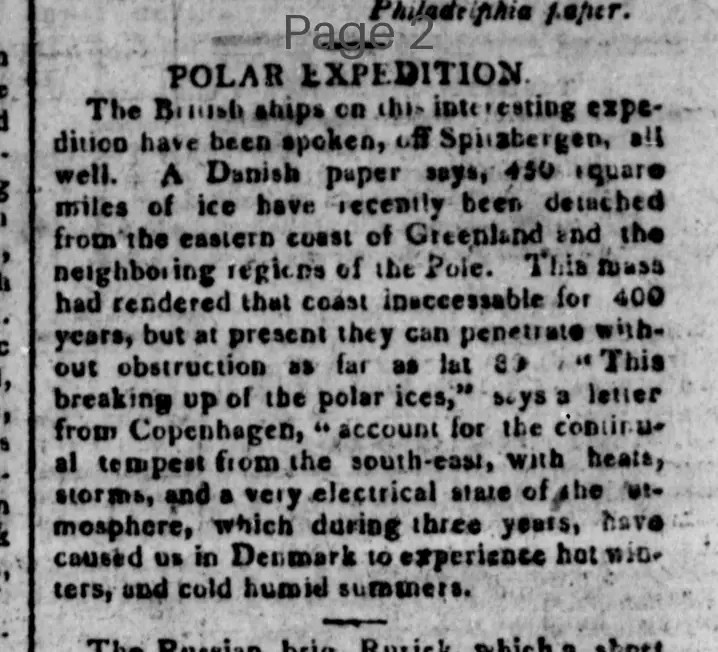
The British ships on this interesting expedition have been spoken, off Spitzbergen, all well. A Danish paper says, 50 square miles of ice have recently been detached from the eastern coast of Greenland and the neighboring regions of the Pole. This mass had rendered that coast inaccessible for 400 years, but at present they can penetrate without obstruction as far as lat. 81°; "This breaking up of the polar ices," says a letter from Copenhagen, "account for the continual tempest from the south-east, with heat, storms, and a very electrical state of the atmosphere, which during three years, have caused us in Denmark to experience hot nights, and cold humid summers."
What sub-type of article is it?
What keywords are associated?
Where did it happen?
Foreign News Details
Primary Location
Spitzbergen
Outcome
50 square miles of ice detached from eastern coast of greenland, rendering it accessible for the first time in 400 years up to latitude 81°; accounts for unusual weather in denmark including south-east tempests, heat, storms, electrical atmosphere, hot nights, and cold humid summers over three years
Event Details
British ships on polar expedition spoken off Spitzbergen, all well. Danish paper reports recent detachment of 50 square miles of ice from eastern Greenland coast and polar regions. This mass had previously made the coast inaccessible for 400 years, but now penetration is possible without obstruction to latitude 81°. A letter from Copenhagen attributes the breaking up of polar ices to continual south-east tempests, heat, storms, and electrical atmosphere, causing hot nights and cold humid summers in Denmark for three years.