Thank you for visiting SNEWPapers!
Sign up free
Editorial
August 18, 1837
Burlington Free Press
Burlington, Chittenden County, Vermont
What is this article about?
Editorial criticizes Jackson and Van Buren's banking policies, the failure of the pet bank system, and the proposed sub-treasury as corrupt. Urges voters to elect change for prosperity. Includes Jackson's letter endorsing government control of revenues.
Clipping
OCR Quality
95%
Excellent
Full Text
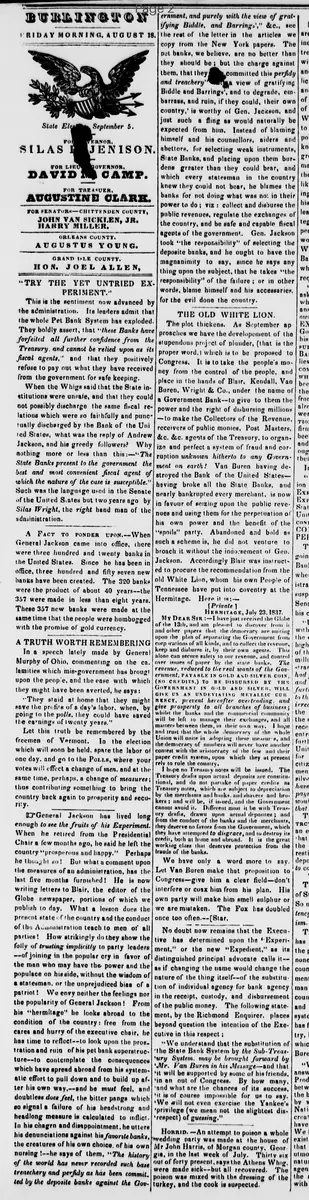
"TRY THE YET UNTRIED EXPERIMENT."
This is the sentiment now advanced by the administration. Its leaders admit that the whole Pet Bank System has exploded. They boldly assert, that "these Banks have forfeited all further confidence from the Treasury, and cannot be relied upon as its fiscal agents," and that they positively refuse to pay out what they have received from the government for safe keeping.
When the Whigs said that the State institutions were unsafe, and that they could not possibly discharge the same fiscal relations which were so faithfully and punctually discharged by the Bank of the United States, what was the reply of Andrew Jackson, and his greedy followers? Why nothing more or less than this:—"The State Banks present to the government the best and most convenient fiscal agent of which the nature of the case is susceptible."
Such was the language used in the Senate of the United States but two years ago by Silas Wright, the right hand man of the administration.
A FACT TO PONDER UPON.—When General Jackson came into office, there were three hundred and twenty banks in the United States. Since he has been in office, three hundred and fifty seven new banks have been created. The 320 banks were the product of about 40 years—the 357 were made in less than eight years. These 357 new banks were made at the same time that the people were humbugged with the promise of gold currency.
A TRUTH WORTH REMEMBERING
In a speech lately made by General Murphy of Ohio, commenting on the calamities which mis-government has brought upon the people, and the ease with which they might have been averted, he says:
“…They staid at home that they might save the profits of a day's labor, when, by going to the polls, they could have saved the earnings of twenty years."
Let this truth be remembered by the freemen of Vermont. In the election which will soon be held, spare the labor of one day, and go to the Polls, where your votes will effect a change of men, and at the same time, perhaps, a change of measures; thus contributing something to bring the country back again to prosperity and security.
General Jackson has lived long enough to see the fruits of his Experiment. When he retired from the Presidential Chair a few months ago, he said he left the country "prosperous and happy." Perhaps he thought so! But what a comment upon the measures of an administration, has the last five months furnished! He is now writing letters to Blair, the editor of the Globe newspaper, portions of which we publish to day. What a lesson does the present state of the country and the conduct of the Administration teach to men of all parties! How strikingly do they show the folly of trusting implicitly to party leaders—of joining in the popular cry in favor of the man who may have the power and the populace on his side, without the wisdom of statesman, or the unprejudiced bias of a patriot! We envy neither the feelings nor the popularity of General Jackson! From his "hermitage" he looks abroad to the condition of the country: free from the cares and hurry of the executive chair, he has time to reflect—to look upon the prostration and ruin of his pet bank superstructure—to contemplate the consequences which have spread abroad from his systematic effort to pull down and to build up after his own way,—and he must feel, and doubtless does feel, the bitter pangs which so signal a failure of his headstrong and headlong measure is calculated to inflict. In his chagrin and disappointment, he utters his denunciations against his favorite banks, the creatures of his own choice, of his own nursing!—he says of them, "The history of the world has never recorded such base treachery and perfidy as has been committed by the deposite banks against the Government, and purely with the view of gratifying Biddle, and the Barings,'" &c., see the rest of the letter in the articles we copy from the New York papers. The pet banks, we believe, are no better than they should be; but the charge against them, that they committed this perfidy and treachery in view of gratifying Biddle and the Barings', and to degrade, embarrass, and ruin, if they could, their own country, is worthy of Gen. Jackson, and just such a fling as would naturally be expected from him. Instead of blaming himself and his counsellors, aiders and abettors, for selecting weak instruments, State Banks, and placing upon them burdens greater than they could bear, and which every statesman in the country knew they could not bear, he blames the banks for not doing what was not in their power to do: viz: collect and disburse the public revenues, regulate the exchanges of the country, and be safe and capable fiscal agents of the government. Gen. Jackson took "the responsibility" of selecting the deposite banks, and he ought to have the magnanimity to say, since he says anything upon the subject, that he takes "the responsibility" of the failure; or in other words, blame himself and his accessories, for the evil done the country.
THE OLD WHITE LION.
The plot thickens. As September approaches we have the development of the stupendous project of plunder, (that is the proper word,) which is to be proposed to Congress. It is to take the people's money from the control of the people, and place in the hands of Blair, Kendall, Van Buren, Wright & Co., under the name of a Government Bank—to give to them the power and the right of disbursing millions—to make the Collectors of the Revenue, receivers of public monies, Post Masters, &c. &c. agents of the Treasury, to organize and perfect a system of fraud and corruption unknown hitherto to any Government on earth! Van Buren having destroyed the Bank of the United States—having broke all the State Banks, and nearly bankrupted every merchant, is now in favour of seizing upon the public revenues and using them for the perpetuation of his own power and the benefit of the "spoils" party. Abandoned and bold as such a scheme is, he did not venture to broach it without the endorsement of Gen. Jackson. Accordingly Blair was instructed to procure the recommendation from the old White Lion, whom his own People of Tennessee have put into coventry at the Hermitage.
Here it is:—
[Private]
HERMITAGE, July 23, 1837.
My Dear Sir:—I have just received the Globe of the 13th, and am pleased to discover from it and other papers that the democracy are uniting upon the plan of separating the Government from corporations of all kinds, and to collect the revenue, keep and disburse it, by their own agents. This alone can secure safety to our revenue, and control over issues of paper by the state banks. The revenue, reduced to the real wants of the Government, PAYABLE IN GOLD AND SILVER COIN, NO CREDITS,) TO BE DISBURSED BY THE GOVERNMENT IN GOLD AND SILVER, WILL GIVE US AN UNDEVIATING METALLIC CURRENCY, prevent hereafter overtrading, and give prosperity to all branches of business; whilst the banks and the commercial community will be left to manage their exchanges, and all matters between them, in their own way. I hope and trust that the whole democracy of the whole Union will unite in adopting these measures, and the democracy of numbers will never have another contest with the aristocracy of the few and their paper credit system, upon which they at present rely to rule the country.
I hope no Treasury notes will be issued. The Treasury drafts upon actual deposits are constitutional, and do not partake of paper credits as Treasury notes, which are subject to depreciation by the merchants and banks, and shavers and brokers: and will be, if issued, and the Government cannot avoid it. Different must it be with Treasury drafts, drawn upon actual deposites: and from the conduct of the banks and the merchants, they deserve no favors from the Government, which they have attempted to disgrace, and to destroy its credit, both at home and abroad. It is the great working class that deserves protection from the frauds of the banks.
We have only a word more to say. Let Van Buren make that proposition to Congress—give him a clear field—don't interfere or coax him from his plan. His own party will make him smell sulphur or we are mistaken. The Fox has doubled once too often.—[Star.
No doubt now remains that the Executive has determined upon the "Experiment," or the new "Expedient," as its distinguished principal advocate calls it—as if changing the name would change the nature of the thing itself—of the substitution of individual agency for bank agency in the receipt, custody, and disbursement of the public money.
The following statement, by the Richmond Enquirer, places beyond question the intention of the Executive in this respect:
"We understand that the substitution of 'the State Bank System by the Sub-Treasury System,' may be brought forward by 'Mr. Van Buren in his Message—and that 'it will be supported by some of his friends, in and out of Congress. By how many, 'and what are the chances of its success, 'it is of course impossible for us to say. 'We will not even exercise the Yankee's 'privilege (we mean not the slightest dis-'respect) of guessing.
This is the sentiment now advanced by the administration. Its leaders admit that the whole Pet Bank System has exploded. They boldly assert, that "these Banks have forfeited all further confidence from the Treasury, and cannot be relied upon as its fiscal agents," and that they positively refuse to pay out what they have received from the government for safe keeping.
When the Whigs said that the State institutions were unsafe, and that they could not possibly discharge the same fiscal relations which were so faithfully and punctually discharged by the Bank of the United States, what was the reply of Andrew Jackson, and his greedy followers? Why nothing more or less than this:—"The State Banks present to the government the best and most convenient fiscal agent of which the nature of the case is susceptible."
Such was the language used in the Senate of the United States but two years ago by Silas Wright, the right hand man of the administration.
A FACT TO PONDER UPON.—When General Jackson came into office, there were three hundred and twenty banks in the United States. Since he has been in office, three hundred and fifty seven new banks have been created. The 320 banks were the product of about 40 years—the 357 were made in less than eight years. These 357 new banks were made at the same time that the people were humbugged with the promise of gold currency.
A TRUTH WORTH REMEMBERING
In a speech lately made by General Murphy of Ohio, commenting on the calamities which mis-government has brought upon the people, and the ease with which they might have been averted, he says:
“…They staid at home that they might save the profits of a day's labor, when, by going to the polls, they could have saved the earnings of twenty years."
Let this truth be remembered by the freemen of Vermont. In the election which will soon be held, spare the labor of one day, and go to the Polls, where your votes will effect a change of men, and at the same time, perhaps, a change of measures; thus contributing something to bring the country back again to prosperity and security.
General Jackson has lived long enough to see the fruits of his Experiment. When he retired from the Presidential Chair a few months ago, he said he left the country "prosperous and happy." Perhaps he thought so! But what a comment upon the measures of an administration, has the last five months furnished! He is now writing letters to Blair, the editor of the Globe newspaper, portions of which we publish to day. What a lesson does the present state of the country and the conduct of the Administration teach to men of all parties! How strikingly do they show the folly of trusting implicitly to party leaders—of joining in the popular cry in favor of the man who may have the power and the populace on his side, without the wisdom of statesman, or the unprejudiced bias of a patriot! We envy neither the feelings nor the popularity of General Jackson! From his "hermitage" he looks abroad to the condition of the country: free from the cares and hurry of the executive chair, he has time to reflect—to look upon the prostration and ruin of his pet bank superstructure—to contemplate the consequences which have spread abroad from his systematic effort to pull down and to build up after his own way,—and he must feel, and doubtless does feel, the bitter pangs which so signal a failure of his headstrong and headlong measure is calculated to inflict. In his chagrin and disappointment, he utters his denunciations against his favorite banks, the creatures of his own choice, of his own nursing!—he says of them, "The history of the world has never recorded such base treachery and perfidy as has been committed by the deposite banks against the Government, and purely with the view of gratifying Biddle, and the Barings,'" &c., see the rest of the letter in the articles we copy from the New York papers. The pet banks, we believe, are no better than they should be; but the charge against them, that they committed this perfidy and treachery in view of gratifying Biddle and the Barings', and to degrade, embarrass, and ruin, if they could, their own country, is worthy of Gen. Jackson, and just such a fling as would naturally be expected from him. Instead of blaming himself and his counsellors, aiders and abettors, for selecting weak instruments, State Banks, and placing upon them burdens greater than they could bear, and which every statesman in the country knew they could not bear, he blames the banks for not doing what was not in their power to do: viz: collect and disburse the public revenues, regulate the exchanges of the country, and be safe and capable fiscal agents of the government. Gen. Jackson took "the responsibility" of selecting the deposite banks, and he ought to have the magnanimity to say, since he says anything upon the subject, that he takes "the responsibility" of the failure; or in other words, blame himself and his accessories, for the evil done the country.
THE OLD WHITE LION.
The plot thickens. As September approaches we have the development of the stupendous project of plunder, (that is the proper word,) which is to be proposed to Congress. It is to take the people's money from the control of the people, and place in the hands of Blair, Kendall, Van Buren, Wright & Co., under the name of a Government Bank—to give to them the power and the right of disbursing millions—to make the Collectors of the Revenue, receivers of public monies, Post Masters, &c. &c. agents of the Treasury, to organize and perfect a system of fraud and corruption unknown hitherto to any Government on earth! Van Buren having destroyed the Bank of the United States—having broke all the State Banks, and nearly bankrupted every merchant, is now in favour of seizing upon the public revenues and using them for the perpetuation of his own power and the benefit of the "spoils" party. Abandoned and bold as such a scheme is, he did not venture to broach it without the endorsement of Gen. Jackson. Accordingly Blair was instructed to procure the recommendation from the old White Lion, whom his own People of Tennessee have put into coventry at the Hermitage.
Here it is:—
[Private]
HERMITAGE, July 23, 1837.
My Dear Sir:—I have just received the Globe of the 13th, and am pleased to discover from it and other papers that the democracy are uniting upon the plan of separating the Government from corporations of all kinds, and to collect the revenue, keep and disburse it, by their own agents. This alone can secure safety to our revenue, and control over issues of paper by the state banks. The revenue, reduced to the real wants of the Government, PAYABLE IN GOLD AND SILVER COIN, NO CREDITS,) TO BE DISBURSED BY THE GOVERNMENT IN GOLD AND SILVER, WILL GIVE US AN UNDEVIATING METALLIC CURRENCY, prevent hereafter overtrading, and give prosperity to all branches of business; whilst the banks and the commercial community will be left to manage their exchanges, and all matters between them, in their own way. I hope and trust that the whole democracy of the whole Union will unite in adopting these measures, and the democracy of numbers will never have another contest with the aristocracy of the few and their paper credit system, upon which they at present rely to rule the country.
I hope no Treasury notes will be issued. The Treasury drafts upon actual deposits are constitutional, and do not partake of paper credits as Treasury notes, which are subject to depreciation by the merchants and banks, and shavers and brokers: and will be, if issued, and the Government cannot avoid it. Different must it be with Treasury drafts, drawn upon actual deposites: and from the conduct of the banks and the merchants, they deserve no favors from the Government, which they have attempted to disgrace, and to destroy its credit, both at home and abroad. It is the great working class that deserves protection from the frauds of the banks.
We have only a word more to say. Let Van Buren make that proposition to Congress—give him a clear field—don't interfere or coax him from his plan. His own party will make him smell sulphur or we are mistaken. The Fox has doubled once too often.—[Star.
No doubt now remains that the Executive has determined upon the "Experiment," or the new "Expedient," as its distinguished principal advocate calls it—as if changing the name would change the nature of the thing itself—of the substitution of individual agency for bank agency in the receipt, custody, and disbursement of the public money.
The following statement, by the Richmond Enquirer, places beyond question the intention of the Executive in this respect:
"We understand that the substitution of 'the State Bank System by the Sub-Treasury System,' may be brought forward by 'Mr. Van Buren in his Message—and that 'it will be supported by some of his friends, in and out of Congress. By how many, 'and what are the chances of its success, 'it is of course impossible for us to say. 'We will not even exercise the Yankee's 'privilege (we mean not the slightest dis-'respect) of guessing.
What sub-type of article is it?
Economic Policy
Partisan Politics
What keywords are associated?
Pet Banks
Bank War
Sub Treasury
Jackson Administration
Fiscal Policy
State Banks
Metallic Currency
Van Buren
What entities or persons were involved?
Andrew Jackson
Martin Van Buren
Silas Wright
Francis Blair
Amos Kendall
Nicholas Biddle
Barings
Editorial Details
Primary Topic
Criticism Of Pet Bank System And Proposal For Sub Treasury
Stance / Tone
Strongly Anti Jackson And Van Buren Administration
Key Figures
Andrew Jackson
Martin Van Buren
Silas Wright
Francis Blair
Amos Kendall
Nicholas Biddle
Barings
Key Arguments
Pet Bank System Has Failed And Exploded
State Banks Cannot Serve As Reliable Fiscal Agents
Jackson's Policies Created Excessive New Banks Leading To Instability
Voters Should Participate To Change Administration And Measures
Jackson Blames Banks Instead Of His Own Choices
Proposed Government Bank Or Sub Treasury Is A Scheme For Corruption And Plunder
Separation Of Government From Banks To Ensure Metallic Currency