Thank you for visiting SNEWPapers!
Sign up free
The Augusta Courier
Augusta, Richmond County, Georgia
What is this article about?
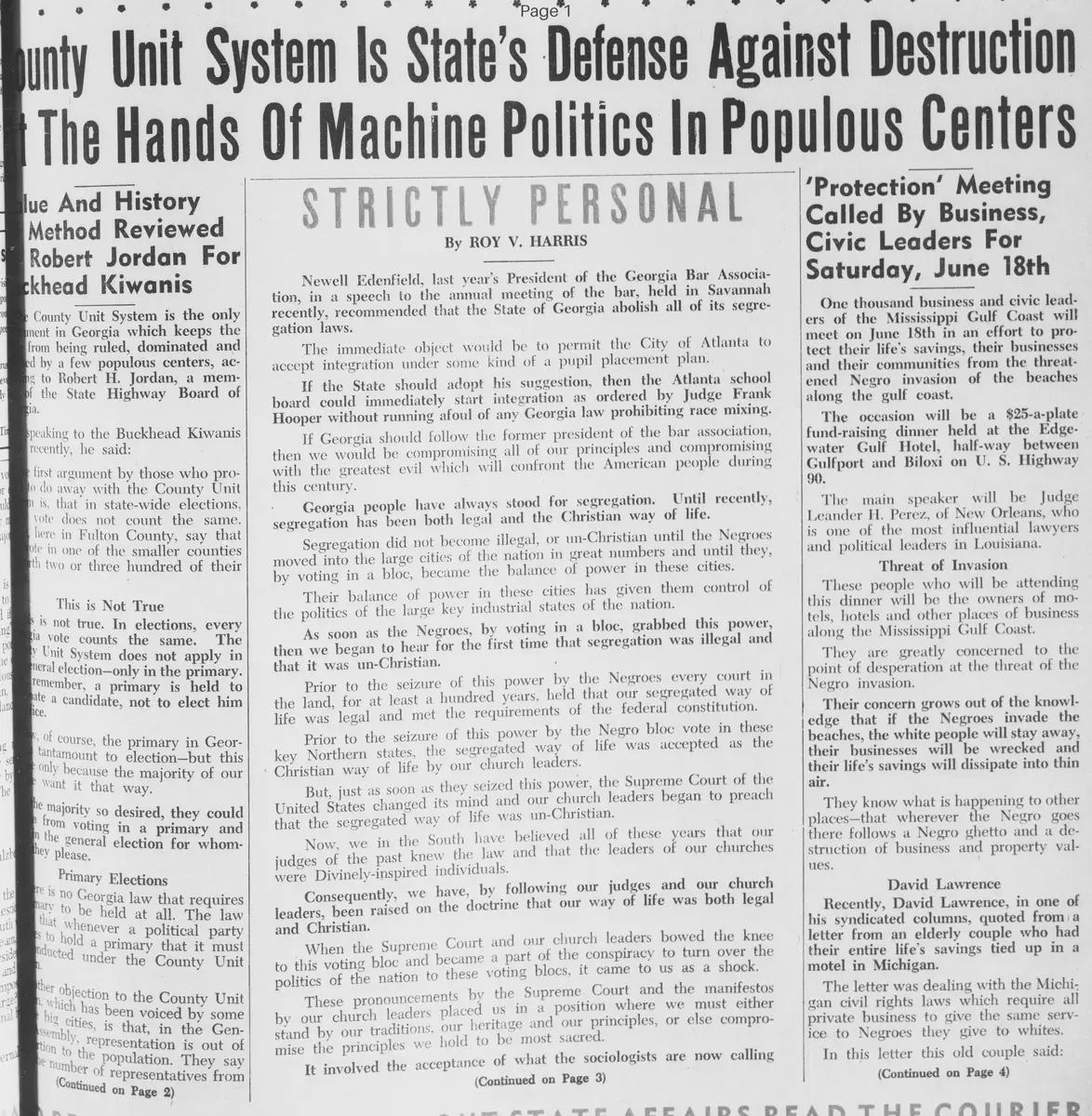
Robert H. Jordan, State Highway Board member, defends Georgia's County Unit System in a speech to Buckhead Kiwanis, arguing it ensures equal vote weight in primaries, prevents urban domination, and aligns with U.S. federal structures, using 1959 population data for examples.
Merged-components note: Continuation of the story on the County Unit System from page 1 to page 2; relabeled the continuation from 'editorial' to 'story' as it is a narrative report on a speech, not an opinion piece.
Clippings
1 of 2
OCR Quality
Full Text
The Hands Of Machine Politics In Populous Centers
THE VALUE AND HISTORY OF THE METHOD REVIEWED
ROBERT JORDAN FOR BUCKHEAD KIWANIS
The County Unit System is the only government in Georgia which keeps the state from being ruled, dominated and controlled by a few populous centers, according to Robert H. Jordan, a member of the State Highway Board of Georgia.
Speaking to the Buckhead Kiwanis recently, he said:
The first argument by those who propose to do away with the County Unit System is, that in state-wide elections, a vote does not count the same.
People here in Fulton County say that one vote in one of the smaller counties is worth two or three hundred of theirs.
This is Not True
This is not true. In elections, every Georgia vote counts the same.
The County Unit System does not apply in general election—only in the primary.
Remember, a primary is held to nominate a candidate, not to elect him publicly.
Now, of course, the primary in Georgia is tantamount to election—but this only because the majority of our people want it that way.
If the majority so desired, they could abstain from voting in a primary and vote in the general election for whomever they please.
Primary Elections
There is no Georgia law that requires a primary to be held at all. The law provides that whenever a political party decides to hold a primary that it must be conducted under the County Unit System.
Another objection to the County Unit System which has been voiced by some of the big cities, is that, in the General Assembly, representation is out of proportion to the population. They say that the number of representatives from
(Continued on Page 2)
Value And History Of Method Reviewed
By
Robert Jordan
For Buckhead Kiwanis
(Continued from page 2)
each county should be determined by the population.
That line of reasoning is nothing short of being ridiculous. Consider, for a moment, what would happen if this were put into effect:
The smallest populated county in Georgia is Echols County, with an estimated 1959 population of 2200 people.
Echols, Fulton Counties
Now, we must assume that Echols County is entitled to at least one seat in the House. If so, for every 2200 people in each of the other counties there would be a Representative. This would be the only way to give equal representation to every individual in Georgia.
The 1959 population of Fulton County is estimated at 581,000 - 264 times that of Echols County. So, Fulton County would have 264 Representatives in the General Assembly.
Furthermore, the six most populated counties in Georgia would have a combined total of 652 Representatives, and the total for the entire state would reach the fantastic number of 1,810.
Need 25-Story Building
The state would have to erect a 25-story building to hold these Representatives when they were in session, and taxes would have to be raised considerably to pay their salaries. And where would you find that many public spirited citizens of the same calibre which we have in the Legislature today?
So, you can see, that it would be impractical and almost impossible to give equal representation to every individual in the state.
Now, some of you might say the solution would be to eliminate some of our counties by consolidation.
Would you also advocate the elimination of some of our states by consolidation?
Representatives In Congress
Since every individual in the United States does not have equal representation in Congress, would you consolidate Georgia, South Carolina and several other states, in order to equalize the population with states such as New York, Ohio, Massachusetts and Pennsylvania?
We are represented in Congress under a State Unit System just as we are represented in the Georgia General Assembly under a County Unit System.
Every state is permitted, under the Constitution, two Senators and at least one Congressman, depending on the population.
State of Nevada
The state of Nevada, with an official population of 160,000 people, has two Senators and one Congressman—or one member of Congress for each 53,000 people.
New York, with a population of 14,800,000 has two Senators and 43 Congressmen—or one member of Congress for every 325,000 people
So, every individual does not have equal representation in the United States Congress.
Now, what about national elections?
Is the President of the United States elected by popular vote or by a State Unit System?
Are the candidates nominated by popular vote or by State Unit System?
By The Unit System
The answer to both questions is by the State Unit System.
In the majority of states, where no presidential primaries are held, the candidate is nominated by delegates from each state, and he is elected under the electoral system and not by popular vote.
Here in Georgia, we vote for 12 electors, who in turn vote for a man for president. Nevada votes for three electors, New York, 45. A vote in Nevada has six times the value as a vote in Georgia or New York.
So, to those who would abolish the County Unit System as unconstitutional, I ask you to what Constitution are you referring?
Not Unconstitutional
It is not unconstitutional if you are referring to the Georgia Constitution, and it does not conflict with the United States Constitution, since the identical system is used in national elections.
In fact, what you are saying is that the Constitution is unconstitutional.
And to those who say the County Unit System is undemocratic, I can only answer that, if it is, the United States is not a democratic government.
Federal Government
Our Federal Government was formed and our Constitution written by men who believed in local government. They recognized the dangers in centralized government, and vested into the various states the power to govern themselves.
They granted each state a voice in government by allowing each one to be represented in Congress. They were aware of the many differences in climate, customs and living habits of the people in each state, and foresaw that these differences would be even greater as the number of states increased.
The State Unit System was adopted to prevent large populated areas from completely controlling the country by bloc voting.
Thomas Jefferson pointed out the undesirable effect of control by the big cities, when he said:
"The mobs of the great cities add just so much strength to the support of pure government as sores do to the strength of the human body."
Population Shifts
There has been a noticeable trend in Georgia during recent years, of population shifts into the urban areas. In fact, over one third of the population of Georgia is located in the six largest counties.
If the County Unit System were abolished, these six counties would control the entire state, and the largest community would become the dictator.
Certainly, no one who believes in constitutional government—in local government—wants this to happen.
In New York, Illinois, Michigan and several other states, the big cities control the state governments. And in those states, corruption, graft and gangism run rampant.
Produced Noted Men
And by this, I do not imply that corruption can take place under county unit system. I do, however, point out to you the calibre of leaders which the County Unit System has produced.
Men such as Walter George, Dick Russell and Herman Talmadge, who gained national respect and admiration for their statesmanship.
Compare these leaders with those of Javits, Douglas, and Powell, who were elected by the bloc minorities in big northern cities. These demagogues cater to every whim of big city machines in order to get elected.
In Atlanta, the bloc vote already has become the deciding factor in elections. One candidate usually receives 85 per cent of the Negro vote, while the white votes are divided among several candidates.
Local Government
When we break down the barriers of local government within our state we are opening the door to the same conditions existing in the large northern cities.
We are destroying the checks and balances of proper government and becoming partners to those who would destroy State Government for the sake of centralized, socialistic government.
I believe that Echols County, and my home county of Talbot—with only 13,000 people—as well as every other county in Georgia has an inherent right to a voice in the affairs of State Government.
The County Unit System gives this voice. It insures the continuation of local government - which was indeed the basic principle upon which this nation was founded.
Georgia Going Forward
Our economy - farming, textiles, kaolin and brick, which are scattered throughout the state—will be represented.
Georgia is moving forward in many fields of endeavor. Under our system of government, we are experiencing progress in almost every area of our economy.
Georgia will continue to grow as our industries grow. A chain is no stronger than its weakest link, and our state will become no stronger than each of our counties.
A QUESTION
We have recently been asked a question concerning Ralph McGill.
Here it is:
"is this man a son of the South?"
"In the name of Heaven and its
an
What do you think?"
What sub-type of article is it?
What themes does it cover?
What keywords are associated?
What entities or persons were involved?
Where did it happen?
Story Details
Key Persons
Location
Georgia, Fulton County, Atlanta
Event Date
1959
Story Details
Robert H. Jordan argues that the County Unit System protects Georgia from urban political domination, ensures fair representation in primaries and legislature, parallels U.S. federal systems, and has produced notable leaders, countering claims of unconstitutionality and undemocracy.