Thank you for visiting SNEWPapers!
Sign up free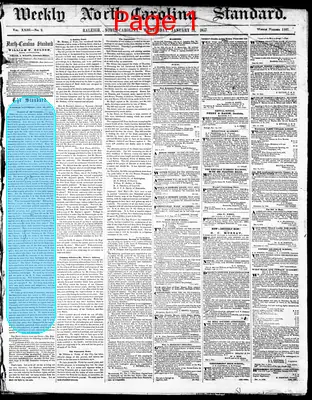
Editorial
January 14, 1857
Weekly North Carolina Standard
Raleigh, Wake County, North Carolina
What is this article about?
Editorial defends Democratic caucus nominations for University of North Carolina Trustees against criticism from Whig/Know Nothing senators like Gen. Dockery and Mr. Pool, arguing necessity for efficiency and accusing opponents of hypocrisy due to their secret society's oaths. Highlights Democratic advancements in education since 1850.
Clipping
OCR Quality
95%
Excellent
Full Text
The Standard.
RALEIGH, SATURDAY, JAN. 10, 1857.
Trustees of the University.
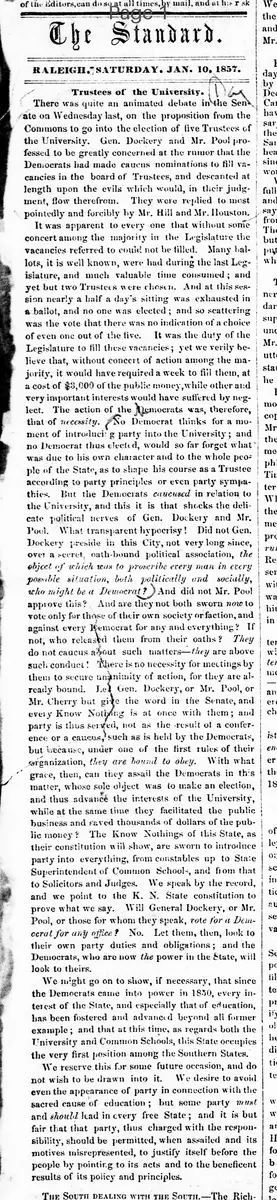
There was quite an animated debate in the Senate on Wednesday last, on the proposition from the Commons to go into the election of five Trustees of the University. Gen. Dockery and Mr. Pool professed to be greatly concerned at the rumor that the Democrats had made caucus nominations to fill vacancies in the board of Trustees, and descanted at length upon the evils which would, in their judgment, flow therefrom. They were replied to most pointedly and forcibly by Mr. Hill and Mr. Houston.
It was apparent to every one that without some concert among the majority in the Legislature the vacancies referred to could not be filled. Many ballots, it is well known, were had during the last Legislature, and much valuable time consumed; and yet but two Trustees were chosen. And at this session nearly a half a day's sitting was exhausted in a ballot, and no one was elected; and so scattering was the vote that there was no indication of a choice of even one out of the five. It was the duty of the Legislature to fill these vacancies; yet we verily believe that, without concert of action among the majority, it would have required a week to fill them, at a cost of $3,000 of the public money, while other and very important interests would have suffered by neglect. The action of the Democrats was, therefore, that of necessity. No Democrat thinks for a moment of introducing party into the University; and no Democrat thus elected, would so far forget what was due to his own character and to the whole people of the State, as to shape his course as a Trustee according to party principles or even party sympathies. But the Democrats caucused in relation to the University, and this it is that shocks the delicate political nerves of Gen. Dockery and Mr. Pool. What transparent hypocrisy! Did not Gen. Dockery preside in this City, not very long since, over a secret, oath-bound political association, the object of which was to proscribe every man in every possible situation, both politically and socially, who might be a Democrat? And did not Mr. Pool approve this? And are they not both sworn now to vote only for those of their own society or faction, and against every Democrat for any and everything? If not, who released them from their oaths? They do not caucus about such matters—they are above such conduct! There is no necessity for meetings by them to secure unanimity of action, for they are already bound. Let Gen. Dockery, or Mr. Pool, or Mr. Cherry but give the word in the Senate, and every Know Nothing is at once with them: and party is thus served, not as the result of a conference or a caucus, such as is held by the Democrats, but because, under one of the first rules of their organization, they are bound to obey. With what grace, then, can they assail the Democrats in this matter, whose sole object was to make an election, and thus advance the interests of the University, while at the same time they facilitated the public business and saved thousands of dollars of the public money? The Know Nothings of this State, as their constitution will show, are sworn to introduce party into everything, from constables up to State Superintendent of Common Schools, and from that to Solicitors and Judges. We speak by the record, and we point to the K. N. State constitution to prove what we say. Will General Dockery, or Mr. Pool, or those for whom they speak, vote for a Democrat for any office? No. Let them, then, look to their own party duties and obligations; and the Democrats, who are now the power in the State, will look to theirs.
We might go on to show, if necessary, that since the Democrats came into power in 1850, every interest of the State, and especially that of education, has been fostered and advanced beyond all former example; and that at this time, as regards both the University and Common Schools, this State occupies the very first position among the Southern States. We reserve this for some future occasion, and do not wish to be drawn into it. We desire to avoid even the appearance of party in connection with the sacred cause of education; but some party must and should lead in every free State; and it is but fair that that party, thus charged with the responsibility, should be permitted, when assailed and its motives misrepresented, to justify itself before the people by pointing to its acts and to the beneficent results of its policy and principles.
RALEIGH, SATURDAY, JAN. 10, 1857.
Trustees of the University.
There was quite an animated debate in the Senate on Wednesday last, on the proposition from the Commons to go into the election of five Trustees of the University. Gen. Dockery and Mr. Pool professed to be greatly concerned at the rumor that the Democrats had made caucus nominations to fill vacancies in the board of Trustees, and descanted at length upon the evils which would, in their judgment, flow therefrom. They were replied to most pointedly and forcibly by Mr. Hill and Mr. Houston.
It was apparent to every one that without some concert among the majority in the Legislature the vacancies referred to could not be filled. Many ballots, it is well known, were had during the last Legislature, and much valuable time consumed; and yet but two Trustees were chosen. And at this session nearly a half a day's sitting was exhausted in a ballot, and no one was elected; and so scattering was the vote that there was no indication of a choice of even one out of the five. It was the duty of the Legislature to fill these vacancies; yet we verily believe that, without concert of action among the majority, it would have required a week to fill them, at a cost of $3,000 of the public money, while other and very important interests would have suffered by neglect. The action of the Democrats was, therefore, that of necessity. No Democrat thinks for a moment of introducing party into the University; and no Democrat thus elected, would so far forget what was due to his own character and to the whole people of the State, as to shape his course as a Trustee according to party principles or even party sympathies. But the Democrats caucused in relation to the University, and this it is that shocks the delicate political nerves of Gen. Dockery and Mr. Pool. What transparent hypocrisy! Did not Gen. Dockery preside in this City, not very long since, over a secret, oath-bound political association, the object of which was to proscribe every man in every possible situation, both politically and socially, who might be a Democrat? And did not Mr. Pool approve this? And are they not both sworn now to vote only for those of their own society or faction, and against every Democrat for any and everything? If not, who released them from their oaths? They do not caucus about such matters—they are above such conduct! There is no necessity for meetings by them to secure unanimity of action, for they are already bound. Let Gen. Dockery, or Mr. Pool, or Mr. Cherry but give the word in the Senate, and every Know Nothing is at once with them: and party is thus served, not as the result of a conference or a caucus, such as is held by the Democrats, but because, under one of the first rules of their organization, they are bound to obey. With what grace, then, can they assail the Democrats in this matter, whose sole object was to make an election, and thus advance the interests of the University, while at the same time they facilitated the public business and saved thousands of dollars of the public money? The Know Nothings of this State, as their constitution will show, are sworn to introduce party into everything, from constables up to State Superintendent of Common Schools, and from that to Solicitors and Judges. We speak by the record, and we point to the K. N. State constitution to prove what we say. Will General Dockery, or Mr. Pool, or those for whom they speak, vote for a Democrat for any office? No. Let them, then, look to their own party duties and obligations; and the Democrats, who are now the power in the State, will look to theirs.
We might go on to show, if necessary, that since the Democrats came into power in 1850, every interest of the State, and especially that of education, has been fostered and advanced beyond all former example; and that at this time, as regards both the University and Common Schools, this State occupies the very first position among the Southern States. We reserve this for some future occasion, and do not wish to be drawn into it. We desire to avoid even the appearance of party in connection with the sacred cause of education; but some party must and should lead in every free State; and it is but fair that that party, thus charged with the responsibility, should be permitted, when assailed and its motives misrepresented, to justify itself before the people by pointing to its acts and to the beneficent results of its policy and principles.
What sub-type of article is it?
Partisan Politics
Education
What keywords are associated?
University Trustees
Democratic Caucus
Know Nothing Party
Partisan Politics
North Carolina Education
Legislative Debate
What entities or persons were involved?
Gen. Dockery
Mr. Pool
Mr. Hill
Mr. Houston
Democrats
Know Nothings
University Of North Carolina Trustees
Editorial Details
Primary Topic
Election Of University Trustees And Democratic Caucus Nominations
Stance / Tone
Pro Democrat Defense Against Know Nothing Hypocrisy
Key Figures
Gen. Dockery
Mr. Pool
Mr. Hill
Mr. Houston
Democrats
Know Nothings
University Of North Carolina Trustees
Key Arguments
Democratic Caucus Was Necessary To Efficiently Fill Vacancies And Save Time/Money
No Intent To Introduce Party Politics Into The University
Hypocrisy Of Dockery And Pool, Bound By Secret Know Nothing Oaths To Proscribe Democrats
Know Nothings Introduce Party Into All Offices Per Their Constitution
Democrats Have Advanced Education Since 1850, Placing Nc First Among Southern States