Thank you for visiting SNEWPapers!
Sign up free
Gazette Of The United States & Evening Advertiser
Philadelphia, Philadelphia County, Pennsylvania
What is this article about?
On May 15, the U.S. House of Representatives debated referring a resolution by Mr. Goodhue for indemnifying merchants suffering British spoliations to a committee also handling British debt sequestration. After arguments, the amendment to combine them passed 57-31, and it was referred.
Clipping
OCR Quality
Full Text
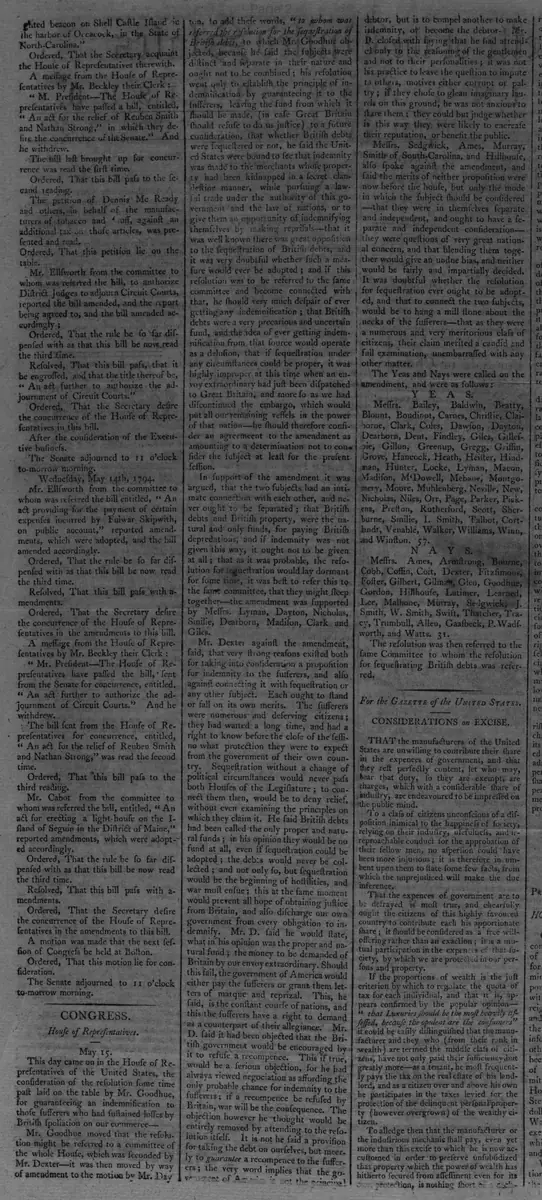
House of Representatives.
May 15.
This day came on in the House of Representatives of the United States, the consideration of the resolution some time past laid on the table by Mr. Goodhue, for guaranteeing an indemnification to those sufferers who had sustained loss by British spoliation on our commerce.
Mr. Goodhue moved that the resolution might be referred to a committee of the whole House, which was seconded by Mr. Dexter--it was then moved by way of amendment to the motion by Mr. Dayton, to add these words, "to whom was referred the resolution for the sequestration of British debts," to which Mr. Goodhue objected, because he said the subjects were distinct and separate in their nature and ought not to be combined; his resolution went only to establish the principle of indemnification by guaranteeing it to the sufferers, leaving the fund from which it should be made, (in case Great Britain should refuse to do us justice) to a future consideration, that whether British debts were sequestered or not, he said the United States were bound to see that indemnity was made to the merchants whose property had been kidnapped in a secret clandestine manner, while pursuing a lawful trade under the authority of this government and the law of nations, or to give them an opportunity of indemnifying themselves by making reprisals--that it was well known there was great opposition to the sequestration of British debts, and it was very doubtful whether such a measure would ever be adopted; and if this resolution was to be referred to the same committee and become connected with that, he should very much despair of ever getting any indemnification; that British debts were a very precarious and uncertain fund, and the idea of ever getting indemnification from that source would operate as a delusion, that if sequestration under any circumstances could be proper, it was highly improper at this time when an envoy extraordinary had just been dispatched to Great Britain, and more so as we had discontinued the embargo, which would put all our remaining vessels in the power of that nation--he should therefore consider an agreement to the amendment as amounting to a determination not to consider the subject at least for the present session.
In support of the amendment it was argued, that the two subjects had an intimate connection with each other, and never ought to be separated; that British debts and British property, were the natural and only funds, for paying British depredations, and if indemnity was not given this way, it ought not to be given at all; that as it was probable, the resolution for sequestration would lay dormant for some time, it was best to refer this to the same committee, that they might sleep together--the amendment was supported by Messrs. Lyman, Dayton, Nicholas, Smilie, Dearborn, Madison, Clark and Giles.
Mr. Dexter against the amendment, said, that very strong reasons existed both for taking into consideration a proposition for indemnity to the sufferers, and also against connecting it with sequestration or any other subject. Each ought to stand or fall on its own merits. The sufferers were numerous and deserving citizens; they had waited a long time, and had a right to know before the close of the session what protection they were to expect from the government of their own country. Sequestration without a change of political circumstances would never pass both Houses of the Legislature; to connect them then, would be to deny relief, without even examining the principles on which they claim it. He said British debts had been called the only proper and natural funds; in his opinion they would be no fund at all, even if sequestration could be adopted; the debts would never be collected; and not only so, but sequestration would be the beginning of hostilities, and war must ensue; this at the same moment would prevent all hope of obtaining justice from Britain, and also discharge our own government from every obligation to indemnify. Mr. D. said he would state, what in his opinion was the proper and natural fund; the money to be demanded of Britain by our envoy extraordinary. Should this fail, the government of America would either pay the sufferers or grant them letters of marque and reprisal. This, he said, is the constant course of nations, and this the sufferers have a right to demand as a counterpart of their allegiance. Mr. D. said it had been objected that the British government would be encouraged by it to refuse a recompense. This if true, would be a serious objection, for he had always viewed negotiation as affording the only probable chance for indemnity to the sufferers; if a recompense be refused by Britain, war will be the consequence. The objection however he thought would be entirely removed by attending to the resolution itself. It is not he said a provision for taking the debt on ourselves, but merely to guarantee a recompence to the sufferers; the very word implies that the government of America is not the principal debtor, but is to compel another to make indemnity, or become the debtor--Mr. D. closed with saying that he had attended only to the reasoning of the gentlemen and not to their personalities; it was not his practice to leave the question to impute to others, motives either corrupt or paltry; if they chose to glean imaginary laurels on this ground, he was not anxious to share them: they could but judge whether in this way they were likely to increase their reputation, or benefit the public.
Messrs. Sedgwick, Ames, Murray, Smith of South-Carolina, and Hillhouse, also spoke against the amendment, and said the merits of neither proposition were now before the house, but only the mode in which the subject should be considered--that they were in themselves separate and independent, and ought to have a separate and independent consideration--they were questions of very great national concern, and that blending them together would give an undue bias, and neither would be fairly and impartially decided.
It was doubtful whether the resolution for sequestration ever ought to be adopted, and that to connect the two subjects, would be to hang a mill stone about the necks of the sufferers--that as they were a numerous and very meritorious class of citizens, their claim merited a candid and full examination, unembarrassed with any other matter.
The Yeas and Nays were called on the amendment, and were as follows:
YEAS.
Messrs. Bailey, Baldwin, Beatty, Blount, Boudinot, Carnes, Christie, Claiborne, Clark, Coles, Dawson, Dayton, Dearborn, Dent, Findley, Giles, Gillespie, Gillon, Greenup, Gregg, Griffin, Grove, Hancock, Heath, Heister, Hindman, Hunter, Locke, Lyman, Mason, Madison, McDowell, Mebane, Montgomery, Moore, Muhlenberg, Neville, New, Nicholas, Niles, Orr, Page, Parker, Pickens, Preston, Rutherford, Scott, Sherburne, Smilie, I. Smith, Talbot, Cortlandt, Venable, Walker, Williams, Winn, and Winton. 57.
NAYS.
Messrs. Ames, Armstrong, Bourne, Cobb, Coffin, Coit, Dexter, Fitzsimons, Foster, Gilbert, Gilman, Glen, Goodhue, Gordon, Hillhouse, Latimer, Learned, Lee, Malbone, Murray, Sedgwick, J. Smith, W. Smith, Swift, Thatcher, Tracy, Trumbull, Allen, Van Gaasbeek, P. Wadsworth, and Watts. 31.
The resolution was then referred to the same Committee to whom the resolution for sequestering British debts was referred.
What sub-type of article is it?
What keywords are associated?
What entities or persons were involved?
Domestic News Details
Event Date
May 15.
Key Persons
Outcome
the amendment to refer the resolution to the same committee handling british debt sequestration passed with 57 yeas and 31 nays. the resolution was referred to that committee.
Event Details
The House debated Mr. Goodhue's resolution for guaranteeing indemnification to sufferers of British spoliations on U.S. commerce. Mr. Goodhue moved referral to a committee of the whole, but Mr. Dayton amended to refer it to the committee on sequestration of British debts. Debate ensued on whether the subjects should be combined, with arguments for separation emphasizing national obligation and negotiation, and for combination citing connected funds. Speakers included Goodhue, Dexter, and others against the amendment, and Lyman, Dayton, etc., for it.