Thank you for visiting SNEWPapers!
Sign up free
Editorial
May 21, 1834
Morning Star
Limerick, York County, Maine
What is this article about?
This 1834 editorial defends moral and religious societies like Temperance, Sabbath Schools, and Bible Societies against objections from Christians, refuting claims that they are unscriptural, political schemes, worldly, corrupt, speculative, or prideful, emphasizing their biblical principles and benefits.
Clipping
OCR Quality
95%
Excellent
Full Text
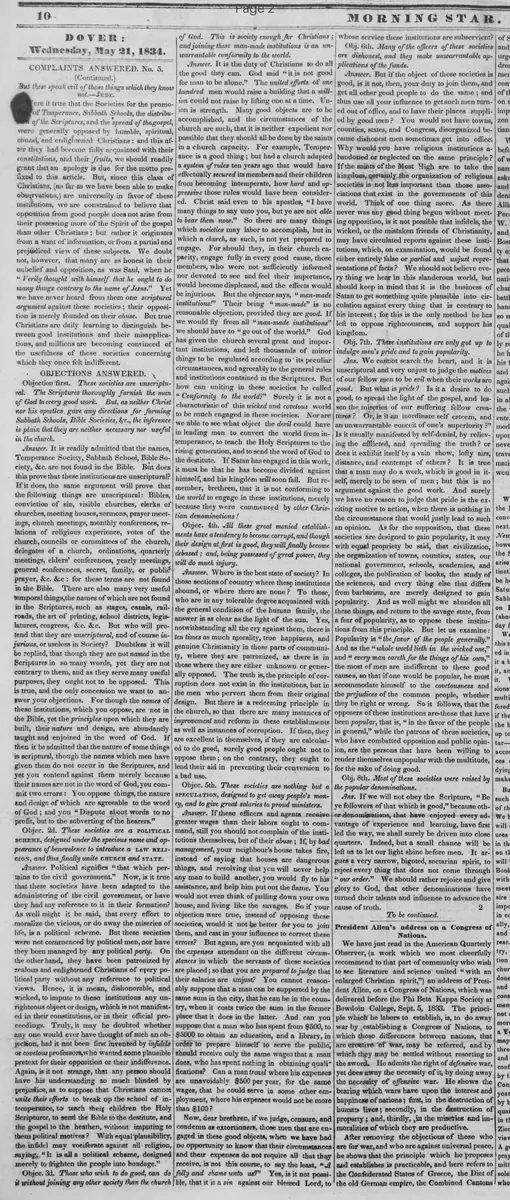
Wednesday, May 21, 1834.
COMPLAINTS ANSWERED. NO. 5.
(Continued.)
note.-Jcde.
of Temperance, Sabbath Schools, the distribution
of the Scriptures, and the spread of the gospel,
were generally opposed by humble, spiritual
sound, and enlightened Christians: and this af-
ter they had become fully acquainted with their
constitutions, and their fruits, we should readily
grant that an apology is due for the motto pre-
fixed to this article. But, since this class of
Christians, (as far as we have been able to make
observations,) are universally in favor of these
institutions, we are constrained to believe that
opposition from good people does not arise from
their possessing more of the Spirit of the gospel
than other Christians; but rather it originates
from a want of information, or from a partial and
prejudiced view of these subjects. We doubt
not, however, that many are as honest in their
unbelief and opposition, as was Saul, when he
"Verily thought with himself that he ought to do
many things contrary to the name of Jesus." Yet
we have never heard from them one scriptural
argument against these societies; their opposi-
tion is merely founded on their abuse. But true
Christians are daily learning to distinguish be-
tween good institutions and their misapplica-
tions, and millions are becoming convinced of
the usefulness of those societies concerning
which they once felt indifferent.
OBJECTIONS ANSWERED.
Objection first. These societies are unscriptural.
The Scriptures thoroughly furnish the man
of God to every good work. But, as neither Christ
nor his apostles gave any directions for forming
Sabbath Schools, Bible Societies, &c., the inference
is plain that they are neither necessary nor useful
in the church.
Answer. It is readily admitted that the names,
Temperance Society, Sabbath School, Bible So-
ciety, &c. are not found in the Bible. But does
this prove that these institutions are unscriptural?
If it does, the same argument will prove that
the following things are unscriptural: Bibles,
conviction of sin, visible churches, clerks of
churches, meeting houses, sermons, prayer meet-
ings, church meetings, monthly conferences, re-
lations of religious experience, votes of the
church, councils or committees of the church.
delegates of a church, ordinations, quarterly
meetings, elders' conferences, yearly meetings.
general conferences, secret, family, or public
prayer, &c. &c: for these terms are not found
in the Bible. There are also many very useful
temporal things, the names of which are not found
in the Scriptures, such as stages, canals, rail-
roads, the art of printing, school districts, legis-
latures, congress, &c. &c. But who will pre-
tend that they are unscriptural, and of course in-
jurious, or useless in Society? Doubtless it will
be replied, that though they are not named in the
Scriptures in so many words, yet they are not
contrary to them, and as they serve many useful
purposes, they ought not to be opposed. This
is true, and the only concession we want to an-
swer your objections. For though the names of
these institutions, which you oppose, are not in
the Bible, yet the principles upon which they are
built, their nature and design, are abundantly
taught and enjoined in the word of God. If
then it be admitted that the nature of some things
is scriptural, though the names which men have
given them do not occur in the Scriptures, and
yet you contend against them merely because
their names are not in the word of God, you com-
mit two errors: You oppose things, the nature
and design of which are agreeable to the word
of God; and you "Dispute about words to no
profit, but to the subverting of the hearers."
Objec. 2d. These societies are a POLITICAL
SCHEME, designed under the specious name and ap-
pearance of benevolence to introduce a LAW RELI-
GION, and thus finally unite CHURCH and STATE.
Answer. Political signifies "that which per-
tains to the civil government." Now, is it true
that these societies have been adapted to the
administering of the civil government, or have
they had any reference to it in their formation?
As well might it be said, that every effort to
moralize the vicious, or do away the miseries of
life, is a political scheme. But these societies
were not commenced by political men, nor have
they been managed by any political party. On
the other hand, they have been patronized by
zealous and enlightened Christians of every po-
litical party without any reference to political
views. Hence, it is mean, dishonorable, and
wicked, to impute to these institutions any un-
righteous object or design, which is not manifest-
ed in their constitutions, or in their official pro-
ceedings. Truly, it may be doubted whether
any one would ever have thought of such an ob-
jection, had it not been first invented by infidels
or covetous professors, who wanted some plausible
pretext for their opposition or their indifference.
Again, is it not strange, that any person should
have his understanding so much blinded by
prejudice, as to suppose that Christians cannot
unite their efforts to break up the school of in-
temperance, to teach their children the Holy
Scriptures, to send the Bible to the destitute, and
the gospel to the heathen, without imputing to
them political motives? With equal plausibility.
the infidel may vociferate against all religion.
saying, "It is all a political scheme, designed
merely to frighten the people into bondage."
Objec. 3d. Those who wish to do good, can do
it without joining any other society than the church
of God. This is society enough for Christians;
and joining these man-made institutions is an un-
warrantable conformity to the world.
Answer. It is the duty of Christians to do all
the good they can. God said "it is not good
for man to be alone." The united efforts of one
hundred men would raise a building that a mill-
ion could not raise by lifting one at a time. Un-
ion is strength. Many good objects are to be
accomplished, and the circumstances of the
church are such, that it is neither expedient nor
possible that they should all be done by the saints
in a church capacity. For example, Temper-
ance is a good thing; but had a church adapted
a system of rules ten years ago that would have
effectually secured its members and their children
from becoming intemperate, how hard and op-
pressive those rules would have been consider-
ed. Christ said even to his apostles, "I have
many things to say unto you, but ye are not able
to bear them now." So there are many things
which societies may labor to accomplish, but in
which a church, as such, is not yet prepared to
engage. For should they, in their church ca-
pacity, engage fully in every good cause, those
members, who were not sufficiently informed
nor devoted to see and feel their importance,
would become displeased, and the effects would
be injurious. But the objector says, "man-made
institutions!" Their being "man-made" is no
reasonable objection, provided they are good. If
we would fly from all "man-made institutions"
we should have to "go out of the world." God
has given the church several great and impor-
tant institutions, and left thousands of minor
things to be regulated according to its peculiar
circumstances, and agreeably to the general rules
and institutions contained in the Scriptures. But
how can uniting in these societies be called
"Conformity to the world?" Surely it is not a
characteristic of this wicked and covetous world
to be much engaged in these societies. Nor are
we able to see what object the devil could have
in leading men to convert the world from in-
temperance, to teach the Holy Scriptures to the
rising generation, and to send the word of God to
the destitute. If Satan has engaged in this work,
it must be that he has become divided against
himself, and his kingdom will soon fall. But re-
member, brethren, that it is not conforming to
the world to engage in these institutions, merely
because they were commenced by other Chris-
tian denominations!
Objec. 4th. All these great monied establish-
ments have a tendency to become corrupt, and though
their design at first is good, they will finally become
debased; and, being possessed of great power, they
will do much injury.
Answer. Where is the best state of society? In
those sections of country where these institutions
abound, or where there are none? To those,
who are in any tolerable degree acquainted with
the general condition of the human family, the
answer is as clear as the light of the sun. Yes,
notwithstanding all the cry against them, there is
ten times as much morality, true happiness, and
genuine Christianity in those parts of communi-
ty, where they are patronized, as there is in
those where they are either unknown or gener-
ally opposed. The truth is, the principle of cor-
ruption does not exist in the institutions, but in
the men who pervert them from their original
design. But there is a redeeming principle in
the church, so that there are many instances of
improvement and reform in these establishments
as well as instances of corruption. If then, they
are excellent in themselves, if they are calculat-
ed to do good, surely good people ought not to
oppose them; on the contrary, they ought to
lend their aid in preventing their conversion to
a bad use.
Objec. 5th. These societies are nothing but a
SPECULATION, designed to get away people's mon-
ey, and to give great salaries to proud ministers.
Answer. If these officers and agents receive
greater wages than their labors ought to com-
mand, still you should not complain of the insti-
tutions themselves, but of their abuse; If, by bad
management, your neighbour's house takes fire,
instead of saying that houses are dangerous
things, and resolving that you will never help
any man to build another, you would fly to his
assistance, and help him put out the flame. You
would not even think of pulling down your own
house, and living like the savages. So if your
objection were true, instead of opposing these
societies, would it not be better for you to join
them, and cast in your influence to correct these
errors? But again, are you acquainted with all
the expenses attendant on the different circum-
stances in which the servants of these societies
are placed; so that you are prepared to judge that
their salaries are unjust? You cannot reason-
ably suppose that a man can be supported by the
same sum in the city, that he can be in the coun-
try, when it costs twice the sum in the former
place that it does in the latter. And can you
suppose that a man who has spent from $500, to
$5000 to obtain an education, and a library, in
order to prepare himself to serve the public,
should receive only the same wages that a man
does, who has spent nothing in obtaining quali-
fications? Can a man travel where his expenses
are unavoidably $500 per year, for the same
wages, that he could serve in some other em-
ployment, where his expenses would not be more
than $100?
Now, dear brethren, if we judge, censure, and
condemn as extortioners, those men that are en-
gaged in these good objects, when we have had
no opportunity to know that their circumstances
and their expenses do not require all that they
receive, is not this course, to say the least, a
folly and shame unto us? Yes, is it not possi-
ble, that it is a sin against our blessed Lord, to
whose service these institutions are subservient?
Obj. 6th. Many of the officers of these societies
are dishonest, and they make unwarrantable ap-
plications of the funds.
Answer. But if the object of these societies is
good, is it not, then, your duty to join them, and
get all other good people to do the same; and
thus use all your influence to get such men turn-
ed out of office, and to have their places suppli-
ed by good men? You would not have towns,
counties, states, and Congress, disorganized be-
cause dishonest men sometimes get into office!
Why would you have religious institutions a-
bandoned or neglected on the same principle?
If the saints of the Most High are to take the
kingdom, certainly the organization of religious
societies is not less important than those asso-
ciations that exist in the governments of this
world. Think of one thing more. As there
never was any good thing begun without meet-
ing opposition, is it not possible that infidels, the
wicked, or the mistaken friends of Christianity.
may have circulated reports against these insti-
tutions, which, on examination, would be found
either entirely false or partial and unjust repre-
sentations of facts? We should not believe eve-
ry thing we hear in this slanderous world, but
should keep in mind that it is the business of
Satan to get something quite plausible into cir-
culations against every thing that is contrary to
his interest; for this is the only method he has
left to oppose righteousness, and support his
kingdom.
Obj. 7th. These institutions tend to indulge men's pride and to gain popularity.
Ans. We cannot search the heart, and it is
unscriptural and very unjust to judge the motives
of our fellow men to be evil when their works are
good. But what is pride? Is it a desire to do
good, to spread the light of the gospel, and les-
sen the miseries of our suffering fellow crea-
tures? Or, is it an inordinate self esteem, and
an unwarrantable conceit of one's superiority?"
Is it usually manifested by self-denial, by reliev-
ing the afflicted, and spreading the truth? or
does it exhibit itself by a vain show, lofty airs,
distance, and contempt of others? It is true
that a man may do a work, which is good in it-
self, merely to be seen of men; but this is no
argument against the good work. And surely
we have no reason to judge that pride is the ex-
citing motive to action, when there is nothing in
the circumstances that would justly lead to such
an opinion. As for the supposition, that these
societies are designed to gain popularity, it may
with equal propriety be said, that civilization,
the organization of towns, counties, states, our
national government, schools, academies, and
colleges, the publication of books, the study of
the sciences, and every thing else that differs
from barbarism, are merely designed to gain
popularity. And as well might we abandon all
these things, and return to the savage state, from
a fear of popularity, as to oppose these institu-
tions from this principle. But let us examine:
Popularity is "the favor of the people generally."
And as the "whole world lieth in the wicked one,"
and "every man careth for the things of his own,"
the most of men are indifferent to these good
causes, so that if one would be popular, he must
accommodate himself to the covetousness and
the prejudices of the common people, whether
they be right or wrong. So it follows, that the
opposers of these institutions are those that have
been popular, that is, "in the favor of the people
in general," while the patrons of these societies,
who have combatted opposition and public opin-
ion, are the persons that have been willing to
render themselves unpopular with the multitude,
for the sake of doing good.
Obj. 8th. Most of these societies were raised by
the popular denominations.
Ans. If we will not obey the Scripture, "Be
ye followers of that which is good," because oth-
er denominations, that have enjoyed every ad-
vantage of experience and learning, have first
led the way, we shall surely be driven into close
quarters. Indeed, but a small chance will be
left us to let our light shine before men. It ar-
gues a very narrow, bigoted, sectarian spirit, to
reject every thing that does not come through
"our order." We should rather rejoice and give
glory to God, that other denominations have
turned their talents and influence to advance the
cause of truth.
To be continued.
COMPLAINTS ANSWERED. NO. 5.
(Continued.)
note.-Jcde.
of Temperance, Sabbath Schools, the distribution
of the Scriptures, and the spread of the gospel,
were generally opposed by humble, spiritual
sound, and enlightened Christians: and this af-
ter they had become fully acquainted with their
constitutions, and their fruits, we should readily
grant that an apology is due for the motto pre-
fixed to this article. But, since this class of
Christians, (as far as we have been able to make
observations,) are universally in favor of these
institutions, we are constrained to believe that
opposition from good people does not arise from
their possessing more of the Spirit of the gospel
than other Christians; but rather it originates
from a want of information, or from a partial and
prejudiced view of these subjects. We doubt
not, however, that many are as honest in their
unbelief and opposition, as was Saul, when he
"Verily thought with himself that he ought to do
many things contrary to the name of Jesus." Yet
we have never heard from them one scriptural
argument against these societies; their opposi-
tion is merely founded on their abuse. But true
Christians are daily learning to distinguish be-
tween good institutions and their misapplica-
tions, and millions are becoming convinced of
the usefulness of those societies concerning
which they once felt indifferent.
OBJECTIONS ANSWERED.
Objection first. These societies are unscriptural.
The Scriptures thoroughly furnish the man
of God to every good work. But, as neither Christ
nor his apostles gave any directions for forming
Sabbath Schools, Bible Societies, &c., the inference
is plain that they are neither necessary nor useful
in the church.
Answer. It is readily admitted that the names,
Temperance Society, Sabbath School, Bible So-
ciety, &c. are not found in the Bible. But does
this prove that these institutions are unscriptural?
If it does, the same argument will prove that
the following things are unscriptural: Bibles,
conviction of sin, visible churches, clerks of
churches, meeting houses, sermons, prayer meet-
ings, church meetings, monthly conferences, re-
lations of religious experience, votes of the
church, councils or committees of the church.
delegates of a church, ordinations, quarterly
meetings, elders' conferences, yearly meetings.
general conferences, secret, family, or public
prayer, &c. &c: for these terms are not found
in the Bible. There are also many very useful
temporal things, the names of which are not found
in the Scriptures, such as stages, canals, rail-
roads, the art of printing, school districts, legis-
latures, congress, &c. &c. But who will pre-
tend that they are unscriptural, and of course in-
jurious, or useless in Society? Doubtless it will
be replied, that though they are not named in the
Scriptures in so many words, yet they are not
contrary to them, and as they serve many useful
purposes, they ought not to be opposed. This
is true, and the only concession we want to an-
swer your objections. For though the names of
these institutions, which you oppose, are not in
the Bible, yet the principles upon which they are
built, their nature and design, are abundantly
taught and enjoined in the word of God. If
then it be admitted that the nature of some things
is scriptural, though the names which men have
given them do not occur in the Scriptures, and
yet you contend against them merely because
their names are not in the word of God, you com-
mit two errors: You oppose things, the nature
and design of which are agreeable to the word
of God; and you "Dispute about words to no
profit, but to the subverting of the hearers."
Objec. 2d. These societies are a POLITICAL
SCHEME, designed under the specious name and ap-
pearance of benevolence to introduce a LAW RELI-
GION, and thus finally unite CHURCH and STATE.
Answer. Political signifies "that which per-
tains to the civil government." Now, is it true
that these societies have been adapted to the
administering of the civil government, or have
they had any reference to it in their formation?
As well might it be said, that every effort to
moralize the vicious, or do away the miseries of
life, is a political scheme. But these societies
were not commenced by political men, nor have
they been managed by any political party. On
the other hand, they have been patronized by
zealous and enlightened Christians of every po-
litical party without any reference to political
views. Hence, it is mean, dishonorable, and
wicked, to impute to these institutions any un-
righteous object or design, which is not manifest-
ed in their constitutions, or in their official pro-
ceedings. Truly, it may be doubted whether
any one would ever have thought of such an ob-
jection, had it not been first invented by infidels
or covetous professors, who wanted some plausible
pretext for their opposition or their indifference.
Again, is it not strange, that any person should
have his understanding so much blinded by
prejudice, as to suppose that Christians cannot
unite their efforts to break up the school of in-
temperance, to teach their children the Holy
Scriptures, to send the Bible to the destitute, and
the gospel to the heathen, without imputing to
them political motives? With equal plausibility.
the infidel may vociferate against all religion.
saying, "It is all a political scheme, designed
merely to frighten the people into bondage."
Objec. 3d. Those who wish to do good, can do
it without joining any other society than the church
of God. This is society enough for Christians;
and joining these man-made institutions is an un-
warrantable conformity to the world.
Answer. It is the duty of Christians to do all
the good they can. God said "it is not good
for man to be alone." The united efforts of one
hundred men would raise a building that a mill-
ion could not raise by lifting one at a time. Un-
ion is strength. Many good objects are to be
accomplished, and the circumstances of the
church are such, that it is neither expedient nor
possible that they should all be done by the saints
in a church capacity. For example, Temper-
ance is a good thing; but had a church adapted
a system of rules ten years ago that would have
effectually secured its members and their children
from becoming intemperate, how hard and op-
pressive those rules would have been consider-
ed. Christ said even to his apostles, "I have
many things to say unto you, but ye are not able
to bear them now." So there are many things
which societies may labor to accomplish, but in
which a church, as such, is not yet prepared to
engage. For should they, in their church ca-
pacity, engage fully in every good cause, those
members, who were not sufficiently informed
nor devoted to see and feel their importance,
would become displeased, and the effects would
be injurious. But the objector says, "man-made
institutions!" Their being "man-made" is no
reasonable objection, provided they are good. If
we would fly from all "man-made institutions"
we should have to "go out of the world." God
has given the church several great and impor-
tant institutions, and left thousands of minor
things to be regulated according to its peculiar
circumstances, and agreeably to the general rules
and institutions contained in the Scriptures. But
how can uniting in these societies be called
"Conformity to the world?" Surely it is not a
characteristic of this wicked and covetous world
to be much engaged in these societies. Nor are
we able to see what object the devil could have
in leading men to convert the world from in-
temperance, to teach the Holy Scriptures to the
rising generation, and to send the word of God to
the destitute. If Satan has engaged in this work,
it must be that he has become divided against
himself, and his kingdom will soon fall. But re-
member, brethren, that it is not conforming to
the world to engage in these institutions, merely
because they were commenced by other Chris-
tian denominations!
Objec. 4th. All these great monied establish-
ments have a tendency to become corrupt, and though
their design at first is good, they will finally become
debased; and, being possessed of great power, they
will do much injury.
Answer. Where is the best state of society? In
those sections of country where these institutions
abound, or where there are none? To those,
who are in any tolerable degree acquainted with
the general condition of the human family, the
answer is as clear as the light of the sun. Yes,
notwithstanding all the cry against them, there is
ten times as much morality, true happiness, and
genuine Christianity in those parts of communi-
ty, where they are patronized, as there is in
those where they are either unknown or gener-
ally opposed. The truth is, the principle of cor-
ruption does not exist in the institutions, but in
the men who pervert them from their original
design. But there is a redeeming principle in
the church, so that there are many instances of
improvement and reform in these establishments
as well as instances of corruption. If then, they
are excellent in themselves, if they are calculat-
ed to do good, surely good people ought not to
oppose them; on the contrary, they ought to
lend their aid in preventing their conversion to
a bad use.
Objec. 5th. These societies are nothing but a
SPECULATION, designed to get away people's mon-
ey, and to give great salaries to proud ministers.
Answer. If these officers and agents receive
greater wages than their labors ought to com-
mand, still you should not complain of the insti-
tutions themselves, but of their abuse; If, by bad
management, your neighbour's house takes fire,
instead of saying that houses are dangerous
things, and resolving that you will never help
any man to build another, you would fly to his
assistance, and help him put out the flame. You
would not even think of pulling down your own
house, and living like the savages. So if your
objection were true, instead of opposing these
societies, would it not be better for you to join
them, and cast in your influence to correct these
errors? But again, are you acquainted with all
the expenses attendant on the different circum-
stances in which the servants of these societies
are placed; so that you are prepared to judge that
their salaries are unjust? You cannot reason-
ably suppose that a man can be supported by the
same sum in the city, that he can be in the coun-
try, when it costs twice the sum in the former
place that it does in the latter. And can you
suppose that a man who has spent from $500, to
$5000 to obtain an education, and a library, in
order to prepare himself to serve the public,
should receive only the same wages that a man
does, who has spent nothing in obtaining quali-
fications? Can a man travel where his expenses
are unavoidably $500 per year, for the same
wages, that he could serve in some other em-
ployment, where his expenses would not be more
than $100?
Now, dear brethren, if we judge, censure, and
condemn as extortioners, those men that are en-
gaged in these good objects, when we have had
no opportunity to know that their circumstances
and their expenses do not require all that they
receive, is not this course, to say the least, a
folly and shame unto us? Yes, is it not possi-
ble, that it is a sin against our blessed Lord, to
whose service these institutions are subservient?
Obj. 6th. Many of the officers of these societies
are dishonest, and they make unwarrantable ap-
plications of the funds.
Answer. But if the object of these societies is
good, is it not, then, your duty to join them, and
get all other good people to do the same; and
thus use all your influence to get such men turn-
ed out of office, and to have their places suppli-
ed by good men? You would not have towns,
counties, states, and Congress, disorganized be-
cause dishonest men sometimes get into office!
Why would you have religious institutions a-
bandoned or neglected on the same principle?
If the saints of the Most High are to take the
kingdom, certainly the organization of religious
societies is not less important than those asso-
ciations that exist in the governments of this
world. Think of one thing more. As there
never was any good thing begun without meet-
ing opposition, is it not possible that infidels, the
wicked, or the mistaken friends of Christianity.
may have circulated reports against these insti-
tutions, which, on examination, would be found
either entirely false or partial and unjust repre-
sentations of facts? We should not believe eve-
ry thing we hear in this slanderous world, but
should keep in mind that it is the business of
Satan to get something quite plausible into cir-
culations against every thing that is contrary to
his interest; for this is the only method he has
left to oppose righteousness, and support his
kingdom.
Obj. 7th. These institutions tend to indulge men's pride and to gain popularity.
Ans. We cannot search the heart, and it is
unscriptural and very unjust to judge the motives
of our fellow men to be evil when their works are
good. But what is pride? Is it a desire to do
good, to spread the light of the gospel, and les-
sen the miseries of our suffering fellow crea-
tures? Or, is it an inordinate self esteem, and
an unwarrantable conceit of one's superiority?"
Is it usually manifested by self-denial, by reliev-
ing the afflicted, and spreading the truth? or
does it exhibit itself by a vain show, lofty airs,
distance, and contempt of others? It is true
that a man may do a work, which is good in it-
self, merely to be seen of men; but this is no
argument against the good work. And surely
we have no reason to judge that pride is the ex-
citing motive to action, when there is nothing in
the circumstances that would justly lead to such
an opinion. As for the supposition, that these
societies are designed to gain popularity, it may
with equal propriety be said, that civilization,
the organization of towns, counties, states, our
national government, schools, academies, and
colleges, the publication of books, the study of
the sciences, and every thing else that differs
from barbarism, are merely designed to gain
popularity. And as well might we abandon all
these things, and return to the savage state, from
a fear of popularity, as to oppose these institu-
tions from this principle. But let us examine:
Popularity is "the favor of the people generally."
And as the "whole world lieth in the wicked one,"
and "every man careth for the things of his own,"
the most of men are indifferent to these good
causes, so that if one would be popular, he must
accommodate himself to the covetousness and
the prejudices of the common people, whether
they be right or wrong. So it follows, that the
opposers of these institutions are those that have
been popular, that is, "in the favor of the people
in general," while the patrons of these societies,
who have combatted opposition and public opin-
ion, are the persons that have been willing to
render themselves unpopular with the multitude,
for the sake of doing good.
Obj. 8th. Most of these societies were raised by
the popular denominations.
Ans. If we will not obey the Scripture, "Be
ye followers of that which is good," because oth-
er denominations, that have enjoyed every ad-
vantage of experience and learning, have first
led the way, we shall surely be driven into close
quarters. Indeed, but a small chance will be
left us to let our light shine before men. It ar-
gues a very narrow, bigoted, sectarian spirit, to
reject every thing that does not come through
"our order." We should rather rejoice and give
glory to God, that other denominations have
turned their talents and influence to advance the
cause of truth.
To be continued.
What sub-type of article is it?
Moral Or Religious
Temperance
Social Reform
What keywords are associated?
Temperance Societies
Sabbath Schools
Bible Societies
Religious Objections
Moral Reform
Christian Unity
Scriptural Principles
Social Benevolence
What entities or persons were involved?
Temperance Society
Sabbath School
Bible Society
Christians
Churches
Editorial Details
Primary Topic
Defense Of Temperance, Sabbath Schools, And Bible Societies Against Christian Objections
Stance / Tone
Strongly Supportive And Refutatory
Key Figures
Temperance Society
Sabbath School
Bible Society
Christians
Churches
Key Arguments
Societies Are Scriptural In Principle Despite Unnamed In Bible
Not Political Schemes But Benevolent Efforts
Church Alone Insufficient; United Efforts Needed For Good
Corruption In Men, Not Institutions; Support To Reform
Not Speculation; Fair Compensation For Labor
Dishonest Officers Should Be Replaced, Not Societies Abandoned
Do Not Indulge Pride; Opposers More Popular With World
Follow Good Regardless Of Originating Denomination