Thank you for visiting SNEWPapers!
Sign up free
The Enquirer
Richmond, Henrico County, Virginia
What is this article about?
Report from Solomon Smith on Gen. Hull's army arrival and encampment at Detroit in July 1812; release of American prisoners via battery fire at Sandwich; Indian council; capture of two U.S. vessels by British; details on forces and failed truce for property.
Clipping
OCR Quality
Full Text
(O.);
Franklinton, July 16.
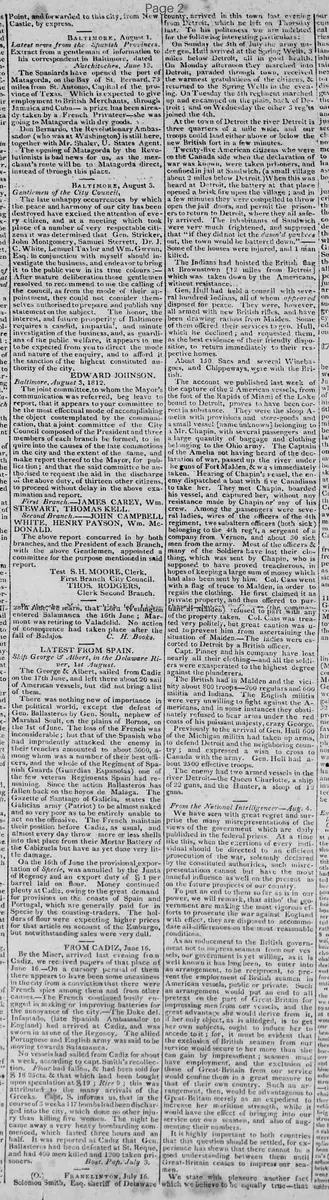
Solomon Smith, Esq. sheriff of Delaware county; arrived in this town last evening from Detroit, which he left on Thursday last. To his politeness we are indebted for the following interesting particulars:
On Sunday the 5th of July the army under Gen. Hull arrived at the Spring Wells, 3 miles below Detroit, all in good health. On Monday afternoon they marched into Detroit, paraded through town, received the warmest gratulations of the citizens, & returned to the Spring Wells in the evening. On Tuesday the 4th regiment marched up and encamped on the plain, back of Detroit; and on Wednesday the other 3 reg'ts joined the 4th.
At the town of Detroit the river Detroit is three quarters of a mile wide, and our troops could land either above or below the new British fort in a few minutes.
Twenty-five American citizens who were on the Canada side when the declaration of war was known, were taken prisoners, and confined in jail at Sandwich, (a small village about 2 miles below Detroit.) when this was heard at Detroit, the battery at that place opened a brisk fire upon the village; and in a few minutes they were compelled to throw open the jail doors, and permit the prisoners to return to Detroit, where they safely arrived. The inhabitants of Sandwich were very much frightened, and supposed that "if they did not let the dann'd yankees out, the town would be battered down." Some of the houses were injured, and 1 man killed.
The Indians had hoisted the British flag at Brownstown [12 miles from Detroit] which was taken down by the Americans, without resistance.
Gen. Hull had held a council with several hundred Indians, all of whom appeared disposed for peace. They were, however, all armed with new British rifles, and have been drawing rations from Maiden. Some of them offered their services to Gen. Hull, which he declined; and requested them, as the best evidence of their friendly disposition, to return immediately to their respective homes.
About 150 Sacs and several Winnebagoes, and Chippeways, were with the British.
The account we published last week of the capture of the 2 American vessels, from the foot of the Rapids of Miami of the Lake bound to Detroit, proves to have been correct in substance. They were the sloop Amelia with provisions and store-goods and a small vessel [name unknown] belonging to a Mr. Chapin, with several passengers and a large quantity of baggage and clothing belonging to the Ohio army. The Captain of the Amelia not having heard of the declaration of war, passed up the river under the guns of Fort Malden, & was immediately taken. Hearing of Chapin's vessel, the enemy dispatched a boat with five Canadians to take her. They met Chapin, boarded his vessel, and captured her, without any resistance made by Chapin or any of his crew. Among the passengers were several ladies, wives of the officers of the 4th regiment, two subaltern officers (both sick) belonging to the 4th reg't, a sergeant of a company from Vernon, and about 50 sick men from the army. Most of the officers & many of the soldiers have lost their clothing, which was sent by Chapin, who is supposed to have proved treacherous, in hopes of keeping a large sum of money which had also been sent by him. Col. Cass went with a flag of truce to Malden, in order to regain the clothing. He first claimed it as private property, and then offered to purchase it. (The command. General) refused to part with any of the property taken. Col. Cass was treated very politely, but great caution was used to prevent him from ascertaining the situation of Malden.--The ladies were escorted to Detroit by a British officer.
Capt. Pinney and his company have lost nearly all their clothing--and all the soldiers were exasperated to the highest degree against the plunderers.
The British had in Malden and the vicinity about 800 troops--200 regulars and 600 militia and Indians. The English militia were very unwilling to fight against the Americans, and in some instances they obstinately refused to bear arms under the red coats of his puissant majesty, crazy George.
Previously to the arrival of Gen. Hull 600 of the Michigan militia had taken up arms, to defend Detroit and the neighboring country; and expressed a wish to cross to Canada with the army. Gen. Hull had about 2500 effective troops.
The enemy had two armed vessels in the river Detroit--the Queen Charlotte, a ship of 22 guns, and the Hunter, a sloop of 12 guns.
What sub-type of article is it?
What keywords are associated?
What entities or persons were involved?
Where did it happen?
Domestic News Details
Primary Location
Detroit
Event Date
July 5 16, 1812
Key Persons
Outcome
one man killed and some houses injured in sandwich during battery fire; two american vessels captured with loss of provisions, goods, baggage, clothing, and money; prisoners released; indians declined for service and sent home; british refused to return captured property.
Event Details
Gen. Hull's army arrived at Spring Wells on July 5, marched into Detroit on July 6, and encamped nearby. Battery fire from Detroit compelled release of 25 American prisoners from Sandwich jail. Americans removed British flag at Brownstown without resistance. Gen. Hull held council with several hundred Indians, declining their services and sending them home. Two American vessels, sloop Amelia and one owned by Mr. Chapin, captured by British near Fort Malden; passengers included officers' wives, sick soldiers; Col. Cass unsuccessfully sought return of property via flag of truce. British had about 800 troops; Michigan militia of 600 armed to defend; enemy had two armed vessels.