Thank you for visiting SNEWPapers!
Sign up free
Gazette Of The United States, & Philadelphia Daily Advertiser
Philadelphia, Philadelphia County, Pennsylvania
What is this article about?
Publication in the Philadelphia Gazette on September 11, 1797, includes burial totals from yellow fever, a report on a Northern Liberties meeting to prevent disease spread, and a letter from William Currie to Benjamin Rush arguing that yellow fever originates from imported contagion, not local miasmata, citing medical authorities like Cullen.
Clipping
OCR Quality
Full Text
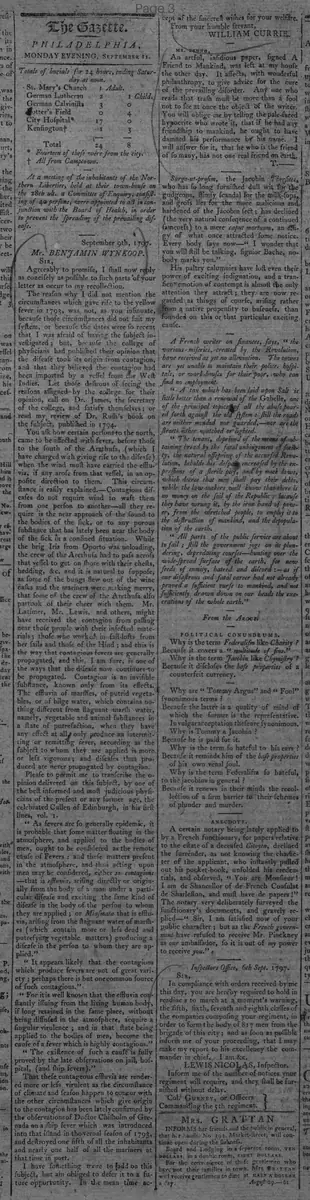
PHILADELPHIA
MONDAY EVENING. SEPTEMBER 11.
Totals of burials: for 24 hours, ending Saturday at noon:*
For thirteen of these were from the city. 2y
All from Camp-town:
At a meeting of the inhabitants of the Northern Liberties, held at their town-house on the 28th ult. a Committee of Enquiry, consisting of 4 persons, were appointed to act in conjunction with the Board of Health, in order to prevent the spreading of the prevailing disease.
September 9th, 1797.
Mr. BENJAMIN RUSH.
SIR,
Agreeably to promise, I shall now reply as concisely as possible to such parts of your letter as occur to my recollection.
The reason why I did not mention the circumstances which gave rise to the yellow fever in 1793, was, not, as you insinuate, because those circumstances did not suit my system, or because the dates were so recent that I was afraid of having the subject investigated; but, because the college of physicians had published their opinion that the disease took its origin from contagion, and that they believed the contagion had been imported by a vessel from the West Indies. Let those desirous of seeing the reasons assigned by the college for their opinion, call on Dr. James, the secretary of the college, and satisfy themselves; or read my review of Dr. Rush's book on the subject, published in 1794.
You ask how certain persons to the north, came to be affected with fever, before those to the south of the Arethusa, (which I have charged with giving rise to the disease) when the wind must have carried the effluvia, if any arose from that vessel, in an opposite direction to them. This circumstance is easily explained.—Contagious diseases do not require wind to waft them from one person to another—all they require is the near approach of the sound to the bodies of the sick, or to any porous substance that has lately been near the body of the sick in a confined situation. While the brig Iris from Oporto was unloading the crew of the Arethusa had to pass across that vessel to get on shore with their chests, bedding, &c. and it is natural to suppose, as some of the bungs flew out of the wine casks and the mariners were making merry, that some of the crew of the Arethusa also partook of their cheer with them. Mr. Latimer, Mr. Lewis, and others, might have received the contagion from passing near those people with their infected materials; those who worked in sail-lofts from her sails and those of the Hind; and this is the way that contagious fevers are generally propagated, and this, I am sure, is one of the ways that the disease now continues to be propagated. Contagion is an invisible substance, known only from its effects.
The effluvia of marshes, of putrid vegetables, or of bilge water, which contains nothing different from stagnant marsh water, namely, vegetable and animal substances in a state of putrefaction, when they have any effect at all only produce an intermitting or remitting fever, according as the subject to whom they are applied is more or less vigorous; and diseases thus produced are never propagated by contagion.
Please to permit me to transcribe the opinion delivered on this subject, by one of the best informed and most judicious physicians of the present or any former age, the celebrated Cullen of Edinburgh, in his First Lines, vol. I.
"As fevers are so generally epidemic, it is probable that some matter floating in the atmosphere, and applied to the bodies of men, ought to be considered as the remote cause of Fevers: and these matters present in the atmosphere, and thus acting upon men may be considered, either as contagions that is effluvia, arising directly or originally from the body of a man under a particular disease and exciting the same kind of disease in the body of the person to whom they are applied; or Miasmata that is effluvia, arising from the stagnant water of marshes (which contain more or less dead and putrefying vegetable matters) producing a disease in the person to whom they are applied."
"It appears likely that the contagions which produce fevers are not of great variety; perhaps there is but one common source of such contagions."
"For it is well known that the effluvia constantly issuing from the living human body, if long retained in the same place, without being diffused in the atmosphere, acquire a singular virulence; and in that state being applied to the bodies of men, become the cause of a fever which is highly contagious."
"The existence of such a cause is fully proved by the late observations on jail, hospital, (and ship fevers)."
That these contagious effluvia are rendered more or less virulent as the circumstances of climate and season happen to concur with the other circumstances which give origin to the contagion has been lately confirmed by the observations of Doctor Chisholm of Grenada on a ship fever which was introduced into that island in the vernal season of 1793, and destroyed one fifth of all the inhabitants and nearly one half of all the mariners at that time in port.
I have something more to add on this subject, but am obliged to defer it to a future opportunity. In the mean time accept of the sincerest wishes for your welfare.
From your humble servant,
WILLIAM CURRIE.
What sub-type of article is it?
What themes does it cover?
What keywords are associated?
What entities or persons were involved?
Letter to Editor Details
Author
William Currie
Recipient
Mr. Benjamin Rush
Main Argument
yellow fever in philadelphia in 1793 and 1797 originated from imported contagion via vessels like the arethusa, not local miasmata or effluvia, and spreads through close contact rather than wind; this is supported by the college of physicians and authorities like cullen.
Notable Details