Thank you for visiting SNEWPapers!
Sign up free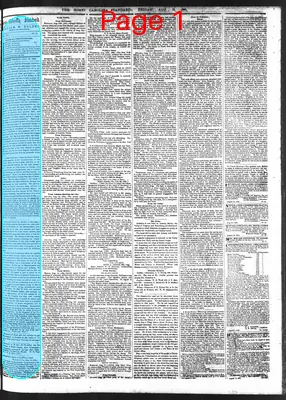
Editorial
August 19, 1864
Semi Weekly Standard
Raleigh, Wake County, North Carolina
What is this article about?
Editorial in the Semi-Weekly Standard criticizes Confederate blockade operations for corruption and profiteering by firms like Alexander Collie & Co., questions North Carolina's financial agents, notes a shift toward peace negotiations in Southern press after elections, and reports W.W. Holden's victory in Wake County sheriff election amid allegations of voter intimidation.
Clipping

OCR Quality
88%
Good
Full Text
SEMI-WEEKLY STANDARD.
WILLIAM W. HOLDEN,
Editor and Proprietor.
No. 47.
VOL. XIV.
TERMS OF THE STANDARD.
Semi Weekly, six months, $3.
The very large circulation of the Standard renders it a valuable medium for advertising.
RALEIGH: FRIDAY, AUG. 19, 1864.
We publish to-day from the Richmond Examiner an article which shows the advantages which the blockade business is to the parties engaged in it. The statements of the Examiner—correct and we see no reason to doubt them—are characterized by the same bold and unselfish disposition by which it is making 'good thing' out of our own. If the Examiner's statements in regard to Messrs. Alexander Collie & Co., Confederate government agents in Europe, held in London, are correct, the absurdity of the idea that these gentlemen are governed in their operations by any other consideration than that of making money, wherever they can make the most money; and the absurd idea that 'their feelings and sympathies are thoroughly with the Confederacy,' is apparent. Members of this firm, having found a couple of geese to be plucked, have plucked them, and now and then they throw a feather or two to one side or the other, if these geese, to prevent clamor, and as a 'tangible display of their active sympathy.' That is all. Col. McRae is too shrewd a person not to know that the first and great object of mercantile houses is to make money, and that any sympathy or benevolence which may be manifested for either governments or individuals is only apparent, and is intended to pave the way to still further advantages and profits. The day may come when the blockade operations of North-Carolina will be thoroughly investigated, and in our opinion it will be found, if such an investigation should be made, that the system has not only greatly added to the debt of the State by just such firms as Alexander Collie & Co., but that it has been marked by gross corruption, and by the most flagrant impositions on the State. Col. McRae states that 'when the State of North Carolina appeared, by her Commissioner, in the London market, he found great difficulty in obtaining a favorable hearing for her loan propositions. She was but little known on 'Change'—she had never borrowed comparatively, and it requires huge borrowing, as well as punctual paying, to make a name.' There is no State on the continent whose credit is better in Europe than that of North-Carolina. Her old coupon bonds, in the hands of the Rothschilds and other bankers in Europe, are classed among the best securities. The assumption that she had no name as a State entitled to credit because she had not borrowed largely, is very ridiculous even from the pen of Col. McRae. This astute financier, who had the honor to be first to introduce our good old State favorably on 'Change,' would have the public believe that the money-lenders of Europe judge of the ability to pay by the wish to borrow, and that the State which most frequently hawks its bonds in market, and borrows most, is entitled to the best credit. If anything of the kind could have affected the State's credit and injured her character on 'Change,' it would have been done by the indecent quarrel which took place in London between the Commissioner, Col. McRae, and his former associate in the naval stores business, Mr. Geo. N. Sanders. On the very heels of the election in this State a peace influence seems to have gone out, most probably from Richmond, on the administration journals, which, up to that very moment, had been pressing the war in the most violent manner, and declaring that all peace men were more or less disloyal to the cause. The change of tone was instantaneous. Certain journals, including the Confederate and Conservative, of this City, hardly gave the people time to vote before they took ground for negotiations, and avowed their willingness to discuss the question of re-union with the Northern people. The article of the Confederate which we publish to-day, and which we may notice more at length hereafter, goes further than we have ever gone, in that it proposes, not a Convention of one or of all the Southern States, but a Convention of all the United States. It cries out to Massachusetts and Vermont, as well as to Illinois and Indiana, 'We have been fighting you three years, and we fear we are whipped. We appeal to you to grant us an armistice, and then meet us in general Convention; and if you can convince us that we can return to the Union with safety and honor, we will at least consider the matter, and the probability is we will re-turn.' We leave it to our readers the Confederate to say if this article is plain English. That paper, we may be sure, will continue to abuse the Northern people, and continue to abuse a large portion of our own people, for effecting peace; but its thoughts are even now running in the peace channel, and it would do almost anything to stop the war and avert what it so greatly fears—subjugation. It wants recognition, and it wants a Convention of all the States: recognition as distant and as doubtful as it ever was; and a general Convention can alone be called in such circumstances of the States of recognition on the application by two-thirds of the Congress. But Col. McRae seems now to be of the opinion that he has heretofore been in favor with the States in view, and to representing himself as an humble suppliant at the door of the United States. These States are imploring his positions them not ours. He is the loyal and true Confederate, and re-tire traitor! What will be the end of all this? The answer is, 'Watch and Wait!' The attention of those who are required to pay tithes of tobacco is directed to the notice of the agent for Wake and Orange Counties, in our paper to-day. SHERIFFALTY OF WAKE.—On Thursday last the Magistrates of Wake County, after investigation and comparison, announced through their Chairman, W. H. High, the vote as follows: W. W. Holden 1,607, J. P. H. Russ 1,067. Extract from a letter to the Editor, dated Randolph Co., Aug. 11, 1864. 'If out of two precincts from Randolph were not received, the vote would stand as follows: Holden 2,270, Russ 1,800.' There were strong guards of armed men at the polls, and many were deterred from voting for Vance against their wishes.
WILLIAM W. HOLDEN,
Editor and Proprietor.
No. 47.
VOL. XIV.
TERMS OF THE STANDARD.
Semi Weekly, six months, $3.
The very large circulation of the Standard renders it a valuable medium for advertising.
RALEIGH: FRIDAY, AUG. 19, 1864.
We publish to-day from the Richmond Examiner an article which shows the advantages which the blockade business is to the parties engaged in it. The statements of the Examiner—correct and we see no reason to doubt them—are characterized by the same bold and unselfish disposition by which it is making 'good thing' out of our own. If the Examiner's statements in regard to Messrs. Alexander Collie & Co., Confederate government agents in Europe, held in London, are correct, the absurdity of the idea that these gentlemen are governed in their operations by any other consideration than that of making money, wherever they can make the most money; and the absurd idea that 'their feelings and sympathies are thoroughly with the Confederacy,' is apparent. Members of this firm, having found a couple of geese to be plucked, have plucked them, and now and then they throw a feather or two to one side or the other, if these geese, to prevent clamor, and as a 'tangible display of their active sympathy.' That is all. Col. McRae is too shrewd a person not to know that the first and great object of mercantile houses is to make money, and that any sympathy or benevolence which may be manifested for either governments or individuals is only apparent, and is intended to pave the way to still further advantages and profits. The day may come when the blockade operations of North-Carolina will be thoroughly investigated, and in our opinion it will be found, if such an investigation should be made, that the system has not only greatly added to the debt of the State by just such firms as Alexander Collie & Co., but that it has been marked by gross corruption, and by the most flagrant impositions on the State. Col. McRae states that 'when the State of North Carolina appeared, by her Commissioner, in the London market, he found great difficulty in obtaining a favorable hearing for her loan propositions. She was but little known on 'Change'—she had never borrowed comparatively, and it requires huge borrowing, as well as punctual paying, to make a name.' There is no State on the continent whose credit is better in Europe than that of North-Carolina. Her old coupon bonds, in the hands of the Rothschilds and other bankers in Europe, are classed among the best securities. The assumption that she had no name as a State entitled to credit because she had not borrowed largely, is very ridiculous even from the pen of Col. McRae. This astute financier, who had the honor to be first to introduce our good old State favorably on 'Change,' would have the public believe that the money-lenders of Europe judge of the ability to pay by the wish to borrow, and that the State which most frequently hawks its bonds in market, and borrows most, is entitled to the best credit. If anything of the kind could have affected the State's credit and injured her character on 'Change,' it would have been done by the indecent quarrel which took place in London between the Commissioner, Col. McRae, and his former associate in the naval stores business, Mr. Geo. N. Sanders. On the very heels of the election in this State a peace influence seems to have gone out, most probably from Richmond, on the administration journals, which, up to that very moment, had been pressing the war in the most violent manner, and declaring that all peace men were more or less disloyal to the cause. The change of tone was instantaneous. Certain journals, including the Confederate and Conservative, of this City, hardly gave the people time to vote before they took ground for negotiations, and avowed their willingness to discuss the question of re-union with the Northern people. The article of the Confederate which we publish to-day, and which we may notice more at length hereafter, goes further than we have ever gone, in that it proposes, not a Convention of one or of all the Southern States, but a Convention of all the United States. It cries out to Massachusetts and Vermont, as well as to Illinois and Indiana, 'We have been fighting you three years, and we fear we are whipped. We appeal to you to grant us an armistice, and then meet us in general Convention; and if you can convince us that we can return to the Union with safety and honor, we will at least consider the matter, and the probability is we will re-turn.' We leave it to our readers the Confederate to say if this article is plain English. That paper, we may be sure, will continue to abuse the Northern people, and continue to abuse a large portion of our own people, for effecting peace; but its thoughts are even now running in the peace channel, and it would do almost anything to stop the war and avert what it so greatly fears—subjugation. It wants recognition, and it wants a Convention of all the States: recognition as distant and as doubtful as it ever was; and a general Convention can alone be called in such circumstances of the States of recognition on the application by two-thirds of the Congress. But Col. McRae seems now to be of the opinion that he has heretofore been in favor with the States in view, and to representing himself as an humble suppliant at the door of the United States. These States are imploring his positions them not ours. He is the loyal and true Confederate, and re-tire traitor! What will be the end of all this? The answer is, 'Watch and Wait!' The attention of those who are required to pay tithes of tobacco is directed to the notice of the agent for Wake and Orange Counties, in our paper to-day. SHERIFFALTY OF WAKE.—On Thursday last the Magistrates of Wake County, after investigation and comparison, announced through their Chairman, W. H. High, the vote as follows: W. W. Holden 1,607, J. P. H. Russ 1,067. Extract from a letter to the Editor, dated Randolph Co., Aug. 11, 1864. 'If out of two precincts from Randolph were not received, the vote would stand as follows: Holden 2,270, Russ 1,800.' There were strong guards of armed men at the polls, and many were deterred from voting for Vance against their wishes.
What sub-type of article is it?
Economic Policy
War Or Peace
Partisan Politics
What keywords are associated?
Blockade Corruption
Confederate Agents
North Carolina Credit
Peace Negotiations
Southern Press
Election Results
Voter Intimidation
What entities or persons were involved?
Alexander Collie & Co.
Col. Mcrae
Geo. N. Sanders
Richmond Examiner
Confederate Journal
W. W. Holden
J. P. H. Russ
W. H. High
Editorial Details
Primary Topic
Criticism Of Blockade Corruption And Shift To Peace Advocacy In Confederate Press
Stance / Tone
Critical Of Profiteering And Skeptical Of Peace Proposals
Key Figures
Alexander Collie & Co.
Col. Mcrae
Geo. N. Sanders
Richmond Examiner
Confederate Journal
W. W. Holden
J. P. H. Russ
W. H. High
Key Arguments
Blockade Business Benefits Profiteers Like Collie & Co. At The Expense Of The Confederacy.
North Carolina's Blockade Operations Involve Gross Corruption And Impositions On The State.
North Carolina Has Strong Credit In Europe, Contradicting Claims Of Poor Reputation.
Post Election, Southern Journals Suddenly Advocate Peace And Reunion Negotiations.
The Confederate Proposes A General Convention Of All States For Armistice And Potential Reunion.
Voter Intimidation Occurred At Polls During The Election.