Thank you for visiting SNEWPapers!
Sign up free
Richmond Enquirer
Richmond, Richmond County, Virginia
What is this article about?
Report on Pennsylvania House of Representatives proceedings from January 8-10, 1824, approving resolutions on president's message and presidential electors' meeting place amid debates on caucuses, candidates like Gen. Jackson, Calhoun, and Adams, and political maneuvering to avoid election devolving to U.S. House. Includes extract from Jan. 14 letter on caucus formation.
Clipping
OCR Quality
Full Text
HOUSE OF REPRESENTATIVES, JANUARY 8
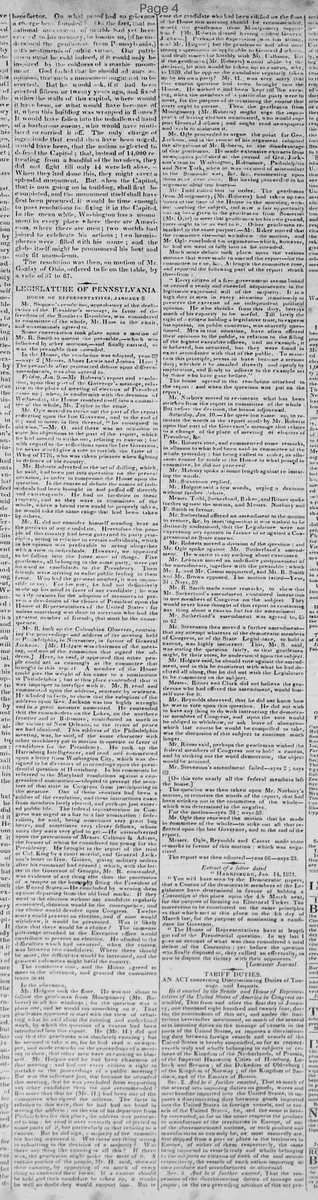
Mr. Shippen's resolution, approbatory of the declaration of the President's message, in favor of the freedom of the Southern Republics, was considered in committee of the whole, Mr. Huss in the chair, and unanimously agreed to. Some conversation took place upon a motion of Mr. R. Smith to amend the preamble,—which was followed by other motions,—and finally carried, as was the preamble thus amended. In the House, the resolution was adopted, yeas 89—nays 2 [Messrs. Abner Lewis and Joshua Horn]. The preamble after protracted debate upon different amendments, was also agreed to. Friday, Jan. 9.—Mr Roberts's report and resolution, upon that part of the Governor's message, relative to the place of meeting of electors of President came up; when, in conformity with the decision of Wednesday, the House resolved itself into a committee of the whole, Mr. Taylor in the chair. Mr. Ogle moved to strike out the part of the report reflecting upon the late Governor, and to the end of it; and to insert in lieu thereof, "be consigned to oblivion."—Mr. O. said there was no occasion to state his objections to the part of the report, which he had moved to strike out, relating to caucus; In with regard to the reflections upon the late Governor, he never would give a vote to tarnish the fame of a Whig of 1776, who was taken prisoner when fighting in defence of his country. Mr. Roberts adverted to the act of drilling, which, he said, had been put into operation on the present occasion, in order to compromit the House upon the question. In the course of debate the names of individuals had been brought in and puffed off directly and extravagantly. He had no facilities in these respects, and as they were in committee of the whole, where a broad view could be properly taken, he would take the same range that had been taken by others. Mr. R. did not consider himself standing here as the partizan of any candidate. Heretofore the people of this country had been governed by party principles, acting in relation to certain individuals, which in his opinion was preferable to acting altogether with a view to individuals. However, we appeared to be falling into the latter state of things. Five gentlemen, all belonging to the same party, were put forward as candidates to the Presidency. Their friends were striving to enlist public feeling in their favor. Who had the greatest number, it was impossible to say. For his part, he had not definitively made up his mind in favor of any candidate; he was only anxious for the adoption of measures to prevent a devolution of the choice of President upon the House of Representatives of the United States: for unless something was done to ascertain who had the greatest number of friends, that must be the consequence. Mr. R. took up the Columbian Observer, containing the proceedings and address of the meeting held at Philadelphia, in November, in favour of General Jackson. [Mr. Holgate was chairman of the meeting, and one of the committee that signed the address.] Here, he said, it appeared that other people could act as cunningly as the committee that brought in this report "A member of the House could give the weight of his name to a nomination in Philadelphia; but at this place contended that it was improper to interfere with it. Mr. R. read and commented upon the address, sentence by sentence. He alluded to facts, to shew that the eulogium of the address upon Gen. Jackson was too highly wrought and in a great measure unmerited He contended that the commanders on the Lakes, on the northern frontier and at Baltimore, contributed as much as the victory of New Orleans, to the terms of peace we had obtained. This address of the Philadelphia meeting, was, he said, of the same character with other machinery put in motion to operate in favor of candidates for the Presidency. He took up the Harrisburg Intelligencer, and read and commented upon a letter from Washington City, which was designed to be directory of proceedings upon the presidential question at Harrisburg. In his comments he referred to the Maryland resolutions against a congressional nomination—adopted to prevent the senators of that state in Congress from participating in the measure. One of these senators had been a soldier of the revolution, and these instructions came from members lately elected, and perhaps just entered public life. The federal representation in Congress was urged as a bar to a fair nomination: federalists, he said, being sometimes very great bug bears, and sometimes very clever fellows, whose votes they were very glad to get.—He animadverted upon the pretensions of Messrs. Calhoun & Adams, the former of whom he considered too young for the Presidency. He brought in the report of the trial of Col. King by a court martial, and General Jackson's letter to Gen. Gaines, giving military orders after his command had ceased; which, with the letter to the Governor of Georgia, Mr. R. contended, was evidence of any thing else than the possession of a temper or the humanity fitting the President of the United States.—He concluded by warning them against departing from the old land marks. If they went to the election without any candidate regularly nominated, disunion would be the consequence, and the choice would devolve upon Congress. Twelve states could prevent an election, and if nine would withdraw, it would be prevented. Was it likely then that there would be a choice? The immense patronage attached to the Executive office would contribute to prevent an election. He alluded to the difficulties when the contest was between two candidates. Where there should be more, the difficulties would be increased, and the greatest calamities might befall the country. The committee rose, and the House agreed to meet in the afternoon, and granted the committee leave to sit. In the afternoon, Mr. Holgate took the floor. He was not about to follow the gentleman from Montgomery (Mr. Roberts) in all his windings; for the question was a plain one, and he would say something on it. That gentleman appeared to start with the view of rebutting what he said about the cunning and underhand work, by which the question of a caucus had been introduced into this report. He (Mr. H) did not say that the gentleman was absolutely cunning; but he seemed to take it so, for he had read a newspaper, and made remarks on the proceedings of a meeting to show, that other men were as cunning as himself. Mr. Holgate said he had been chairman of that meeting: and had not every citizen a right to partake in the proceedings of a public meeting? But was the inference just, that because he attended this meeting, that he was precluded from supporting any other candidate than the one recommended? But more than that he (Mr. H.) had been one of the committee who signed the address, The facts in relation to this were, that he had had no hand in writing the address: on the eve of his departure from Philadelphia for this place, the address was presented to him: he read it over cursorily and objected to some parts of it, but particularly so that relating to a caucus, But he did sign, a majority of the committee having approved it. Was there any thing wrong in submitting to the decision of a majority? Was there any thing like cunning on all this? "If there was, the gentleman might make the most of it. A certain portion of the people, Mr. H. said, showed their cunning, by approving of so much of every thing as answered their views, If a caucus should be held and their candidate be taken up, it would be well no doubt they would support him. But in case the candidate who had been vilified on the floor of the House this morning should be recommended, would the gentleman from Montgomery support him? Mr. Roberts denied having vilified General Jackson. Perhaps the expression was too strong, said Mr. Holgate: but the gentleman had also used strong expressions as applicable to General Jackson, and dealt some rather haughtily with Mr. Calhoun. But if the gentleman (Mr. Roberts) would abide by the decision, let who would be taken up to caucus, "why, in 1820, did he oppose the candidate regularly taken up by his own party? Mr. H. was very sorry that this caucus question had been brought into the House. He wished it had been kept till the evening, when the members of a particular party were to meet, for the purpose of determining the course that party ought to pursue. Then the gentleman from Montgomery (Mr. Roberts) might urge the impropriety of having electors nominated, who would support General Jackson; and might read newspapers and travels to maintain it. Mr. Ogle proceeded to argue the point for Gen. Jackson, and in the course of his argument rebutted the allegations of Mr. Roberts, to the disadvantage of that gentleman. He made extensive extracts from newspapers published at the period of Gen. Jackson's tour to Washington, Baltimore, Philadelphia and New York, when he was accused of misconduct in the Seminole war, &c. &c. commenting upon them as he went along. But having proceeded in his argument about two hours—Mr Todd called him to order. The gentleman from Montgomery, (Mr. Roberts) had taken up two hours of the time of the House in the morning, without touching the subject, and now a fair opportunity having been given to the gentleman from Somerset (Mr. Ogle) to meet that gentleman on his own ground, there ought to be an end to it. Other gentlemen remarked in the same purport.—Mr. Baker moved that the committee rise—but withdrew the motion, and Mr. Ogle concluded his argument—which, however, he had not gone as fully into as he intended. Much more debate took place upon the various motions that were made to amend the report—for the committee to rise, &c. At length the committee rose, and reported the following part of the report struck therefrom:
"Every citizen of a free government seems bound to accord a ready and cheerful acquiescence in the legitimate expressed will of the majority. It is a high duty in men in every situation tenaciously to preserve the exercise of an independent political opinion. He who shrinks from this duty, betrays much of his capacity to be useful. Till lately the right of a citizen holding a legislative trust, to express his opinion, on public concerns, was scarcely questioned. Men in this situation, have often offered their opinions to the public, in relation to the filling of the highest executive offices, and no example, is believed, has occurred, but they were found in exact accordance with that of the public. To maintain this principle, seems to have become a serious duty, whether it be assailed directly and openly by implication, and firmly to adhere to the example set by those who have gone before."
The house agreed to the resolution attached to the report: and when the question was put on the report, Mr. Norbury moved to re-instate what has been stricken from the report in committee of the whole: But before the decision, the house adjourned. Saturday, Jan. 10.—The question came up, to re-instate the words in the report made by Mr. Roberts upon that part of the Governor's message that relates to a change of the place of meeting of electors of President, &c. Mr. Roberts rose, and commenced some remarks, in allusion to what had been said in committee of the whole yesterday: but being called to order, as allusions cannot be made in the House to what passed in committee, he did not proceed. Mr. Mahany spoke at some length against re-instating the words. Mr. Stevenson replied. Mr. Holgate said a few words, urging a decision without further debate. Messrs. Todd, Sutherland, Baker, and Ritner spoke further against the motion, and Messrs. Norbury and F. Smith in favour. Mr. Sutherland offered an amendment to the motion to restore, &c. by inserting—that it was wished to be distinctly understood, that the Legislature were not expressing any opinion in favour of or against a Congressional or State caucus. Mr. Roberts moved a division of the question: and Mr. Ogle spoke against Mr. Sutherland's amendment. He wanted to say nothing about caucusses. Mr. Lehman moved an indefinite postponement of the amendments, together with the preamble: which Mr. L. and Mr. Cassat supported, and Mr. R. Smith and Mr. Brown opposed. The motion failed—Yeas, 31: Nays, 59. Mr. R. Smith made some remarks, to shew that Mr. Sutherland's amendment contained instruction to our members of Congress on the subject They would never have thought of this report as containing any thing about a caucus but for the amendment Mr. Sutherland's amendment was agreed to, 45 to 42. Mr. Stevenson then moved a further amendment—that any attempt whatever of the democratic members of Congress, or of the State Legislature, to hold a caucus, was highly incorrect. This, Mr. S. said, was stating the question fairly, so that gentlemen might, by their votes, be understood upon the subject. Mr. Holgate said, he should vote against the amendment, and in this he consistent with what he had declared all along, that he did not wish the Legislature to be committed on the subject. Messrs. Ritner and Clark did not believe the gentleman who had offered the amendment, would himself vote for it. Mr. Reynolds observed, that he did not know how he was to vote upon this question. He did not wish to have any thing to do with instructing the democratic members of Congress, and upon the vote would be obliged to withdraw, or ask leave of absence—which last course he would be compelled to take, was the discussion of this subject to continue much longer. Mr. Ritner said, perhaps the gentleman wished the federal members of Congress not to hold a caucus, and by striking out the word democratic, the object would be attained. Mr. Stevenson's amendment failed—ayes 2; nays 69. [On this vote nearly all the federal members left the house.] The question was then taken upon Mr. Norbury's motion, to reinstate the words of the report, that had been stricken out in the committee of the whole—which was determined in the negative. For the motion—ayes 34; nays 53. Mr. Ogle then renewed the motion that he made in committee of the whole—to strike out all that reflected upon the late Governor, and to the end of the report. Messrs. Ogle, Reynolds and Cassat made some remarks in favour of this motion: which was negatived. The report was then adopted—yeas 66—nays 23.
Extract of a letter dated
"HARRISBURG, Jan. 14, 1824.
"You will have seen by the Democratic papers, that a Caucus of the democratic members of the Legislature have determined in favour of holding a Convention at this place upon the 4th March next, for the purpose of forming an Electoral Ticket. The convention to be constituted on the same principles as that which met at this place on the 4th day of March last, for the purpose of nominating a candidate for Governor.
"The House of Representatives have at length got rid of the Presidential question. In my last I gave an account of what was then considered a total defeat of the Caucusites: yet before the question was finally disposed of, they rallied so effectually, as now to dispute the victory with their opponents."
[Lancaster Journal.
What sub-type of article is it?
What themes does it cover?
What keywords are associated?
What entities or persons were involved?
Where did it happen?
Story Details
Key Persons
Location
Harrisburg, Pennsylvania
Event Date
January 8 10, 1824
Story Details
The Pennsylvania House debates and passes resolutions supporting the president's message on Southern Republics' freedom and addressing the meeting place for presidential electors. Intense discussions occur on caucuses, criticisms of candidates like Jackson, Calhoun, and Adams, and efforts to prevent the presidential choice from devolving to the U.S. House, with amendments struck and reports adopted amid partisan exchanges.