Thank you for visiting SNEWPapers!
Sign up free
Arizona Republican
Phoenix, Maricopa County, Arizona
What is this article about?
Pre-war analysis in December's Everybody's Magazine by O. K. Davis forecasts Russia-Japan conflict resolution by war, favoring Russia's numerical superiority over Japan's mobility and naval prowess, with sea command crucial for Japan.
Clipping
OCR Quality
Full Text
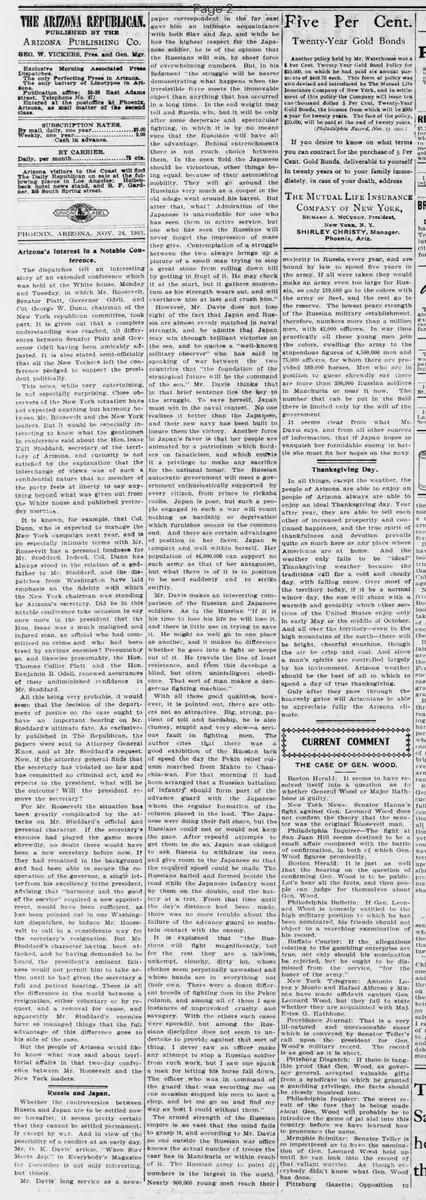
Whether the controversies between Russia and Japan are to be settled now or hereafter, it seems pretty certain that they cannot be settled permanently except by war. And in view of the possibility of a conflict at an early day, Mr. O. K. Davis' article, "When Slav Meets Jap," in Everybody's Magazine for December is not only interesting, but timely.
Mr. Davis' long service as a newspaper correspondent in the far east gave him an intimate acquaintance with both Slav and Jap, and while he has the highest respect for the Japanese soldier, he is of the opinion that the Russians will win, by sheer force of overwhelming numbers. But, in his judgment "the struggle will be nearer demonstrating what happens when the irresistible force meets the immovable object than anything that has occurred in a long time. In the end weight may tell and Russia win, but it will be only after some desperate and spectacular fighting, in which it is by no means sure that the Russians will have all the advantage. Behind entrenchments there is not much choice between them. In the open field the Japanese should be victorious, other things being equal, because of their astonishing mobility. They will go around the Russians very much as a cooper in the old adage went around his barrel. But after that, what? Admiration of the Japanese is unavoidable for one who has seen them in active service, but one who has seen the Russians will never forget the impression of mass they give. Contemplation of a struggle between the two always brings up a picture of a small man trying to stop a great stone from rolling down hill by getting in front of it. He may check it at the start, but it gathers momentum as his strength wears out, and will overthrow him at last and crush him."
However, Mr. Davis does not lose sight of the fact that Japan and Russia are almost evenly matched in naval strength, and he admits that Japan may win through brilliant victories on the sea, and he quotes a "well-known military observer" who has said in speaking of war between the two countries that "the foundation of the strategical future will be the command of the sea." Mr. Davis thinks that in that brief sentence lies the key to the struggle. To save herself, Japan must win in the naval contest. No one realizes it better than the Japanese, and their new navy has been built to ensure them the victory. Another force in Japan's favor is that her people are animated by a patriotism which borders on fanaticism, and which counts it a privilege to make any sacrifice for the national honor. The Russian autocratic government will meet a government enthusiastically supported by every citizen, from prince to ricksha coolie. Japan is poor, but such a people engaged in such a war will count nothing as hardship or deprivation which furnishes means to the common end. And there are certain advantages of position in her favor. Japan is compact and well within herself. Her population of 46,000,000 can support no such army as that of her antagonist, but what there is of it is in position to be used suddenly and to strike swiftly.
Mr. Davis makes an interesting comparison of the Russian and Japanese soldiers. As to the Russian "If it is his time to lose his life he will lose it, and there is little use in trying to save it. He might as well go to one place as another, and it makes no difference whether he goes into a fight or keeps out of it. He travels the line of least resistance, and from this develops a blind, but often unintelligent obedience. That sort of man makes a dangerous fighting machine."
With all these good qualities, however, it is pointed out, there are others not so attractive. Big, strong, patient of toil and hardship, he is also clumsy, stupid and very slow-a serious fault in fighting men. The author cites that there was a good exhibition of the Russian lack of speed the day the Pekin relief column marched from Mahto to Chan-chia-wan. For that morning it had been arranged that a Russian battalion of infantry should form part of the advance guard with the Japanese whom the regular formation of the column placed in the lead. The Japanese were doing their full share, but the Russians could not or would not keep the pace. After repeated attempts to get them to do so, Japan was obliged to ask Russia to withdraw its men and give room to the Japanese so that the required speed could be made. The Russians halted and formed beside the road while the Japanese infantry went by them on the double, and the battery at a trot. From that time until the day's distance had been made, there was no more trouble about the failure of the advance guard to maintain contact with the enemy.
It is explained that "the Russians will fight magnificently, but for the rest they are a lawless, unkempt, slouchy, dirty lot, whose clothes seem perpetually unwashed and whose hands are in everything not their own. There were a dozen different breeds of fighting men in the Pekin column, and among all of them I saw instances of unprovoked cruelty and savagery. With the others such cases were sporadic, but among the Russians discipline does not seem to undertake to provide against that sort of thing. I never saw an officer make any attempt to stop a Russian soldier from such work, but I saw one spank a man for letting his horse fall down. The officer who was in command of the guard that was escorting me on one occasion stopped his men to loot a shop, and let me go on and find my way as best I could without them."
The armed strength of the Russian empire is so vast that the mind fails to grasp it, and according to Mr. Davis no one outside the Russian war office knows the actual number of troops the czar has in Manchuria or within reach of it. The Russian army in point of numbers is the largest in the world. Nearly 900,000 young men reach their majority in Russia every year, and are bound by law to spend five years in the army. If all were taken they would make an army even too large for Russia, so only 219,000 go to the colors with the army or fleet, and the rest go to the reserve. The lowest peace strength of the Russian military establishment, therefore, numbers more than a million men, with 42,000 officers. In war time practically all these young men join the colors, swelling the army to the stupendous figures of 4,500,000 men and 75,000 officers, for whom there are provided 560,000 horses. Men who are in position to guess shrewdly say there are more than 300,000 Russian soldiers in Manchuria or near it now. The number that can be put in the field there is limited only by the will of the government.
It seems clear from what Mr. Davis says, and from all other sources of information, that if Japan hopes to vanquish her formidable enemy in battle she must fix her hopes on the navy.
What sub-type of article is it?
What keywords are associated?
What entities or persons were involved?
Where did it happen?
Foreign News Details
Primary Location
Russia And Japan
Event Date
December
Key Persons
Event Details
Analysis by Mr. O. K. Davis predicts that controversies between Russia and Japan will likely lead to war, with Russia favored due to overwhelming numbers despite Japanese mobility and naval strengths. Japanese patriotism and compact position are advantages, but Russian mass and vast army may prevail after desperate fighting. Naval command is key for Japan to win.