Thank you for visiting SNEWPapers!
Sign up free
The New Hampshire Gazette
Portsmouth, Rockingham County, New Hampshire
What is this article about?
Reports on General Lafayette's prominent role in post-revolutionary France: his appointment as Commandant General of the National Guards, a planned grand review in Paris, and his speech advocating abolition of the death penalty in the Chamber of Deputies on August 17, 1830. Praises his humanitarian efforts and popularity.
Clipping
OCR Quality
Full Text
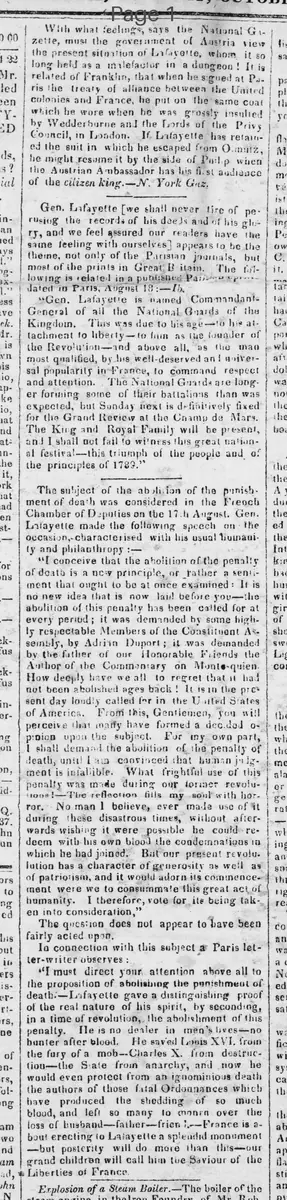
Gen. Lafayette [we shall never tire of perusing the records of his deeds and of his glory, and we feel assured our readers have the same feeling with ourselves] appears to be the theme, not only of the Parisian journals, but most of the prints in Great Britain. The following is related in a published Paris letter dated in Paris, August 18;—
"Gen. Lafayette is named Commandant General of all the National Guards of the Kingdom. This was due to his age—to his attachment to liberty—to him as the founder of the Revolution!—and above all, as the man most qualified, by his well-deserved and universal popularity in France, to command respect and attention. The National Guards are longer forming some of their battalions than was expected, but Sunday next is definitively fixed for the Grand Review at the Champ de Mars. The King and Royal Family will be present, and I shall not fail to witness this great national festival—this triumph of the people and of the principles of 1789."
The subject of the abolition of the punishment of death was considered in the French Chamber of Deputies on the 17th August. Gen. Lafayette made the following speech on the occasion,—characterised with his usual humanity and philanthropy :—
"I conceive that the abolition of the penalty of death is a new principle, or rather a sentiment that ought to be at once examined: It is no new idea that is now laid before you—the abolition of this penalty has been called for at every period; it was demanded by some highly respectable Members of the Constituent Assembly, by Adrien Duport; it was demanded by the father of our honorable Friends the Author of the Commentary on Montesquieu. How deeply have we all to regret that it had not been abolished ages back! It is in the present day loudly called for in the United States of America. From this, Gentlemen, you will perceive that many have formed a decided opinion upon the subject. For my own part, I shall demand the abolition of the penalty of death, until I am convinced that human judgment is infallible. What frightful use of this penalty was made during our former revolutions! The reflection fills my soul with horror. No man I believe, ever made use of it during these disastrous times, without afterwards wishing it were possible he could redeem with his own blood the condemnations in which he had joined. But our present revolution has a character of generosity as well as of patriotism, and it would adorn its commencement were we to consummate this great act of humanity. I therefore, vote for its being taken into consideration,"
The question does not appear to have been fairly acted upon.
In connection with this subject a Paris letter-writer observes:
I must direct your attention above all to the proposition of abolishing the punishment of death:—Lafayette gave a distinguishing proof of the real nature of his spirit, by seconding, in a time of revolution, the abolishment of this penalty. He is no dealer in men's lives—no barterer after blood. He saved Louis XVI. from the fury of a mob—Charles X. from destruction—the State from anarchy, and now he would even protect from an ignominious death the authors of those fatal Ordinances which have produced the shedding of so much blood, and left so many to mourn over the loss of husband—father—friend.—France is about erecting to Lafayette a splendid monument—but posterity will do more than this—our grand children will call him the Saviour of the Liberties of France.
What sub-type of article is it?
What keywords are associated?
What entities or persons were involved?
Where did it happen?
Foreign News Details
Primary Location
Paris
Event Date
August 17 18
Key Persons
Outcome
lafayette named commandant general of national guards; grand review planned for sunday next at champ de mars; proposition to abolish death penalty considered but not fairly acted upon; praise for lafayette's humanitarian actions and planned monument.
Event Details
Commentary on Austria's view of Lafayette's situation; anecdote comparing to Franklin; Lafayette appointed Commandant General due to his age, liberty attachment, revolution founding, and popularity; National Guards review at Champ de Mars with King present; Lafayette's speech in Chamber of Deputies advocating abolition of death penalty, citing historical calls and U.S. example; letter praising Lafayette's spirit in supporting abolition during revolution, his past saves, and future legacy as savior of French liberties.