Thank you for visiting SNEWPapers!
Sign up free
The Daily Advertiser
New York, New York County, New York
What is this article about?
Debate in New York House of Assembly on February 15 regarding the validity of leases obtained by John Livingston and associates from Indians for western lands, covering about 12 million acres. Members discuss constitutionality, potential Indian war, and measures to declare them void.
Merged-components note: This is a continuation of the story about debates in the House of Assembly regarding leases from the Indians, spanning from page 2 to page 3 with sequential reading order.
Clippings
1 of 2
OCR Quality
Full Text
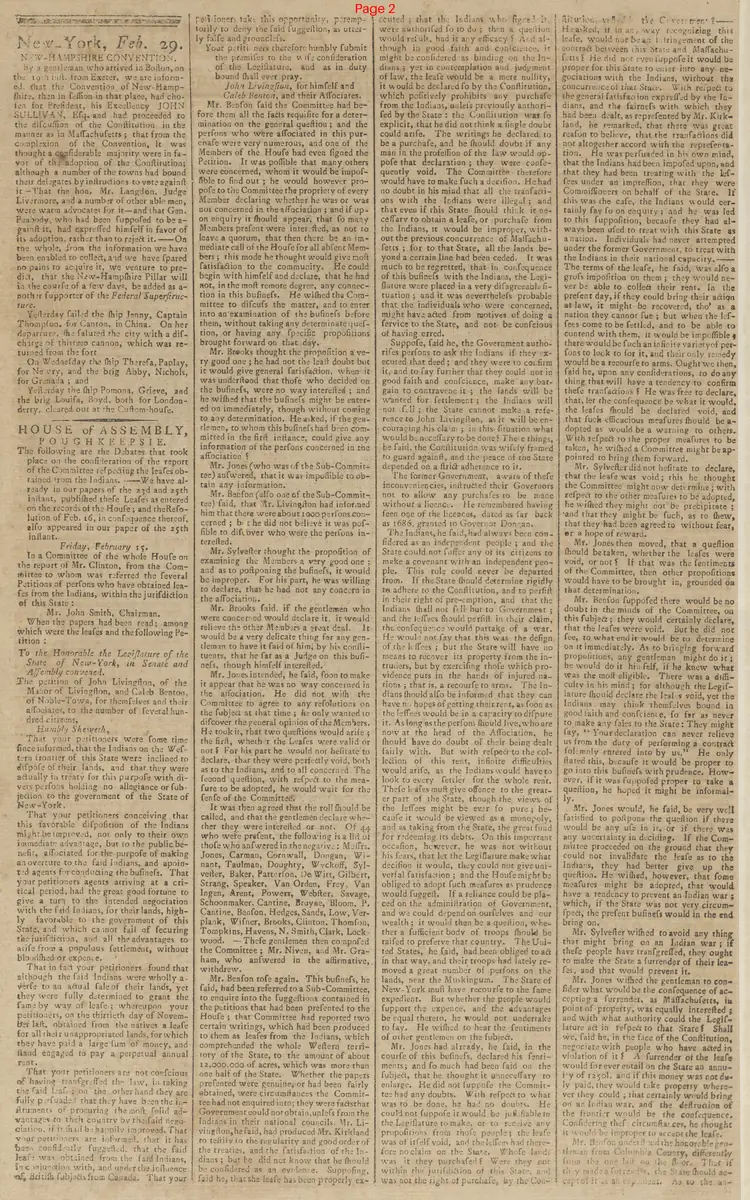
POUGHKEEPSIE.
The following are the Debates that took place on the consideration of the report of the Committee respecting the leases obtained from the Indians.—We have already in our papers of the 23d and 25th instant, published these Leases as entered on the records of the House: and the Resolution of Feb. 16, in consequence thereof, also appeared in our paper of the 25th instant.
Friday, February 15.
In a Committee of the whole House on the report of Mr. Clinton, from the Committee to whom was referred the several Petitions of persons who have obtained leases from the Indians, within the jurisdiction of this State:
Mr. John Smith, Chairman.
When the papers had been read; among which were the leases and the following Petition:
To the Honorable the Legislature of the State of New-York, in Senate and Assembly convened.
The petition of John Livingston, of the Manor of Livingston, and Caleb Benton, of Noble-Town, for themselves and their associates, to the number of several hundred citizens,
Humbly Sheweth.
That your petitioners were some time since informed, that the Indians on the Western frontier of this State were inclined to dispose of their lands, and that they were actually in treaty for this purpose with divers persons holding no allegiance or subjection to the government of the State of New-York.
That your petitioners conceiving that this favorable disposition of the Indians might be improved, not only to their own immediate advantage, but to the public benefit, associated for the purpose of making an overture to the said Indians, and appointed agents for conducting the business. That your petitioners agents arriving at a critical period, had the great good fortune to give a turn to the intended negociation with the said Indians, for their lands, highly favorable to the government of this State, and which cannot fail of securing the jurisdiction, and all the advantages to arise from a populous settlement, without bloodshed or expence.
That in fact your petitioners found that although the said Indians were wholly averse to an actual sale of their lands, yet they were fully determined to grant the same by way of lease; whereupon your petitioners, on the thirtieth day of November last, obtained from the natives a lease for all their unappropriated lands, for which they have paid a large sum of money, and stand engaged to pay a perpetual annual rent.
That your petitioners are not conscious of having transgressed the law, in taking the said Lease; on the other hand they are fully persuaded that they have been the instruments of procuring the most solid advantages to their country by the said negociation, if it has been happily improved. That your petitioners are informed, that it has been confidently suggested, that the said lease was obtained from the said Indians, in conjunction with, and under the influence of, British subjects from Canada. That your petitioners take this opportunity, peremptorily to deny the said suggestion, as utterly false and groundless.
Your petitioners therefore humbly submit the premises to the wise consideration of the Legislature, and as in duty bound shall ever pray.
John Livingston, for himself and
Caleb Benton, and their Associates.
Mr. Benson said the Committee had before them all the facts requisite for a determination on the general question; and the persons who were associated in this purchase were very numerous, and one of the Members of the House had even signed the Petition. It was possible that many others were concerned, whom it would be impossible to find out; he would however propose to the Committee the propriety of every Member declaring whether he was or was not concerned in the association; and if upon enquiry it should appear, that so many Members present were interested, as not to leave a quorum, that then there be an immediate call of the House for all absent Members; this mode he thought would give most satisfaction to the community. He could begin with himself and declare, that he had not, in the most remote degree, any connection in this business. He wished the Committee to discuss the matter, and to enter into an examination of the business before them, without taking any determinate question, or having any specific propositions brought forward on that day.
Mr. Brooks thought the proposition a very good one; he had not the least doubt but it would give general satisfaction, when it was understood that those who decided on the business, were no way interested; and he wished that the business might be entered on immediately, though without coming to any determination. He asked, if the gentlemen, to whom this business had been committed in the first instance, could give any information of the persons concerned in the association?
Mr. Jones (who was of the Sub-Committee) answered, that it was impossible to obtain any information.
Mr. Benson (also one of the Sub-Committee) said, that Mr. Livingston had informed him that there were about 2000 persons concerned; but he did not believe it was possible to discover who were the persons interested.
Mr. Sylvester thought the proposition of examining the Members a very good one; and as to postponing the business, it would be improper. For his part, he was willing to declare, that he had not any concern in the association.
Mr. Brooks said, if the gentlemen who were concerned would declare it, it would relieve the other Members a great deal. It would be a very delicate thing for any gentleman to have it said of him, by his constituents, that he sat as a Judge on this business, though himself interested.
Mr. Jones intended, he said, soon to make it appear that he was no way concerned in the association. He did not wish the Committee to agree to any resolutions on the subject at that time; he only wanted to discover the general opinion of the Members. He took it, that two questions would arise: the first, whether the Leases were valid or not. For his part he would not hesitate to declare, that they were perfectly void, both as to the Indians, and to all concerned. The second question, with respect to the measure to be adopted, he would wait for the sense of the Committee.
It was then agreed that the roll should be called, and that the gentlemen declare whether they were interested or not. Of 44 who were present, the following is a list of those who answered in the negative: Messrs. Jones, Carman, Cornwall, Dongan, Winnant, Taulman, Doughty, Wyckoff, Sylvester, Baker, Patterson, De Witt, Gilbert, Strang, Speaker, Van Orden, Frey, Van Ingen, Arent, Powers, Webster, Savage, Schoonmaker, Cantine, Bruyne, Bloom, P. Cantine, Benson, Hedges, Sands, Low, Verplank, Wiser, Brooks, Clinton, Thomson, Tompkins, Havens, N. Smith, Clark, Lockwood. These gentlemen then composed the Committee: Mr. Niven, and Mr. Graham, who answered in the affirmative, withdrew.
Mr. Benson rose again. This business, he said, had been referred to a Sub-Committee, to enquire into the suggestions contained in the petitions that had been presented to the House; that Committee had reported two certain writings, which had been produced to them as leases from the Indians, which comprehended the whole Western territory of the State, to the amount of about 12,000,000 of acres, which was more than one half of the State. Whether the papers presented were genuine, or had been fairly obtained, were circumstances the Committee had not enquired into; they were facts that Government could not obtain, unless from the Indians in their national councils. Mr. Livingston, he said, had produced Mr. Kirkland to testify to the regularity and good order of the treaties, and the satisfaction of the Indians; but he did not know that he should be considered as an evidence. Supposing, said he, that the lease has been properly executed: that the Indians who executed it were authorized so to do; then a question would result, had it any efficacy? And although in good faith and conscience, it might be considered as binding on the Indians; yet in contemplation and judgment of law, the lease would be a mere nullity. It would be declared so by the Constitution, which positively prohibits any purchase from the Indians, unless previously authorized by the State: the Constitution was so explicit, that he did not think a single doubt could arise. The writings he declared, to be a purchase, and he should doubt if any man in the profession of the Law would oppose that declaration; they were consequently void. The Committee therefore would have to make such a decision. He had no doubt in his mind that all the transactions with the Indians were illegal; and that even if this State should think it necessary to obtain a lease, or purchase from the Indians, it would be improper, without the previous concurrence of Massachusetts; for to that State, all the lands beyond a certain line had been ceded. It was much to be regretted, that in consequence of this business with the Indians, the Legislature were placed in a very disagreeable situation; and it was nevertheless probable that the individuals who were concerned, might have acted from motives of doing a service to the State, and not be conscious of having erred.
Suppose, said he, the Government authorizes persons to ask the Indians if they executed that deed; and they were to confirm it, and to say further that they could not in good faith and conscience, make any bargain to contravene it; the lands will be wanted for settlement; the Indians will not sell; the State cannot make a reference to John Livingston, as it will be encouraging his claim; in this situation what would be necessary to be done? The things, he said, the Constitution was wisely framed to guard against, and the peace of the State depended on a strict adherence to it.
The former Government, aware of these inconveniencies, instructed their Governors not to allow any purchases to be made without a licence. He remembered having seen one of the licences, dated as far back as 1686, granted to Governor Dongan.
The Indians, he said, had always been considered as an independent people; and the State could not suffer any of its citizens to make a covenant with an independent people. This rule could never be departed from. If the State should determine rigidly to adhere to the Constitution, and to persist in their right of pre-emption, and that the Indians shall not sell but to Government; and the lessees should persist in their claim, the consequence would partake of a war. He would not say that this was the design of the Lessees; but the State will have no means to recover its property from the intruders, but by exercising those which Providence puts in the hands of injured nations: that is, a recourse to arms. The Indians should also be informed that they can have no hopes of getting their rent, as soon as the lessees would be in a capacity to dispute it. As long as the persons should live, who are now at the head of the Association, he should have no doubt of their being dealt fairly with. But with respect to the collection of this rent, infinite difficulties would arise, as the Indians would have to look to every settler for the whole rent. These leases must give offence to the greater part of the State, though the views of the lessees might be ever so pure; because it would be viewed as a monopoly, and as taking from the State, the great fund for redeeming its debts. On this important occasion, however, he was not without his fears, that let the Legislature make what decision it would, they could not give universal satisfaction; and the House might be obliged to adopt such measures as prudence would suggest. If a reliance could be placed on the administration of Government, and we could depend on ourselves and our wealth; it would then be a question, whether a sufficient body of troops should be raised to preserve that country. The United States, he said, had been obliged to act in that way, and their troops had lately removed a great number of persons on the lands, near the Muskingum. The State of New-York must have recourse to the same expedient. But whether the people would support the expence, and the advantages be equal thereto, he would not undertake to say. He wished to hear the sentiments of other gentlemen on the subject.
Mr. Jones had already, he said, in the course of this business, declared his sentiments; and so much had been said on the subject, that he thought it unnecessary to enlarge. He did not suppose the Committee had any doubts. With respect to what was to be done, he had no doubts. He could not suppose it would be justifiable in the Legislature to make, or to receive any propositions from those people; the lease was of itself void, and the lessees had therefore no claim on the State. Whose land was it they purchased? Were they not within the jurisdiction of this State, and was not the right of purchase, by the Constitution, vested in the Government?
He asked, if in any way recognizing this lease, would not be an infringement of the contract between this State and Massachusetts? He did not even suppose it would be proper for this State to enter into any negociations with the Indians, without the concurrence of that State. With respect to the general satisfaction expressed by the Indians, and the fairness with which they had been dealt, as represented by Mr. Kirkland, he remarked, that there was great reason to believe, that the transactions did not altogether accord with the representation. He was persuaded in his own mind, that the Indians had been imposed upon, and that they had been treating with the lessees under an impression, that they were Commissioners on behalf of the State. If this was the case, the Indians would certainly say so on enquiry; and he was led to this supposition, because they had always been used to treat with this State as a nation. Individuals had never attempted under the former Government, to treat with the Indians in their national capacity.—
The terms of the lease, he said, was also a gross imposition on them; they would never be able to collect their rent. In the present day, if they could bring their action at law, it might be recovered, tho' as a nation they cannot sue; but when the lessees come to be settled, and to be able to contend with them, it would be impossible there would be such an infinite variety of persons to look to for it, and their only remedy would be a recourse to arms. Ought we then, said he, upon any considerations, to do any thing, that will have a tendency to confirm these transactions? He was free to declare, that, let the consequence be what it would, the leases should be declared void, and that such efficacious measures should be adopted as would be a warning to others. With respect to the proper measures to be taken, he wished a Committee might be appointed to bring them forward.
Mr. Sylvester did not hesitate to declare, that the lease was void; this he thought the Committee might now determine; with respect to the other measures to be adopted, he wished they might not be precipitate; and that they might be such, as to shew, that they had been agreed to without fear, or a hope of reward.
Mr. Jones then moved, that a question should be taken, whether the leases were void, or not. If that was the sentiments of the Committee, then other propositions would have to be brought in, grounded on that determination.
Mr. Benson supposed there would be no doubt in the minds of the Committee, on this subject; they would certainly declare, that the leases were void. But he did not see, to what end it would be to determine on it immediately. As to bringing forward propositions, any gentleman might do it; he would do it himself, if he knew what was the most eligible. There was a difficulty in his mind; for although the Legislature should declare the leases void, yet the Indians may think themselves bound in good faith and conscience, so far as never to make any sales to the State: They might say, Your declaration can never relieve us from the duty of performing a contract solemnly entered into by us. He only stated this, because it would be proper to go into this business with prudence. However, if it was supposed proper to take a question, he hoped it might be informally.
Mr. Jones would, he said, be very well satisfied to postpone the question if there would be any use in it, or if there was any uncertainty in deciding. If the Committee proceeded on the ground that they could not invalidate the lease as to the Indians, they had better give up the question. He wished, however, that some measures might be adopted, that would have a tendency to prevent an Indian war; which, if the State was not very circumspect, the present business would in the end bring on.
Mr. Sylvester wished to avoid any thing that might bring on an Indian war; if these people have transgressed, they ought to make the State a surrender of their leases, and that would prevent it.
Mr. Jones wished the gentleman to consider what would be the consequence of accepting a surrender, as Massachusetts, in point of property, was equally interested; and with what authority could the Legislature act in respect to that State? Shall we, said he, in the face of the Constitution, negotiate with people who have acted in violation of it? A surrender of the lease would or ever entail on the State an annuity of £1200. and if this money was not duly paid, they would take property wherever they could; that certainly would bring on an Indian war, and the destruction of the frontier would be the consequence. Considering these circumstances, he thought it would be improper to accept the lease.
Mr. Benson understood the honorable gentleman from Columbia County, differently from the one last offered for. That if they made a surrender, the State should accept of it as an expedient. As to the annual rent of Connecticut, he should deem that an eligible purchase. If the State is to purchase the whole Indian Country in the same way as the late Indian purchase, he believed they would pay an annuity of L. 12,000 a year, computing the interest of the purchase money. If, by accepting a surrender of the lease, the State could extinguish the whole Indian claim, he should deem it a very happy thing.
Mr. Sylvester rose to explain: There were two questions before the Committee, one, whether the lease was valid and the other, what measures should be taken if it was not. As to the first question, it was a very plain one, because there could be no doubt on the subject. The second was one of magnitude, which he could wish might be determined at some future day; and that the State should have nothing to do with the lessees, until they first made a formal, and unequivocal surrender. To come to any hasty resolutions would be the very way to bring on an Indian war.
Mr. Jones was very sorry to be obliged to trouble the Committee so often; but he would repeat again his ideas on the subject. He thought any kind of negotiation with the lessees would lower the dignity of the State. And he did not see that the bargain would even be favorable, as the Indians had reserved to themselves many valuable and entire rights, and to have whatever part of the country that pleased them: by this provision, they might reclaim the whole. If, said he, we are afraid that the lessees will be stronger than the State, then we had better give up the country to them; but he was sorry to hear a doubt that the State was not able to do justice to its citizens. Those were his sentiments, and he wished the Committee would not from hope, or fear, do any thing to injure the State. He then moved for the Committee to rise and report their progress, which was accordingly done.
What sub-type of article is it?
What themes does it cover?
What keywords are associated?
What entities or persons were involved?
Where did it happen?
Story Details
Key Persons
Location
Poughkeepsie, New York; Western Frontier Of New York
Event Date
Friday, February 15
Story Details
Petitioners John Livingston and Caleb Benton obtained leases from Indians for western lands on November 30, claiming it benefits the state. Assembly debates validity, declaring them void under constitution prohibiting private purchases; discuss potential Indian war, negotiations with Massachusetts, and measures like declaring void and possible military action.