Thank you for visiting SNEWPapers!
Sign up free
Story
May 1, 1879
Independent Statesman
Concord, Merrimack County, New Hampshire
What is this article about?
Dr. I. A. Watson reports on a 1878 diphtheria epidemic in Groveton, N.H., starting with schoolchildren due to poor sanitary conditions around the schoolhouse, including stagnant water, privies, and polluted mill pond, emphasizing filth as the cause.
Clipping
OCR Quality
88%
Good
Full Text
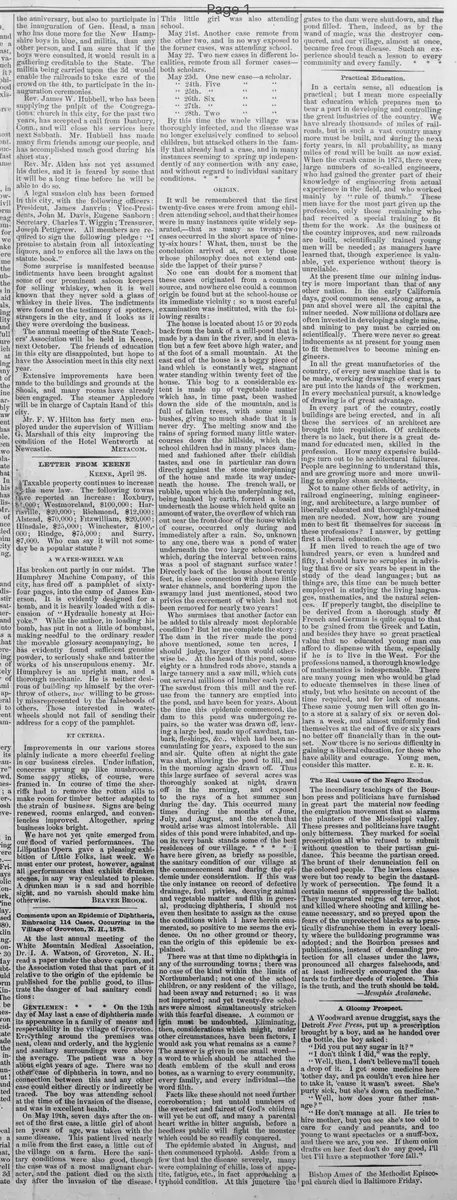
Comments upon an Epidemic of Diphtheria,
Embracing 114 Cases, Occurring in the
Village of Groveton, N. H., 1878.
At the last annual meeting of the
White Mountain Medical Association,
Dr. I. A. Watson, of Groveton, N. H.,
read a paper under the above caption, and
the Association voted that that part of it
relative to the origin of the epidemic be
published for the public good, to illus-
trate the danger of bad sanitary condi-
tions:
GENTLEMEN:
On the 12th
day of May last a case of diphtheria made
its appearance in a family of means and
respectability in the village of Groveton.
Everything around the premises was
neat, clean and orderly, and the hygienic
and sanitary surroundings were above
the average. The patient was a boy
about eight years of age. There was no
other case of diphtheria in town, and no
connection between this and any other
case could either directly or indirectly be
traced. The boy was attending school
at the time of the invasion of the disease,
and was in excellent health.
On May 19th, seven days after the on-
set of the first case, a little girl of about
ten years of age, was taken with the
same disease. This patient lived nearly
a mile from the first case, a little out of
the village on a farm. Here the sani-
tary conditions were also good, though
the case was of a most malignant char-
acter, and the patient died on the sixth
day after the invasion of the disease.
This little girl was also attending
school.
May 21st. Another case remote from
the other two, and in no way exposed to
the former cases, was attending school.
May 22. Two new cases in different lo-
calities, remote from all former cases-
both scholars
May 23d. One new case-a scholar.
24th. Five
to
May
25th.
6
May
26th. Six
May
May
27th.
4
28th. Two
May
By this time the whole village was
thoroughly infected, and the disease was
no longer exclusively confined to school
children, but attacked others in the fam-
ily that already had a case, and in many
instances seeming to spring up indepen-
dently of any connection with any case,
and without regard to individual sanitary
conditions.
ORIGIN.
It will be remembered that the first
twenty-five cases were from among chil-
dren attending school, and that their homes
were in many instances quite widely sep-
separated,-that as many as twenty-two
cases occurred in the short space of nine-
ty-six hours! What, then, must be the
conclusion arrived at, even by those
whose philosophy does not extend out-
side the lappet of their purse?
No one can doubt for a moment that
these cases originated from a common
source, and nowhere else could a common
origin be found but at the school-house or
its immediate vicinity; so a most careful
examination was instituted, with the fol-
lowing results:
The house is located about 15 or 20 rods
back from the bank of a mill-pond that is
made by a dam in the river, and in eleva-
tion but a few feet above high water, and
at the foot of a small mountain. At the
east end of the house is a boggy piece of
land which is constantly wet, stagnant
water standing within twenty feet of the
house. This bog to a considerable ex-
tent is made up of vegetable matter
which has, in time past, been washed
down the side of the mountain, and is
full of fallen trees, with some small
bushes, giving so much shade that it is
never dry. The melting snow and the
rains of spring formed many little water-
courses down the hillside, which the
school children had in many places dam-
med and fashioned after their childish
tastes, and one in particular ran down
directly against the stone underpinning
of the house and made its way under-
neath the house. The trench wall, or
rubble, upon which the underpinning set,
being banked by earth, formed a basin
underneath the house which held quite an
amount of water, the overflow of which ran
out near the front door of the house which
of course, occurred only during and
immediately after a rain. So, unknown
to any one, there was a pond of water
underneath the two large school-rooms.
which, during the interval between rains
was a pool of stagnant surface water!
Directly back of the house about twenty
feet, in close connection with these little
water channels, and bordering upon the
swampy land just mentioned, stood two
privies the excrement of which had not
been removed for nearly two years!
Who surmises that another factor can
be added to this already most deplorable
condition? But let me complete the story:
The dam in the river made the pond
above mentioned, some ten acres, I
should judge, larger than would other-
wise be. At the head of this pond, some
eighty or a hundred rods above, stands a
large tannery and a saw mill, which cuts
out several millions of lumber each year.
The sawdust from this mill and the ref-
use from the tannery are emptied into
the pond, and have been for years. About
the time this epidemic commenced, the
dam to this pond was undergoing re-
paire, so the water was drawn off, leav-
ing a large bed, made up of sawdust, tan-
bark, fleshings, &c., which had been ac-
cumulating for years, exposed to the sun
and air. Quite often at night the gate
was shut, allowing the pond to fill, and
in the morning again drawn off. Thus
this large surface of several acres was
thoroughly soaked at night, drawn
off in the morning, and exposed
to the rays of a hot summer sun
during the day. This occurred many
times during the months of June,
July, and August, and the stench that
would arise was almost intolerable. All
sides of this pond were inhabited, and up-
upon its very bank stands some of the best
residences of our village. * * * * I
have here given, as briefly as possible,
the sanitary condition of our village at
the commencement and during the epi-
demic under consideration. If this was
the only instance on record of defective
drainage, foul privies, decaying animal
and vegetable matter and filth in gener-
al, producing diphtheria, I should not
even then hesitate to assign as the cause
the conditions which I have herein enu-
merated, so positive to me seems the evi-
dence. On no other ground or theory,
can the origin of this epidemic be ex-
plained.
There was at that time no diphtheria in
any of the surrounding towns; there was
no case of the kind within the limits of
Northumberland; not one of the school
children, or any resident of the village,
had been away and returned; so it was
not imported: and yet twenty-five schol-
ars were almost simultaneously stricken
with this fearful disease. A common or-
ign must be undoubted. Eliminating
then, considerations which might, under
other circumstances, have been factors, I
would ask you what remains as a cause?
The answer is given in one small word-
a word to which should be attached the
death emblem of the skull and cross
bones, as a warning to every community,
every family, and every individual-the
word filth.
Facts like these should not need further
corroboration: but untold numbers of
the sweetest and fairest of God's children
will yet be cut off, and many a parental
heart writhe in bitter anguish, before a
heedless public will fight the monster
which could be so readily conquered.
The epidemic abated in August, and
then commenced typhoid. Aside from a
few that had the disease severely, many
were complaining of chills, loss of appe-
tite, fatigue, etc., in fact approaching a
typhoid condition. At this juncture the
gates to the dam were shut down, and the
pond filled. Then, indeed, as by the
wand of magic, was the destroyer con-
quered, and our village, almost at once,
became free from disease. Such an ex-
perience should teach a lesson to every
community and every family.
Embracing 114 Cases, Occurring in the
Village of Groveton, N. H., 1878.
At the last annual meeting of the
White Mountain Medical Association,
Dr. I. A. Watson, of Groveton, N. H.,
read a paper under the above caption, and
the Association voted that that part of it
relative to the origin of the epidemic be
published for the public good, to illus-
trate the danger of bad sanitary condi-
tions:
GENTLEMEN:
On the 12th
day of May last a case of diphtheria made
its appearance in a family of means and
respectability in the village of Groveton.
Everything around the premises was
neat, clean and orderly, and the hygienic
and sanitary surroundings were above
the average. The patient was a boy
about eight years of age. There was no
other case of diphtheria in town, and no
connection between this and any other
case could either directly or indirectly be
traced. The boy was attending school
at the time of the invasion of the disease,
and was in excellent health.
On May 19th, seven days after the on-
set of the first case, a little girl of about
ten years of age, was taken with the
same disease. This patient lived nearly
a mile from the first case, a little out of
the village on a farm. Here the sani-
tary conditions were also good, though
the case was of a most malignant char-
acter, and the patient died on the sixth
day after the invasion of the disease.
This little girl was also attending
school.
May 21st. Another case remote from
the other two, and in no way exposed to
the former cases, was attending school.
May 22. Two new cases in different lo-
calities, remote from all former cases-
both scholars
May 23d. One new case-a scholar.
24th. Five
to
May
25th.
6
May
26th. Six
May
May
27th.
4
28th. Two
May
By this time the whole village was
thoroughly infected, and the disease was
no longer exclusively confined to school
children, but attacked others in the fam-
ily that already had a case, and in many
instances seeming to spring up indepen-
dently of any connection with any case,
and without regard to individual sanitary
conditions.
ORIGIN.
It will be remembered that the first
twenty-five cases were from among chil-
dren attending school, and that their homes
were in many instances quite widely sep-
separated,-that as many as twenty-two
cases occurred in the short space of nine-
ty-six hours! What, then, must be the
conclusion arrived at, even by those
whose philosophy does not extend out-
side the lappet of their purse?
No one can doubt for a moment that
these cases originated from a common
source, and nowhere else could a common
origin be found but at the school-house or
its immediate vicinity; so a most careful
examination was instituted, with the fol-
lowing results:
The house is located about 15 or 20 rods
back from the bank of a mill-pond that is
made by a dam in the river, and in eleva-
tion but a few feet above high water, and
at the foot of a small mountain. At the
east end of the house is a boggy piece of
land which is constantly wet, stagnant
water standing within twenty feet of the
house. This bog to a considerable ex-
tent is made up of vegetable matter
which has, in time past, been washed
down the side of the mountain, and is
full of fallen trees, with some small
bushes, giving so much shade that it is
never dry. The melting snow and the
rains of spring formed many little water-
courses down the hillside, which the
school children had in many places dam-
med and fashioned after their childish
tastes, and one in particular ran down
directly against the stone underpinning
of the house and made its way under-
neath the house. The trench wall, or
rubble, upon which the underpinning set,
being banked by earth, formed a basin
underneath the house which held quite an
amount of water, the overflow of which ran
out near the front door of the house which
of course, occurred only during and
immediately after a rain. So, unknown
to any one, there was a pond of water
underneath the two large school-rooms.
which, during the interval between rains
was a pool of stagnant surface water!
Directly back of the house about twenty
feet, in close connection with these little
water channels, and bordering upon the
swampy land just mentioned, stood two
privies the excrement of which had not
been removed for nearly two years!
Who surmises that another factor can
be added to this already most deplorable
condition? But let me complete the story:
The dam in the river made the pond
above mentioned, some ten acres, I
should judge, larger than would other-
wise be. At the head of this pond, some
eighty or a hundred rods above, stands a
large tannery and a saw mill, which cuts
out several millions of lumber each year.
The sawdust from this mill and the ref-
use from the tannery are emptied into
the pond, and have been for years. About
the time this epidemic commenced, the
dam to this pond was undergoing re-
paire, so the water was drawn off, leav-
ing a large bed, made up of sawdust, tan-
bark, fleshings, &c., which had been ac-
cumulating for years, exposed to the sun
and air. Quite often at night the gate
was shut, allowing the pond to fill, and
in the morning again drawn off. Thus
this large surface of several acres was
thoroughly soaked at night, drawn
off in the morning, and exposed
to the rays of a hot summer sun
during the day. This occurred many
times during the months of June,
July, and August, and the stench that
would arise was almost intolerable. All
sides of this pond were inhabited, and up-
upon its very bank stands some of the best
residences of our village. * * * * I
have here given, as briefly as possible,
the sanitary condition of our village at
the commencement and during the epi-
demic under consideration. If this was
the only instance on record of defective
drainage, foul privies, decaying animal
and vegetable matter and filth in gener-
al, producing diphtheria, I should not
even then hesitate to assign as the cause
the conditions which I have herein enu-
merated, so positive to me seems the evi-
dence. On no other ground or theory,
can the origin of this epidemic be ex-
plained.
There was at that time no diphtheria in
any of the surrounding towns; there was
no case of the kind within the limits of
Northumberland; not one of the school
children, or any resident of the village,
had been away and returned; so it was
not imported: and yet twenty-five schol-
ars were almost simultaneously stricken
with this fearful disease. A common or-
ign must be undoubted. Eliminating
then, considerations which might, under
other circumstances, have been factors, I
would ask you what remains as a cause?
The answer is given in one small word-
a word to which should be attached the
death emblem of the skull and cross
bones, as a warning to every community,
every family, and every individual-the
word filth.
Facts like these should not need further
corroboration: but untold numbers of
the sweetest and fairest of God's children
will yet be cut off, and many a parental
heart writhe in bitter anguish, before a
heedless public will fight the monster
which could be so readily conquered.
The epidemic abated in August, and
then commenced typhoid. Aside from a
few that had the disease severely, many
were complaining of chills, loss of appe-
tite, fatigue, etc., in fact approaching a
typhoid condition. At this juncture the
gates to the dam were shut down, and the
pond filled. Then, indeed, as by the
wand of magic, was the destroyer con-
quered, and our village, almost at once,
became free from disease. Such an ex-
perience should teach a lesson to every
community and every family.
What sub-type of article is it?
Medical Curiosity
Historical Event
Disaster
What themes does it cover?
Catastrophe
Misfortune
Moral Virtue
What keywords are associated?
Diphtheria Epidemic
Groveton Nh
Sanitary Conditions
School Children
Filth Cause
Mill Pond Pollution
What entities or persons were involved?
Dr. I. A. Watson
Where did it happen?
Groveton, N. H.
Story Details
Key Persons
Dr. I. A. Watson
Location
Groveton, N. H.
Event Date
1878
Story Details
Diphtheria epidemic begins in May 1878 with schoolchildren in Groveton, traced to poor sanitary conditions at schoolhouse including stagnant water, unclean privies, and polluted mill pond; 114 cases total, abates when pond refilled.