Thank you for visiting SNEWPapers!
Sign up free
The National Intelligencer And Washington Advertiser
Washington, District Of Columbia
What is this article about?
In the U.S. House of Representatives on March 13, debate continued on Mr. Gregg's resolution proposing trade restrictions against Britain, seen by some as pacific and others as warlike. Arguments focused on national honor, economic impact, and pending negotiations. Motions to discharge the committee failed (24-101 for Gregg's, 26-98 for Ean's), and the resolution was not considered in committee (47-70). Further debate ensued, including a lengthy speech by Mr. J. Randolph advocating negotiation over action.
Merged-components note: These components form a continuous congressional debate report spanning page 1 and page 2. The page 2 component was labeled 'story' but fits better as 'domestic_news' like the others.
Clippings
1 of 2
OCR Quality
Full Text
HOUSE
OF REPRESENTATIVES.
THURSDAY, MARCH 13.
DEBATE
On Mr. Gregg's Resolution.
(CONTINUED.)
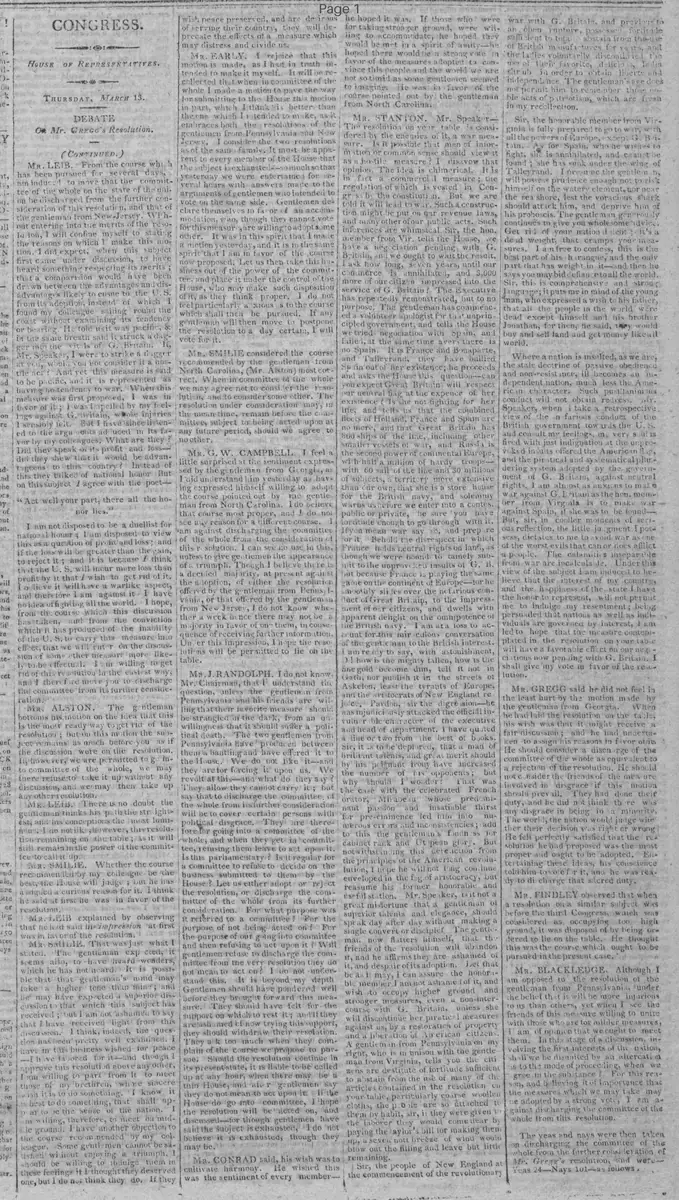
Mr. LEIB. From the course which has been pursued for several days, I am induced to move that the committee of the whole on the state of the union be discharged from the further consideration of this resolution, and that of the gentleman from New-Jersey. Without entering into the merits of the resolution, I will confine myself to stating the reasons on which I make this motion. I did expect, when this subject first came under discussion, to have heard something respecting its merits; that a comparison would have been drawn between the advantages and disadvantages likely to ensue to the U. S. from its adoption, instead of which I found my colleague sailing round the coast without examining its tendency or bearing. He told us it was pacific, & in the same breath said it struck a dagger into the vitals of G. Britain. It, Mr. Speaker, I were to strike a dagger at you, would you not consider it a hostile act? And yet this measure is said to be pacific, and it is represented as having no tendency to war. When this measure was first proposed, I was in favor of it; I was impelled by my feelings against G.Britain, whose injuries I sensibly felt. But I have since listened to the arguments adduced in its favor by my colleagues, What are they? Did they speak of its profit and loss—did they shew that it would be advantageous to this country? Instead of this they talked of national honor But on this subject I agree with the poet
"Act well your part, there all the honor lies."
I am not disposed to be a duellist for national honor; I am disposed to view this as a question of profit and loss; and if the loss will be greater than the gain, to reject it; and it is because I think that the U. S. will incur more loss than profit by it that I wish to get rid of it. I believe it will have a warlike aspect, and therefore I am against it. I have no idea of fighting all the world. I hope, from the course which this discussion has taken, and from the conviction which it has produced of the inability of the U. S. to carry this measure into effect, that we will enter on the discussion of some other measure more likely to be effectual. I am willing to get rid of this resolution in the easiest way, and I therefore move you to discharge the committee from its further consideration.
Mr. ALSTON. The gentleman bottoms his motion on the idea that this is the most ready way to get rid of the resolution; but on this motion the subject remains as much before you as if the discussion were on the resolution. If, however, we are permitted to go into committee of the whole, we may there refuse to take it up without any discussion, and we may then take up any other resolution.
Mr. LEIB. There is no doubt the gentleman thinks his path the straightest, and his conceptions the most luminous. I do not like, however, the resolution remaining on the table; as it will still remain in the power of the committee to call it up.
MR. SMILIE. Whether the course recommended by my colleague be the best, the House will judge; but he has assigned a curious reason for it. I think he said at first he was in favor of the resolution.
MR. LEIB explained by observing that he had said his impression at first was in favor of the resolution.
Mr. SMILIE. That was just what I stated. The gentleman expected, it seems also, to have heard wonders, which he has not heard. It is possible that that gentleman's mind may take a higher tone than mine; and he may have expected a superior discussion to that which this subject has received; but I am not ashamed to say that I have received light from this discussion. I think, indeed, the question has been pretty well examined. I have in this business wished for peace—I have labored for it—and though I approve this resolution above any other, I am willing to part from it to meet those of my brethren, whose wish it is to do something. I know it is best to do something, that shall appear to be the sense of the nation. I am willing, therefore, to meet on middle ground. I have another objection to the course recommended by my colleague, Some gentlemen cannot be satisfied without enjoying a triumph. I should be willing to indulge them in these feelings if I thought they deserved one, but I do not think they do. If they wish peace preserved, and are desirous of serving their country, they will deprecate the effects of a measure which may distress and divide us.
MR. EARLY: I rejoice that this motion is made, as I had in truth intended to make it myself. It will be recollected that when in committee of the whole I made a motion to pave the way for submitting to the House this motion in part, which I think is better than the one which I intended to make, as it embraces both the resolutions of the gentlemen from Pennsylvania and New Jersey. I consider the two resolutions as of the same family. It must be apparent to every member of the House that the subject is exhausted—so much so that yesterday we were entertained for several hours with answers made to the arguments of gentlemen who intended to vote on the same side. Gentlemen declare themselves in favor of an accommodation, who, though they cannot vote for this measure are willing to adopt some other. It was in this spirit that I made a motion yesterday, and it is in the same spirit that I am in favor of the course now proposed: Let us then take this business out of the power of the committee, and place it under the control of the House, who may make such disposition of it, as they think proper. I do not feel particularly anxious as to the course which shall then be pursued. If any gentleman will then move to postpone the resolution to a day certain, I will vote for it.
Mr. SMILIE considered the course recommended by the gentleman from North Carolina, (Mr Alston) most correct. When in committee of the whole we may agree not to consider the resolution, and to consider some other. The resolution under consideration may, in the mean time, remain before the Committee, subject to being acted upon at any future period, should we agree to no other.
MR.G. W. CAMPBELL. I feel a little surprised at the sentiment expressed by the gentleman from Georgia, as I did understand him yesterday as having expressed himself willing to adopt the course pointed out by the gentleman from North Carolina. I do believe that course most proper, and I do not see any reason for a different course. I am against discharging the committee of the whole from the consideration of this resolution. I can see no just in this, unless to give gentlemen the appearance of a triumph. Though I believe there is a decided majority, at present against the adoption, of either the resolution offered by the gentleman from Pennsylvania, or that offered by the gentleman from New Jersey, I do not know whether a week hence there may not be a majority in favor of one them, in consequence of receiving further information. Under this impression, I hope the resolutions will be permitted to lie on the table.
Mr. J. RANDOLPH. I do not know, Mr. Chairman, that I understand the question, unless the gentleman from Pennsylvania and his friends are willing that their favorite measure should be strangled in the dark, from an unwillingness that it should suffer a political death. The two gentlemen from Pennsylvania have produced between them a bantling and have offered it to the House. We do not like it—and they are for forcing it upon us. We revolt at this and what do they say? They allow they cannot carry it; but say that to discharge the committee of the whole from its further consideration will be to cover certain persons with political disgrace. They are therefore for going into a committee of the whole, and when they get in committee, refusing them leave to act upon it. Is this parliamentary? Is it regular for a committee to refuse to decide on the business submitted to them by the House? Let us either adopt or reject the resolution, or discharge the committee of the whole from its further consideration. For what purpose was it referred to a committee? For the purpose of not being acted on? For the purpose of our going into committee and then refusing to act upon it? Will gentlemen refuse to discharge the committee from the very resolution they do not mean to act on? I do not understand this. It is beyond my depth Gentlemen should have pondered well before they brought forward this measure. They should have felt for the support on which to rest it; and if they are ashamed of now trying this support, they should withdraw their resolution. They ask too much when they complain of the Course we propose to pursue. Should the resolution continue in its present state. it is liable to be called up at any hour, when there may be a thin House, and after gentlemen say they do not mean to act upon it. If the House do go into committee, I hope the resolution will be acted on, and discussed—for though gentlemen have said the Subject is exhausted, I do not believe it is exhausted, though they may be.
Mr. CONRAD said, his wish was to cultivate harmony. He wished this was the sentiment of every member—he hoped it was. If those who were for taking stronger ground, were willing to accommodate, he hoped they would be met in a spirit of amity—he hoped there would be a strong vote in favor of the measures adopted to convince this people and the world we are not so timid as some gentlemen seemed to imagine. He was in favor of the course pointed out by the gentleman from North Carolina.
MR. STANTON. Mr. Speaker—
The resolution on your table, is considered by the enemies of it, a war measure. Is it possible that men of information or common sense should view it as a hostile measure? I disavow that opinion. The idea is chimerical. It is in fact a commercial measure: the regulation of which is vested in Congress by the constitution. But we are told it will lead to war. Such a construction might be put on our revenue laws, and many other of our public acts. Such inferences are whimsical. Sir, the hon. member from Virginia tells the House, we have a negotiation pending with G. Britain, and we ought to wait the result. I ask how long, seven years, until our commerce is annihilated, and 3,000 more of our citizens impressed into the service of G. Britain? The Executive has repeatedly remonstrated, but to no purpose. The gentleman has commenced a volunteer apologist for that unprincipled government, and tells the House we tried negotiation with Spain, and failed, at the same time avers there is no Spain. "It is France and Bonaparte, and Talleyrand, they have bullied Spain out of her existence; he proceeds and asks the House this question—can you expect Great Britain will respect our neutral flag at the expense of her existence? Is she not fighting for her life, and tells us that the combined fleets of Holland, France and Spain are no more, and that Great Britain has 800 ships of the line, including other smaller vessels of war, and Russia is the second power of continental Europe, with half a million of hardy troops—with 60 sail of the line and 30 millions of subjects, a territory more extensive than our own, that she is a store house for the British navy, and solemnly warns us before we enter into a contest public or private, be sure you have fortitude enough to go through with it. If you mean war say so, and prepare for it. Behold the disrespect in which France holds neutral rights on land, as though we were bound to tamely submit to the unprovoked insults of G. B. but because France is playing the Same game on the continent of Europe—for he smoothly slides over the nefarious conduct of Great Britain, to the impressment of our citizens, and dwells with apparent delight on the omnipotence of the British navy. I am at a loss to account for this miraculous conversion of the gentleman to the British interest. I am ready to say, with astonishment, ) ! how is the mighty fallen, how is the fine gold become dim, tell it not in Gath, nor publish it in the streets of Askelon, least the tyrants of Europe, and the aristocrats of New England rejoice. Pardon, sir the digression—he has injudiciously attacked the official invulnerable character of the executive and head of department. I have quoted a line or two from the best of books. Sir, it is to be deplored, that a man of brilliant talents, and great merit should by his poignant irony have increased the number of his opponents; but why should I wonder? That was the case with the celebrated French orator, Mirabeau whose predominant passion and insatiable thirst for pre-eminence led him into numerous errors and inconsistencies; add to this the gentleman's fondness for cabinet rank and European glory. But notwithstanding this defection from the principles of the American revolution, I hope he will not long continue enveloped in the fog of aristocracy, but resume his former honorable and useful station. Mr. Speaker, Is it not a great misfortune that a gentleman of superior talents and elegance, should speak day after day without making a single convert or disciple The gentleman now flatters himself, that the friends of the resolution will abandon it, and he affirms they are ashamed of it, and despair of its adoption. Let that be as it may, I can assure the honorable member I am not ashamed of it, and wish to occupy higher ground and stronger measures, even a non-intercourse with G. Britain, unless she will discontinue her piratical measures against us, by a restoration of property and a liberation of American citizens. A gentleman from Pennsylvania on my right, who is in unison with the gentleman from Virginia, tells you the citizens are destitute of fortitude sufficient to abstain from the use of many of the articles contained in the resolution on your table, particularly coarse woollen cloths the people are so attached to them by habit, sir, if they were given to the laborer they would come dear by paying the tailor's bill for making them up, a seven knot breeze of wind would blow out the filling and leave but little remaining.
Sir, the people of New England at the commencement of the revolutionary war with G. Britain, and previous to an open rupture, possessed fortitude sufficient to totally abstain from the use of British manufactures for years, and the ladies voluntarily discontinued the use of their favorite, delicious, Indian shrub in order to obtain liberty and independence The gentleman's necrology does not permit him to remember those noble acts of patriotism, which are fresh in my recollection.
Sir. the honorable member from Virginia is fully prepared to go to war, with all the powers of Europe, except: G. Britain. As for Spain, who he wishes to fight. she is annihilated, and cannot be found : she has sunk under the wing of Talleyrand. I presume the gentleman will possess prudence enough not to risk himself on the water element, nor near the sea shore, lest the voracious shark should attack him, and deprive him of his proboscis. The gentleman generously continues to give you wholesome advice: Get rid of your national debt ;-it's a dead weight, that cramps your measures. I am free to confess, this is the best part of his harangue, and the only part that has weight in it—and then he says you may bid defiance to all the world. Sir, this is comprehensive and strong language; it puts me in mind of the young man, who expressed a wish to his father, that all the people in the world were dead except himself and his brother Jonathan, for then, he said, they would buy and sell land and get money like all world.
Where a nation is insulted, as we are, the stale doctrine of passive obedience and non-resistance, ill becomes an independent nation, much less the American character. Such pusillanimous conduct will not obtain redress. Mr. Speaker, when I take a retrospective view of the nefarious conduct of the British government towards the U. S. and consult my feelings, in very soul is fired with just indignation at the unprovoked insults offered the American flag, and the piratical and systematic plundering system adopted by the government of G. Britain, against neutral rights. I am almost as anxious to make war against G. Britain as the hon. member from Virginia is to make war—against Spain, if she was to be found— But, sir, in cooler moments of serious reflection, the little judgment I possess, dictates to me to avoid war as one of the worst evils that can or does afflict a people. The calamities inseparable from war are incalculable, Under this view of the subject I am induced to believe that the interest of my country, and the happiness of the state I have the honor to represent, will not permit me to indulge my resentment; being persuaded that nations as well as individuals are governed by interest, I am led to hope that the measure contemplated in the resolution on your table will have a favorable effect on our negotiations now pending with G. Britain. I shall give my vote in favor of the resolution.
Mr. GREGG said he did not feel in the least hurt by the motion made by the gentleman from Georgia. When he had laid the resolution on the table, his wish was that it might receive a fair discussion; and he had undertaken to assign his reasons in favor of it He should consider a discharge of the committee of the whole as equivalent to a rejection of the resolution, He should not consider the friends of the measure involved in disgrace if this motion should prevail. They had done their duty, and he did not think there was any disgrace in being in a minority, The world, the nation would judge whether their decision was right or wrong He felt perfectly satisfied that the resolution he had proposed was the most proper and ought to be adopted. Entertaining these ideas, his conscience told him to vote for it, and he was ready to discharge that sacred duty.
MR. FINDLEY observed that when a resolution on a similar subject was before the third Congress when was considered as occupying too high ground, it was disposed of by being ordered to lie on the table. He thought this was the course which ought to be pursued in the present case.
MR. BLACKLEDGE. Although I am opposed to the resolution of the gentleman from Pennsylvania, under the belief that it will be more injurious to us than others, yet when I see the friends of this measure willing to unite with those who are for milder measures, I am of opinion that we ought to meet them. In this stage of a discussion, involving the first interests of the nation, shall we be disunited by an altercation as to the mode of proceeding, when we agree in the substance? For this reason, and believing it of importance that the measures which we may take may be adopted by a strong vote, I am against discharging the committee of the whole from this resolution.
The yeas and nays were then taken on discharging the committee of the whole from the further consideration of Mr. Gregg's resolution, and were—
Yeas 24 Nays 101—as follows.
Yeas.--Messrs. Bassett, Jefferson,
Easly, Clark, J. Clay, Earle, Early,
Eppes, Garn, Goldsborough, Good-
wyn, Gray, Holmes, Jones, Leib, Lew-
is, Jr. Masters, Nicholson, J. Randolph,
Sandford, Spalding, P. R. Thompson,
Verplanck, and D. R. Williams.
Nays.--Messrs. Alston, Jr. Ander-
son, Par. Barker, Bedinger, Betton,
Birwell, Bishop, Blackledge, Blake, Jr.
Blount, Broom, Brown, Boyle, G. W.
Campbell, Chandler, Chitenden, Clai-
borne, M. Clay, Clinton, Jr. Conrad,
Cook, Covington, Crowninshield, Cutts,
Dana, Darby, Davenport, Jr. Dawson,
Elliot, Ellis, Elmer, Ely, Findley, Fisk,
Fowler, Gregg, Green, Halsey, Haml-
ton, Hastings, H. Inns, Hough, Jackson,
Kelly, Kenan, Knight, Mac Farland,
Magruder, Marion, M'Creery, N. R.
Moore, T. Moore, J. Morrow, Mosely.
Mumford, J. Nelson, Newton, Jr. Olin,
Pitkin, Jr. Pugh, Quincy, T. M. Ran-
dolph, Rea, of Penn. Rhea, of Tenn.
Richards, Russell, Sailly, Sammons,
Schuneman, Seaver, Sloan, Smilie, J. C.
Smith, J. Smith, S. Smith, Southard,
Stanford, Stanton, Stedman, Sturgus,
Taggart, Tallmadge, Tenney, Thomas,
T. W. Thompson. Tracy, Van Cortlandt,
Van Rensselaer, Varnum, Wadsworth,
Walton, J. Whitehill, R. Whitehill,
Wickes, M. Williams, N. Williams,
Wilson, Winn, Winston and Wynns.
The question was then taken on dis-
charging the committee from Mr.
Ean's resolution, by yeas and nays-
Yeas 26--Nays 98.
The House then resolved itself into a
committee of the whole on the state of
the union.
The Chairman put the question, on
considering Mr. Gregg's resolution, on
which the committee divided--Ayes 47
-Noes 70.
Mr. J. CLAY moved to consider the
resolution offered by himself, and that
of his friend from Maryland (Mr. Ni-
cholsen.)
MR. SMILIE moved to consider the
latter resolution.
MR. J. RANDOLPH said he would
make a superseding motion, which was
that the committee should rise, and he
would assign his reasons for this motion.
I am well aware, said Mr. R. and I
consider it the happiest and fairest fea-
ture of our policy, that in a deliberate
body a majority must govern. This is
a position which has often been enforced
on me, and which I have sometimes
enforced on others. But I hope no ma-
jority will be indisposed to act honest-
ly--though a majority ought to govern,
it should not be on motives of caprice,
freaks, or passion, but wisely; and it
ought not, at this time of day, to feel
power, and forget right. The reason
why I am in favor of the committee rising
is the same which I advanced the other
day against the resolution of the gentle-
man from Pennsylvania--a reason which
it is astonishing, to my mind, does not
operate on every member of the com-
mittee--the state of things here and
abroad. Is there a member prepared
to vote for the resolution of my excellent
friend from Pennsylvania (Mr. J. Clay)
or of my worthy friend from Maryland?
(Mr. Nicholson) I believe not--I for
one am not prepared. The other day,
when I said I was disposed to treat with
Britain for the very reason that I was
indisposed to treat with her in 1793, I
perceived a sneer on the faces of gentle-
men and that they scouted the idea.
But what is the fact? The gentleman
from Massachusetts quoted the message
of the President shewing that this busi-
ness is still res integra. What infor-
mation does the President in that mes-
sage give us? That he had tried nego-
ciation and failed? That, as in another
quarter, our minister had been shoved
neck and shoulders out of the cabinet?
No--that negotiation is still pending
between our minister and the minister
of Britain. Can then gentlemen, while
the business is res infecta, be disposed
to act on either the resolution of the
gentleman from Pennsylvania or that of
the gentleman from Maryland?
Again--Must we not every day ex-
pect information from Europe; and
ought not this information to have an
influence on this assembly, if indeed we
are a deliberative assembly. Surely it
ought. On political empirics who pre-
scribe the same medicine to every dis-
case, this information may have no ef-
fect. But on the minds of sober men, it
ought to have, it must have an effect.
The situation of the powers with whom
we have these momentous discussions
may have been materially changed by
the events of the last ninety days. Will
gentlemen undertake to say that motives
which influenced the mind of a Bern-
storff, ought to have no weight with us?
Will they, under these circumstances,
go into committee to grope in the dark,
to catch at something, on a subject of
which they know little in relation to
events of which they know less? No--
this is not the moment to act. The
committee have declared that that mo-
ment has not arrived. They have, in
their capacity of House, refused to dis-
charge them from the resolution of the
gentleman from Pennsylvania, & have in
the same capacity refused to act upon
it. And what does this prove but that
the moment for action has not come;
unless, indeed, this venerable assembly
will condescend to become the wet
nurse to the bantling of the two gentle-
men from Pennsylvania, who, provided
they can maintain it at a distance, hope
their indiscretion will be overlooked--a
Jaundiced pun, which, if it can be kept in
an obscure farm house, may be smother-
ed over. I, however, am not disposed
to offer it the pap-spoon; still less am
I disposed to be disturbed by its cries,
or those of its brethren.
It must be obvious to you, Mr. Chair-
man, that this is not the fit time to de-
cide on our British relations--that
while there is a pending negotiation
with her such discussion must be pre-
matu re. These resolutions are the pro-
ductions of a political hot-bed--they are
not the growth of a genial sun, but rear-
ed in a forcing house: and I will tell
gentlemen, that politics bear forcing as
little as the physical productions of na-
ture.
A gentleman from Massachusetts,
whom I now see in his place, offered a
few days ago to this committee a string
of observations, which he declared
were not intended either for a resolu-
tion not then before the committee, or
for that offered by the gentleman from
Pennsylvania. Now the committee
having determined not to discuss the
resolution offered by the gentleman from
Pennsylvania, and as those remarks
were not offered on the subject then be-
fore the committee, they may have
been left to guess that they were intend-
ed for the question now under consider-
ati on; and as I believe they were full as
applicable to this as any other question,
I hope to be indulged in making a few
observations relative to them. But at
the same time I disclaim the preface
that gentleman prefixed to his remarks,
viz. that he did not mean to examine
the question before the committee. I
do mean to examine that question, to
shew why this is not the proper time for
acting on this subject:--to shew that
all discussion on it is premature: and
that we ought to abstain from acting up-
upon it until we shall have heard from
the other side of the Atlantic.
As well as I remember, the gentle-
man set out by recalling the attention of
the House to the message of the Presi-
dent of the 17th of January last. Yes
sir, he began in the style of old
times--infandum renovare dolorem--
to call the House back to the message of
the 17th of January. To what part of
it? To that part which is public, or to
that part which is locked up in the es-
crutoire of the clerk, or is in his
breeches pocket, for aught I know--
that part which it is his business to
keep from the eyes of the nation? Now
what is our situation? A brave Sena-
tor, with our doors open, calls the at-
tention of the House to an amphibious
and ambiguous message, part secret and
part public. And is this the situation in
which gentlemen would put us? Are
we thus to be knocked down with the
hammer of Executive infallibility? I
hope not. When that message came,
on the 17th of January, how long had we
been in conclave? I believe a fort-
night. When did the dispatches ar-
rive? I undertake to say, because I
know it, it was prior to the 20th of De-
cember--because I made proper enqui-
ry at the office of the Secretary of State,
where I had myself received dispatch-
es from London. What are the con-
tents of those dispatches? Did they ad-
vocate the course this House has pur-
sued, or a course totally different? And
yet that very message has been quoted
under the idea that no man could say to
the contrary, and that we would sink
beneath the weight of its authority.
Those dispatches came to this country
before the 20th of December. On that
day I returned from Baltimore, and re-
ceiv ed a communication from their au-
thor of a contemporaneous date; I have
called at the office of the Secretary of
State, and was informed by the head of
that department that they had both ar-
rived at the same time. And it was
when I discovered that the head of the
second department under the govern-
nment did not know that they were in
existence, much less that his opinion on
them had not been consulted, that I de-
clared, what I repeat, that there is no
cabinet. You have no cabinet. What!
the head of the treasury department, a
vigorous and commanding statesman,
a practical statesman, the benefit of
whose wisdom and experience the
nation fondly believes is always obtain-
ed before the great measures of the go-
vernment are taken, unacquainted
with, and unconsulted on important
dispatches, and yet talk of a cabinet!
Not merely unconsulted, but ignorant of
the documents. Well the act passed,
and on the 16th of January was sent to
the other House--and on the 17th dis-
patch es come which might have mate-
rially changed the decision of the House;
and am I, feeling this, and knowing the
House had been trifled with, to be de-
nounced for telling you if you had had
the necessary information, your de-
cision would have been different from
what it was? I know this--for many
gentlemen who voted for the measure
adopted, told me their votes would have
been different had they had the neces-
sary information. I say the decision of
the House, if we had known what we
ought to have known, and which had
been received four weeks before, would
have been different; and I have no he-
sitation in saying there is no cabinet,
when I see a man, second to none for
vigorous understanding, and practical
good sense, ousted from it. I say as I
have said before, if the Executive
wants our confidence, let him give us
his. But when we are excluded from
his confidence, let him not demand ours.
I will not give mine on these terms, and
I have no hesitation in saying so. Yes,
sir, I now say with open doors what I
said when your doors were shut, & what I
believe--that it is not for the master
and mate (and I speak it without dis-
paragement to any man) in bad wea-
ther to go below, and leave the manage-
nment of the ship to the cook and cab-
bin boy. The nation expects to know
--they believe they do know, the opi-
nion of the Executive. But do they
know it? Where have they got it?
Does it appear in this string of resolu-
tions? Have we the opinion of the
President? Have we his constitutional
recommendation? No. You have no-
thing--Let the clerk produce the bud-
get! But we shall be told that this
House has a right to give a direction to
the President. This is the last refine-
ment on courtly flattery. Shall the
House act on information neither official
or constitutional, on the sole pretext of
giving the executive a direction, when
they believe they are acting on what
gentlemen get up, and give us reason to
believe are the secret wishes of the
executive. It is out of the question for
any persons who are men of standing
to condescend, under such circumstan-
ces, to do the work of the cabinet or the
water closet. No tools must be found:
and to such tools such work will be, as it
has been uniformly committed, I do
not only say they must be, but that they
have been found. But at the threshold of
every thing I can offer, I am met by these
Nestors of the land, by these old-coach-
men who love the smack of the whip,
who talk of old times, of the stamp act,
of the non-intercourse, and other revo-
lutionary acts--But let me tell gen-
tlemen this is all violence and declama-
tion. You would not suppose that the
maxims of Chesterfield had been studi-
ed by the gentleman from Pennsylvania
--and yet the fact is that manner is
every thing. But I beg you to com-
pa re the matter I have offered with the
mild, meek, and peaceable sentiments
of gentlemen. Because one gentleman
has delivered his sentiments in a voice
that freezes before it reaches this quar-
ter of the House, and another gentle-
man mumbles our confiscate the national debt; does that affect the principle
at issue? And because another man,
with some warmth, recommends a dif-
ferent course, are you therefore to stone
and crucify him?
The gentleman from Massachusetts,
to whom I have alluded, has told us
what the question between this country
and G. Britain is. He says it does not
respect enemy's property, but the colo-
nial trade. He says that the tobacco
and flour, the rice and cotton, trans-
ported by our vessels, come as much
within the question quo ad enemy pro-
perty, as the colonial trade. But is there
any presumptive evidence that the rice,
the cotton, the tobacco, or any other ar-
ticles of American growth that are car-
ried by our vessels, are enemy's proper-
ty? There is none. Now take the
other side of the question--Recollect
that Holland, France and Spain have
not a ship on the ocean; that the coffee,
sugar and cotton of her colonies, which
find their way to Europe, must go there
under the cover of a neutral flag. What
is the presumption? That a large
part of those productions, thus trans-
ported, are relatively to Britain enemy
property. How is a discrimination to
be made between those products which
are, and those which are not the pro-
perty of an enemy? Is it not a fact that
a few disreputable neighbors will bring
a stigma on a whole neighborhood?
Will any man deny the fact? Are the
French and Spanish colonies independent? And what is the fact? That
under the neutral flag the whole of the
immensely valuable productions of those
colonies find a conveyance. What do
we say? That we have a right to car-
ry those productions from the colonies
to the belligerent nations? No--We
say, the bringing them to the U. S. and
paying duties on them, neutralises the
property. But do they? Indisputably
not. The moment you concede the point
that you cannot carry on a direct trade,
it becomes a question no longer of prin-
ciple--but a question on which you must
treat on the ground of expediency. And
you must treat--you will treat--rela-
tive to it. There is one consideration,
which, whether it has or has not engag-
ed the attention of gentlemen, ought not
to be lost sight of--and that is that our
bulky productions can be carried by on-
ly two powers in the world--by our-
selves or G. Britain--No other nation
possesses the tonnage--Go then into
war with G. Britain, and where will
you find the tonnage to carry your pro-
ducts? You cannot find it. But, on the
other hand, the British fabrics may be
brought in Danish bottoms. There will
be neutral tonnage enough to bring to
your doors the productions of Britain.
But where will you find the neutral ton-
nage to carry your produce abroad?
We are told that this is not a war mea-
sure--that Grotius and Puffendorf, and
other distinguished civilians have decid-
ed that it is a pacific measure. But it
unfortunately happens that great states-
men, on the theatre of active life, will not
suffer themselves to be dictated to by
the mumblers of antiquity; and gentle-
men, who will not be governed by cir-
cumstances, who exclaim fiat justitia
ruat coelum, must be content with mak-
ing diagrams in their closets, while these
active statesmen are deciding the desti-
ny of nations. They tell us they have
Grotius & Puffendorf at their backs--
But I would rather have at my back the
pose comitatus of the ten miles square,
weak and inefficient as I know it to be-
Yes, it is too true, the gentlemen will
not listen for a moment to circumstan-
ces. It is in vain that we say G. Britain
is armed, that she has a fleet in the
West Indies--that she has a ship over
every square league in the ocean. They
will not consider the propensity of an
armed nation to strike--They will list-
en only to newspapers, & pamphlets &
circular letters. Putting all these things
out of consideration, they are for play-
ing the part of Bobadil. They will not
reflect that circumstances always go-
vern practical men--they persist in
their abstract theories. These Laputian
and Lilliputian politics won't do. What
are gentlemen about? While they are
disputing whether the egg shall be bro-
ken at the big or little end, and whe-
ther the committee shall be discharged
from the resolution in the House, or the
House shall first go into committee, and
the resolution be there discharged,
they are pursuing measures which will
be felt in Britain, and which will forci-
bly re-act on ourselves. The gentleman
from Massachusetts (Mr. Crownin-
shield) has told us what he would, and
what he would not do, if he were a citi-
zen of the republic of St. Marino. We
would suppose from this declaration
that he was a grand inhabitant of
Utopia, about to carry on war a-
gainst Lilliput. Such a man may be
celebrated as a seaman, and may be
able to make an able First Lord of the
Admiralty over a fleet of privateers;
but as a politician he is a Lilliputian
delegate.
But we are told again, that this is a
peace measure, and that we ourselves
are the belligerent parties, who style it
a war measure. One of the profound-
est statesmen told Joseph the second,
one of your gimcrack men, that if he
should attempt to force the navigation of
the Scheldt, the fort would fire upon
him. What said Joseph? I will not
stoop to time and circumstances--he
talked of natural rights, and go he
would--The Dutch would never dare
to fire. Compare the relative situation
of the little republic of Holland, when
her days of glory have passed away,
when she has fallen into the hands of a
conqueror--compare her present situ-
ati on with that she enjoyed before the
wings of her power were clipped by
France. The emperor Joseph sent out
his fleets, and the only intelligence he
received of their fate, was that fire
Dutch had fired. He deemed it impos-
sible--he could not believe that the
little republic of Holland should fire on
the Austrian Eagle. He thought as
gentlemen think, and he was deceived;
and you will be deceived too. For this
commercial principle is not a principle
of peace, but of war. Gentlemen may
go to Carthage, if they please, stop at
Genoa, and pass on to London, and
they will invariably find it so; and
they will find each of those nations com-
mercial in proportion as they were war-
like, and warlike in proportion as they
were commercial. And why do com-
merce and war go thus hand in hand,
but because commerce always disposes
the nation to go to war, which is not dis-
posed to give up a lucrative trade. The
idea of the pacific tendency of com-
merce is a mere ignis fatuus. We find
Holland ceased to be a great commer-
cial power, when she ceased to be able
to fight the combined fleets of France
and England.
But I shall be told that whithersoever
it may lead us, this spirit of commercial
monopoly ought never to be extinguish-
ed--I shall be told it is a base principle
to crouch even to necessity; that we
ought to set not only reason and common
sense at defiance, but likewise necessi-
ty, which knows no law, but prescribes
law to all. Well, I am free to confess,
if this assertion is not beyond my com-
prehension, I have for the first time in
my life found the reason of the planter's
servant, who, on being asked what was
the matter with his horse, said he was
ashamed because he was dead--The
poor animal had ingloriously crouched
to the base principle of necessity, and
had given up the ghost, when he ought
to have kept the field. And this is
what we are called upon to do by gen-
tlemen who will not acknowledge the law
of necessity, and who scout it as a prin-
ciple which it does not become us to act
upon. If these notions are to prevail,
let us take Don Quixotte as our first
minister of state and Sancho Panza as
the second in command. These are the
natural hands to hold the reins of go-
vernment, in case all regard to the
principle of necessity is disclaimed. I
hope gentlemen, who hold this doctrine,
never mean to die, to sleep, or to weep
at the distresses of their fellow men, or
in any other respect acknowledge the
base principle of necessity. But I, who
profess to yield a compliance not only to
the laws of necessity, but of probabilities,
and who consider politics as only a sci-
ence of probabilities, can no longer find
a medium between myself and those,
who disclaim all regard to the laws
of necessity, and am obliged to con-
fess that I am among the number of
those who would negotiate with Great
Britain.
I am perfectly aware of the tedious
time the Committee must have had in
listening to my remarks--not more so,
I assure you to them than to myself. I
am aware of the arguments offered di-
rectly out of doors, and indirectly in
this House, against the course which I
believe it is for the interest of this na-
tion to pursue. One of the first causes
of surprise which presented itself to me
on coming to the seat of government
was that, while the people of the U. S.
thought all eyes were fixed on the shores
of the Atlantic, all eyes were in fact fixed
on the half way house between this and
George Town--that the question was
not what we should do with France, or
Spain, or England; but who should be
the next President: And at this mo-
ment, every motion that is made--I do
not mean, in the parliamentary sense of
the word, at this place--is made with a
view to the occupation of that House.
And it is for this reason that cer-
tain men are to be put down, and cer-
tain men are to be put up--As I have
said before, I have conceived it the
greatest happiness attendant on the go-
vernment of this people, that all their
political relations, the different parties
and their connections and bearings and
effects, could be debated in the face of
the nation. Now, we are told from
good authority, that there is a certain
party called the federal party, and that
there are other parties in the United
States, called republican parties. Well,
sir. Certain gentlemen have been held
up as willing to court the attention and
support of the federal party--men by
whom no villain has been spared, let
him belong to what party he may--men
by whom no villainy has been spared,
to whatever party it may have attach-
ed. So much for federalism--There
is another question relative to what is
generally called Burrism. I am wi-
ling to meet gentlemen on that ground.
If we belong to the third party, be it
so. I am willing to meet them on other
ground.
[There was here a loud call to order
in which Mr. Thomas joined. The
Speaker decided that Mr. Randolph
was in order. An appeal was taken to
the House, who confirmed his decision.]
Mr. Randolph proceeded. I am o-
bliged to the gentleman for the respite
he has given me, as I really felt much
exhausted. I knew where the shoe
pinched. I will take gentlemen on ano-
ther principle--on the principle of
Burrism, as it is called. Will gentle-
men attack us on that ground? Will
they say we are the rotten part of the
republican party--the go-betweens of
any sects--the solicitors of any office--
the tools of any faction? Now, sir,
on the subject of federalism--I mean no
imputation to any man or party of men
--are we the advocates of federalism?
Does the Administration, and especially
the department of the navy, or does it
not administer the government on the
principles of federalism? Has that de-
partment ever been administered, or
can it ever be administered on princi-
ples more federal? There is another
department--the post office depart-
ment--the sweetest engine ever put
into the hands of an unprincipled man.
Are we for administering the govern-
ment on principles of Burrism? This is
a delicate subject--I speak with a full
consciousness that it is. Now for the
last ism--Yazooism.--Are we Yazoo
men? Have our enemies ever charged
us with this?
Mr. Randolph here made an alla-
sion, which from noise in the House we
did not hear, to a misconception by
Messrs. Sumter and Marion of a pre-
vious remark made by him relative to
militia generals:--and then asked; Is
there a man that would disdain to sit
aside of such men? The allusion I made
was fully understood; but those, whom
it hit, were willing to shift it from
their own shoulders on those whom it
did not fit.
I am really sorry, Mr. Speaker, for
the time I have occupied. When I
came into the House yesterday, it ap-
peared to me as if the proposition before
us was to appoint a board of commis-
sioners to settle the account current
every member with the House. We
heard a great deal of palaver and blar-
ney; but of that description which can
never take me in. I abjure it. I raise
my hand against it. I will never be-
come its dupe. I am willing to allow
that in the heat of debate, expression
improper for me to use, but not impro-
per in their application to those to whom
they referred, may have escaped me--
the verba ardentia of an honest mind. I
scorn to retract them. They were made
in the presence of the nation, and in
their presence I will defend them. I
will never snivel, whatever may be the
result. I have moved that the com-
mittee should rise with a perfect know-
ledge of the existing circumstances. I
knew the moment we adjourned over on
Saturday, that the old story would be
repeated, that gentlemen would seek the
Lord, agree upon some given princi-
ple, that all might go together. And I
have not been disappointed. But it is
for you to say, whether at this moment,
when you are watching your daily and
nightly mails for news from Europe--
when you are oscillating between Bona-
parte and the coalition--you are pre-
pa red to decide ultimately on this sub-
ject. I feel for one that I am not. As
to the accusation of being the apologist
of Britain, it is idlest charge that ever
was made. When I first took a seat in
this House I was denounced with being
a French partisan, because I opposed
those men who then held the reins of
government in their hands in their
measures for carrying us into war with
that nation; and now that I am for
pursuing the same course towards G.
Britain, which I was then in favor of
pursuing towards France, I am charged
with being the apologist of Britain. To
this denunciation I am willing to submi t,
which all men must submit to who are
not willing to risk the peace of their
country
(Debate to be continued.)
What sub-type of article is it?
What keywords are associated?
What entities or persons were involved?
Where did it happen?
Domestic News Details
Primary Location
Washington
Event Date
Thursday, March 13.
Key Persons
Outcome
motion to discharge committee from mr. gregg's resolution: yeas 24, nays 101. motion for mr. ean's resolution: yeas 26, nays 98. in committee, consideration of mr. gregg's resolution: ayes 47, noes 70. debate continued without resolution adopted.
Event Details
Members of the House debated Mr. Gregg's resolution proposing commercial restrictions on British goods, arguing its pacific versus warlike nature, economic profit and loss, national honor, and impact on pending negotiations with Britain. Mr. Leib moved to discharge the committee; others discussed procedural alternatives. Votes rejected discharging the committee. In committee, the resolution was not taken up. Mr. J. Randolph spoke at length against premature action, advocating negotiation and criticizing executive handling.