Thank you for visiting SNEWPapers!
Sign up free
The Cook County Herald
Grand Marais, Cook County, Minnesota
What is this article about?
Hungarian peasants on the Alfoeld plain organize popular 'dances of the starving' as a stratagem to protest a new reichstag bill hostile to laborers, amid last summer's strike and bad harvest. The bill empowers employers to withhold wages from suspected socialist agitators and forces labor compliance, sparking pillage, tax strikes, and military intervention.
Clipping
OCR Quality
Full Text
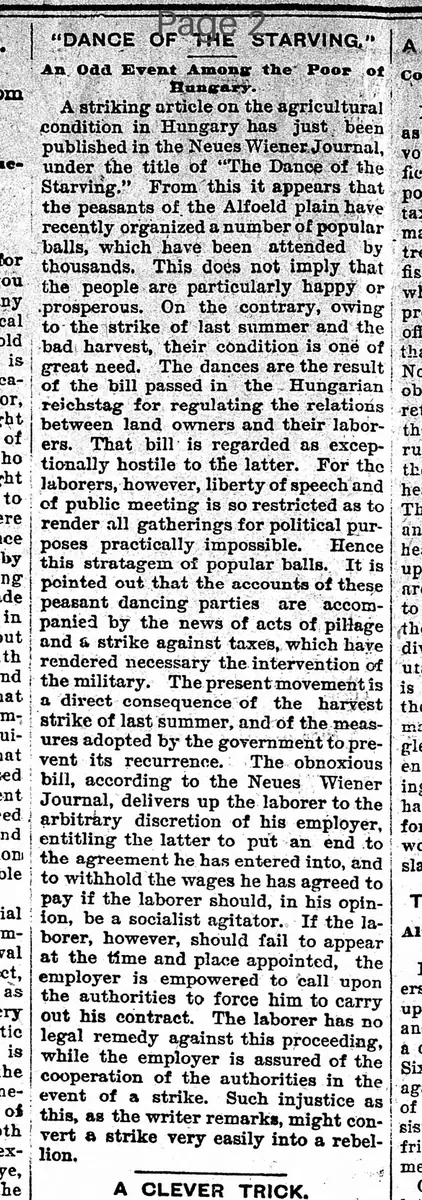
An Odd Event Among the Poor of Hungary.
A striking article on the agricultural condition in Hungary has just been published in the Neues Wiener Journal, under the title of "The Dance of the Starving." From this it appears that the peasants of the Alfoeld plain have recently organized a number of popular balls, which have been attended by thousands. This does not imply that the people are particularly happy or prosperous. On the contrary, owing to the strike of last summer and the bad harvest, their condition is one of great need. The dances are the result of the bill passed in the Hungarian reichstag for regulating the relations between land owners and their laborers. That bill is regarded as exceptionally hostile to the latter. For the laborers, however, liberty of speech and of public meeting is so restricted as to render all gatherings for political purposes practically impossible. Hence this stratagem of popular balls. It is pointed out that the accounts of these peasant dancing parties are accompanied by the news of acts of pillage and a strike against taxes, which have rendered necessary the intervention of the military. The present movement is a direct consequence of the harvest strike of last summer, and of the measures adopted by the government to prevent its recurrence. The obnoxious bill, according to the Neues Wiener Journal, delivers up the laborer to the arbitrary discretion of his employer, entitling the latter to put an end to the agreement he has entered into, and to withhold the wages he has agreed to pay if the laborer should, in his opinion, be a socialist agitator. If the laborer, however, should fail to appear at the time and place appointed, the employer is empowered to call upon the authorities to force him to carry out his contract. The laborer has no legal remedy against this proceeding, while the employer is assured of the cooperation of the authorities in the event of a strike. Such injustice as this, as the writer remarks, might convert a strike very easily into a rebellion.
What sub-type of article is it?
What keywords are associated?
Where did it happen?
Foreign News Details
Primary Location
Hungary
Event Date
Recently; Last Summer
Outcome
military intervention due to acts of pillage and tax strikes; bill enables employers to withhold wages from suspected socialist agitators and forces labor compliance with authority support, potentially converting strikes into rebellion.
Event Details
Peasants of the Alfoeld plain organize popular balls attended by thousands as a stratagem to protest due to restricted political gatherings. This follows last summer's strike and bad harvest, leading to great need. The Hungarian reichstag bill regulates land owners and laborers relations, seen as hostile to the latter, delivering laborers to employers' discretion. Accounts of dances accompany news of pillage and tax strikes requiring military intervention. The movement stems from government measures to prevent recurrence of the harvest strike.