Thank you for visiting SNEWPapers!
Sign up free
Constitutional Whig
Richmond, Virginia
What is this article about?
WM. F. Gordon responds to Fluvanna freeholders' request via the Enquirer, advocating for extending suffrage to qualified non-freeholders, reducing House of Delegates for efficiency, equal representation by white population, reorganizing the executive by diminishing or abolishing the Council, and reforming judiciary tenure for greater accountability.
Clipping
OCR Quality
Full Text
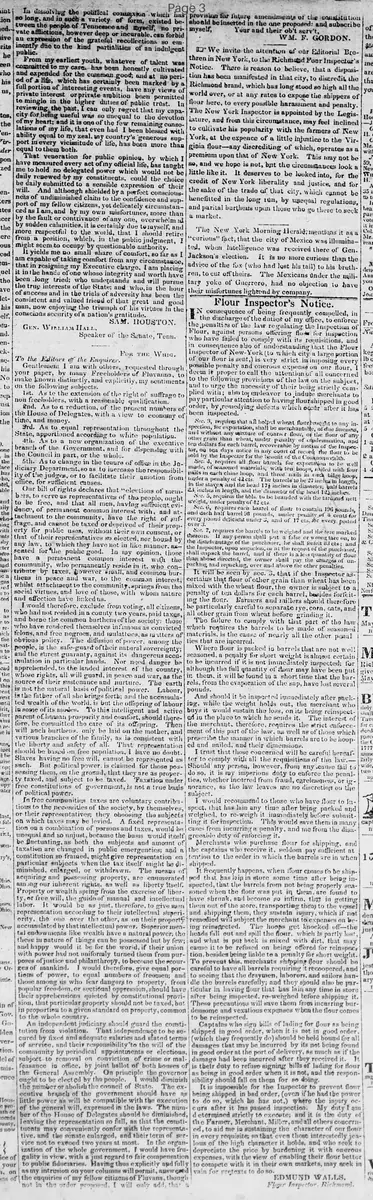
To the Editors of the Enquirer.
Gentlemen: I am with others, requested through your paper, by many Freeholders of Fluvanna, to make known distinctly, and explicitly, my sentiments on the following subjects.
1st. As to the extension of the right of suffrage to non freeholders, with a reasonable qualification.
2nd. As to a reduction, of the present numbers of the House of Delegates, with a view to economy of time, and money.
3rd. As to equal representation throughout the State, apportioned according to white population.
4th. As to a new organization of the executive branch of the Government, and for dispensing with the Council in part, or the whole.
5th. As to change in the tenure of office in the Judiciary Department, so as to increase the responsibility of the judges, or to facilitate their amotion from office, for sufficient causes.
Our bill of rights declares that "elections of members, to serve as representatives of the people, ought to be free, and that all men, having sufficient evidence, of permanent common interest with, and attachment to the community, have the right of suffrage, and cannot be taxed or deprived of their property for public uses, without their own consent, or that of their representatives so elected, nor bound by any law, to which they have not in like manner, assented for the public good." In my opinion, those have a permanent common interest with the community, who permanently reside in it, who contribute by taxes, however small, and common burthens in peace and war, to the common interest, whilst attachment to the community, springs from the social virtues, and love of those, with whom nature and affection have linked us.
I would therefore, exclude from voting, all citizens, who had not resided in a county two years, paid taxes, and borne the common burthens of the society: those who have rendered themselves infamous as convicted felons, and free negroes, and mulattoes, as matters of obvious policy. The diffusion of power, among the people, is the safe-guard of their natural sovereignty; and the surest guaranty, against its dangerous accumulation in particular hands. Nor need danger be apprehended, to the landed interest of the country, whose rights, all will guard, in peace and war, as the source of their sustenance and nurture. The earth is not the natural basis of political power. Labour, is the father of all she brings forth; and the accumulated wealth of the world, is but the offspring of labour in some of its varieties. To this intelligent and active parent of human prosperity and comfort, should therefore, be committed the care of its offspring. Then will such burthens, only be laid on the mother, and various branches of the family, as is consistent with the liberty and safety of all. That representation should be based on free population, I have no doubt. Slaves having no free will, cannot be represented as such. But political power is claimed for those possessing them, on the ground, that they are as properly taxed, and subject to be taxed. Taxation under free constitutions of government, is not a true basis of political power.
In free communities taxes are voluntary contributions to the necessities of the society, by themselves, or their representatives; they choosing the subjects on which taxes may be levied. A fixed representation on a combination of persons and taxes, would be unequal and so unjust, because the basis would itself be fluctuating, as both the subjects and amount of taxation are changed in public emergencies; and a constitution so framed, might give representation on particular subjects when the tax itself might be diminished, enlarged, or withdrawn. The means of acquiring and possessing property, are enumerated among our inherent rights, as well as liberty itself. Property or wealth spring from the exercise of liberty, or free will, the guide of manual and intellectual labor. It would be as just, therefore, to give men representation according to their intellectual superiority, the one over the other, as on their property accumulated by that intellectual power. Superior mental endowments like wealth have a natural power; and these in nature of things can be possessed but by few; and happy would it be for the world, if their union with power had not uniformly turned them from purposes of justice and philanthropy, to become the scourges of mankind. I would therefore, give equal portions of power, to equal numbers of freemen; and those among us who fear dangers to property, from popular freedom, or sectional oppression, should have their apprehensions quieted by constitutional provision, that particular property should not be taxed, but in proportion to a given standard on property, common to the whole country.
An independent judiciary should guard the constitution from violation. That independence to be secured by fixed and adequate salaries and stated terms of service, and their responsibility to the will of the community by periodical appointments or elections, subject to removal on conviction of crime or malfeasance in office, by joint ballot of both houses of the General Assembly: On principle the governor ought to be elected by the people. I would diminish the number or abolish the council of State. The executive branch of the government should have as little power as will be compatible with the execution of the general will, expressed in the laws. The number of the House of Delegates should be diminished, leaving the representation so full, as that the constituents may conveniently confer with the representative, and the senate enlarged, and their term of service not to exceed two years at most. In the organization of the whole government, I would have frugality in view, with a just regard to fair compensation to public fiduciaries. Having thus explicitly and fully as my intrusion on your columns will permit, answered the inquiries of my fellow citizens of Fluvanna, though not in the order proposed, I will only add, that a provision for future amendments of the constitution should be inserted in the one proposed: and subscribe myself,
Your and their ob't serv't,
WM. F. GORDON.
What sub-type of article is it?
What themes does it cover?
What keywords are associated?
What entities or persons were involved?
Letter to Editor Details
Author
Wm. F. Gordon
Recipient
To The Editors Of The Enquirer
Main Argument
advocates extending suffrage to qualified non-freeholders based on residency and taxes, excluding felons and free negroes/mulattoes; reducing house of delegates for economy; equal representation by white population; reorganizing executive to limit council and elect governor; reforming judiciary for accountability via elections and removal processes.
Notable Details