Thank you for visiting SNEWPapers!
Sign up free
Literary
March 25, 1915
El Paso Herald
El Paso, El Paso County, Texas
What is this article about?
An essay describing the massive size, age, and historical significance of California's giant sequoia trees, exemplified by a 1,341-year-old specimen at the American Museum of Natural History, with tree rings marking centuries of growth and climatic changes.
Clipping
OCR Quality
98%
Excellent
Full Text
The World's Oldest Trees
By Garrett P. Serviss.
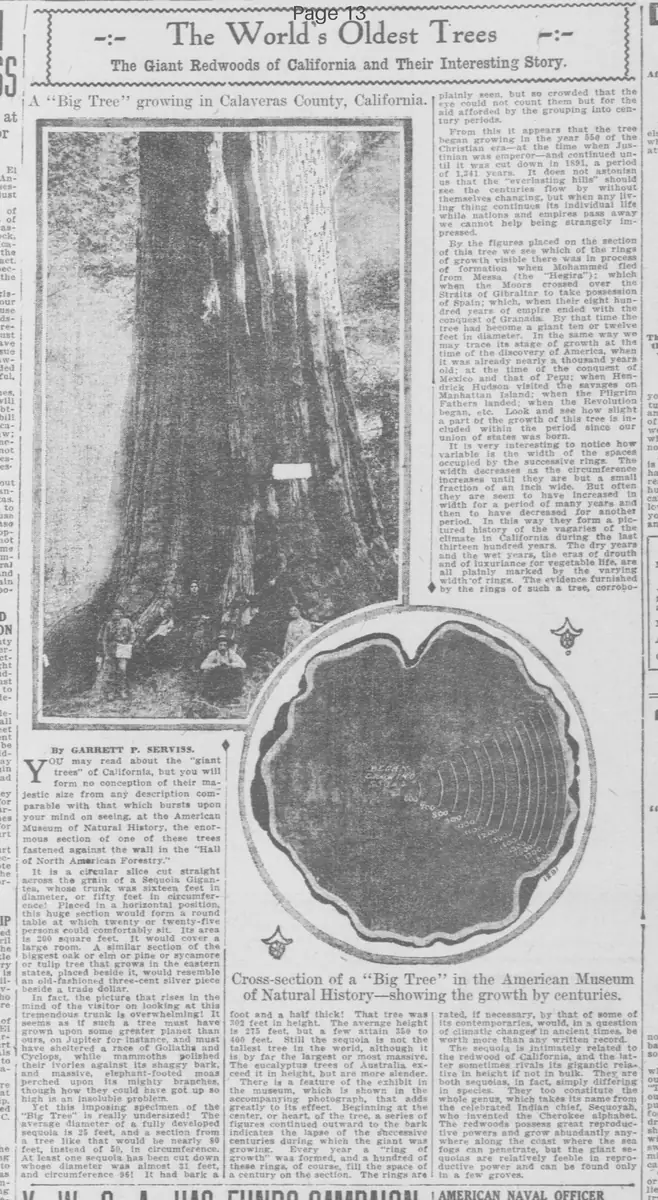
You may read about the "giant trees" of California, but you will form no conception of their majestic size from any description comparable with that which bursts upon your mind on seeing, at the American Museum of Natural History, the enormous section of one of these trees fastened against the wall in the "Hall of North American Forestry."
It is a circular slice cut straight across the grain of a Sequoia Gigantea, whose trunk was sixteen feet in diameter, or fifty feet in circumference. Placed in a horizontal position, this huge section would form a round table at which twenty or twenty-five persons could comfortably sit. Its area is 200 square feet. It would cover a large room. A similar section of the biggest oak or elm or pine or sycamore or tulip tree that grows in the eastern states, placed beside it, would resemble an old-fashioned three-cent silver piece beside a trade dollar.
In fact, the picture that rises in the mind of the visitor on looking at this tremendous trunk is overwhelming! It seems as if such a tree must have grown upon some greater planet than ours, on Jupiter for instance, and must have sheltered a race of Goliaths and Cyclops, while mammoths polished their ivories against its shaggy bark, and massive, elephant-footed moas perched upon its mighty branches, though how they could have got up so high is an insoluble problem.
Yet this imposing specimen of the "Big Tree" is really undersized! The average diameter of a fully developed sequoia is 25 feet, and a section from a tree like that would be nearly 80 feet, instead of 50, in circumference.
At least one sequoia has been cut down whose diameter was almost 31 feet, and circumference 96! It had bark a foot and a half thick! That tree was 302 feet in height. The average height is 275 feet, but a few attain 350 to 400 feet. Still the sequoia is not the tallest tree in the world, although it is by far the largest or most massive.
The eucalyptus trees of Australia exceed it in height, but are more slender.
There is a feature of the exhibit in the museum, which is shown in the accompanying photograph, that adds greatly to its effect. Beginning at the center, or heart, of the tree, a series of figures continued outward to the bark indicates the lapse of the successive centuries during which the giant was growing.
Every year a "ring of growth" was formed, and a hundred of these rings, of course, fill the space of a century on the section. The rings are plainly seen, but so crowded that the eye could not count them but for the aid afforded by the grouping into century periods.
From this it appears that the tree began growing in the year 550 of the Christian era—at the time when Justinian was emperor—and continued until it was cut down in 1891, a period of 1,341 years.
It does not astonish us that the "everlasting hills" should see the centuries flow by without changing, but when any living thing continues its individual life while nations and empires pass away we cannot help being strangely impressed.
By the figures placed on the section of this tree we see which of the rings of growth visible there was in process of formation when Mohammed fled from Mecca (the "Hegira"); when the Moors crossed over the Straits of Gibraltar to take possession of Spain; which, when their eight hundred years of empire ended with the conquest of Granada. By that time the tree had become a giant ten or twelve feet in diameter. In the same way we may trace its stage of growth at the time of the discovery of America, when it was already nearly a thousand years old; at the time of the conquest of Mexico and that of Pegu; when Hendrick Hudson visited the savages on Manhattan Island; when the Pilgrim Fathers landed; when the Revolution began, etc. Look and see how slight a part of the growth of this tree is included within the period since our union of states was born.
It is very interesting to notice how variable is the width of the spaces occupied by the successive rings. The width decreases as the circumference increases until they are but a small fraction of an inch wide. But often they are seen to have increased in width for a period of many years and then to have decreased for another period. In this way they form a pictured history of the vagaries of the climate in California during the last thirteen hundred years. The dry years and the wet years, the eras of drouth and of luxuriance for vegetable life, are all plainly marked by the varying width of rings. The evidence furnished by the rings of such a tree, corroborated, if necessary, by that of some of its contemporaries, would, in a question of climatic changes in ancient times be worth more than any written record.
The sequoia is intimately related to the redwood of California, and the latter sometimes rivals its gigantic relative in height if not in bulk. They are both sequoias, in fact, simply differing in species.
They too constitute the whole genus, which takes its name from the celebrated Indian chief, Sequoyah, who invented the Cherokee alphabet.
The redwoods possess great reproductive powers and grow abundantly anywhere along the coast where the sea fogs can penetrate, but the giant sequoias are relatively feeble in reproductive power and can be found only in a few groves.
By Garrett P. Serviss.
You may read about the "giant trees" of California, but you will form no conception of their majestic size from any description comparable with that which bursts upon your mind on seeing, at the American Museum of Natural History, the enormous section of one of these trees fastened against the wall in the "Hall of North American Forestry."
It is a circular slice cut straight across the grain of a Sequoia Gigantea, whose trunk was sixteen feet in diameter, or fifty feet in circumference. Placed in a horizontal position, this huge section would form a round table at which twenty or twenty-five persons could comfortably sit. Its area is 200 square feet. It would cover a large room. A similar section of the biggest oak or elm or pine or sycamore or tulip tree that grows in the eastern states, placed beside it, would resemble an old-fashioned three-cent silver piece beside a trade dollar.
In fact, the picture that rises in the mind of the visitor on looking at this tremendous trunk is overwhelming! It seems as if such a tree must have grown upon some greater planet than ours, on Jupiter for instance, and must have sheltered a race of Goliaths and Cyclops, while mammoths polished their ivories against its shaggy bark, and massive, elephant-footed moas perched upon its mighty branches, though how they could have got up so high is an insoluble problem.
Yet this imposing specimen of the "Big Tree" is really undersized! The average diameter of a fully developed sequoia is 25 feet, and a section from a tree like that would be nearly 80 feet, instead of 50, in circumference.
At least one sequoia has been cut down whose diameter was almost 31 feet, and circumference 96! It had bark a foot and a half thick! That tree was 302 feet in height. The average height is 275 feet, but a few attain 350 to 400 feet. Still the sequoia is not the tallest tree in the world, although it is by far the largest or most massive.
The eucalyptus trees of Australia exceed it in height, but are more slender.
There is a feature of the exhibit in the museum, which is shown in the accompanying photograph, that adds greatly to its effect. Beginning at the center, or heart, of the tree, a series of figures continued outward to the bark indicates the lapse of the successive centuries during which the giant was growing.
Every year a "ring of growth" was formed, and a hundred of these rings, of course, fill the space of a century on the section. The rings are plainly seen, but so crowded that the eye could not count them but for the aid afforded by the grouping into century periods.
From this it appears that the tree began growing in the year 550 of the Christian era—at the time when Justinian was emperor—and continued until it was cut down in 1891, a period of 1,341 years.
It does not astonish us that the "everlasting hills" should see the centuries flow by without changing, but when any living thing continues its individual life while nations and empires pass away we cannot help being strangely impressed.
By the figures placed on the section of this tree we see which of the rings of growth visible there was in process of formation when Mohammed fled from Mecca (the "Hegira"); when the Moors crossed over the Straits of Gibraltar to take possession of Spain; which, when their eight hundred years of empire ended with the conquest of Granada. By that time the tree had become a giant ten or twelve feet in diameter. In the same way we may trace its stage of growth at the time of the discovery of America, when it was already nearly a thousand years old; at the time of the conquest of Mexico and that of Pegu; when Hendrick Hudson visited the savages on Manhattan Island; when the Pilgrim Fathers landed; when the Revolution began, etc. Look and see how slight a part of the growth of this tree is included within the period since our union of states was born.
It is very interesting to notice how variable is the width of the spaces occupied by the successive rings. The width decreases as the circumference increases until they are but a small fraction of an inch wide. But often they are seen to have increased in width for a period of many years and then to have decreased for another period. In this way they form a pictured history of the vagaries of the climate in California during the last thirteen hundred years. The dry years and the wet years, the eras of drouth and of luxuriance for vegetable life, are all plainly marked by the varying width of rings. The evidence furnished by the rings of such a tree, corroborated, if necessary, by that of some of its contemporaries, would, in a question of climatic changes in ancient times be worth more than any written record.
The sequoia is intimately related to the redwood of California, and the latter sometimes rivals its gigantic relative in height if not in bulk. They are both sequoias, in fact, simply differing in species.
They too constitute the whole genus, which takes its name from the celebrated Indian chief, Sequoyah, who invented the Cherokee alphabet.
The redwoods possess great reproductive powers and grow abundantly anywhere along the coast where the sea fogs can penetrate, but the giant sequoias are relatively feeble in reproductive power and can be found only in a few groves.
What sub-type of article is it?
Essay
What themes does it cover?
Nature
What keywords are associated?
Sequoia Gigantea
Giant Trees
Tree Rings
California Forestry
Natural History
Redwood
Climate History
What entities or persons were involved?
By Garrett P. Serviss.
Literary Details
Title
The World's Oldest Trees
Author
By Garrett P. Serviss.
Form / Style
Prose Essay On Natural History
Key Lines
It Is A Circular Slice Cut Straight Across The Grain Of A Sequoia Gigantea, Whose Trunk Was Sixteen Feet In Diameter, Or Fifty Feet In Circumference.
From This It Appears That The Tree Began Growing In The Year 550 Of The Christian Era—At The Time When Justinian Was Emperor—And Continued Until It Was Cut Down In 1891, A Period Of 1,341 Years.
The Evidence Furnished By The Rings Of Such A Tree, Corroborated, If Necessary, By That Of Some Of Its Contemporaries, Would, In A Question Of Climatic Changes In Ancient Times Be Worth More Than Any Written Record.
The Sequoia Is Intimately Related To The Redwood Of California, And The Latter Sometimes Rivals Its Gigantic Relative In Height If Not In Bulk.